
Long before scientists and conservationists reveal new discoveries or advance our collective knowledge, they’re hard at work in the field and the lab—gathering data, observing changes, and testing new ideas to understand and protect the natural world. Field Notes offers a firsthand glimpse into the people, places, and projects paving the way for conservation science.
The sun is setting over Mount Auburn Cemetery in Cambridge, Massachusetts. The wrought-iron gates are about to swing shut. I keep thinking that my wife and I will have to leave soon, as we usually do at closing time, having bird-watched among the headstones and garden beds until the last possible minute.
But tonight we’re allowed, even called, to stay. We’re part of a small group led by Jenni Austiff, a herpetologist at Boston University, and we’re here not to look for birds but to listen for frogs.
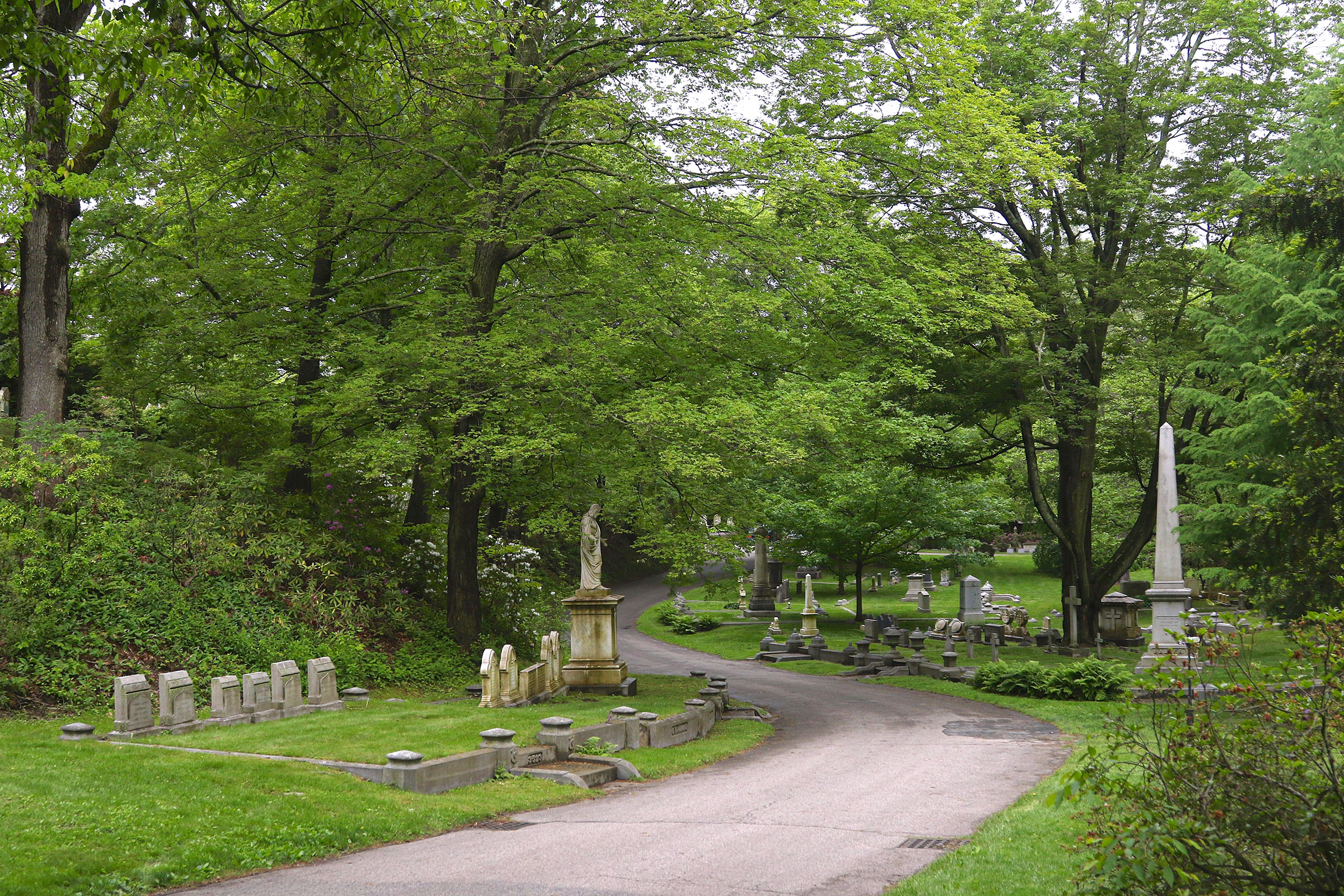
Austiff has chosen Mount Auburn Cemetery as a new local site for a national amphibian census known as FrogWatch USA. While a cemetery may seem like a strange place to survey frogs, this particular one has balanced life and death since its founding in 1831, when horticulturists bought the land to memorialize the dead and to experiment with plant collections.
Today, the cemetery is both a burial ground and a 70-hectare (17-acre) bastion of biodiversity in one of the most densely populated regions of North America. Guests come to visit their late loved ones or the graves of local luminaries, but they also come to be among the living: to walk through grass and under trees, to point at turtles and warblers, and to drench themselves in whichever New England season is currently on tap. Many also volunteer for the dozens of community science projects hosted here, returning year after year to band bats or count caterpillars or record the spring flowering dates of some of the cemetery’s 5,000 carefully labeled trees.
I’ve seen the cemetery in daylight hundreds of times, but this is my first time staying after dark. I look up just as a cormorant flies past the moon—the last bird of the day—and pull my coat tighter around me. The late-April chill will probably bother us more than the frogs, Austiff says. We head deeper into the cemetery.
At our first survey site, Willow Pond, we arrange ourselves near one of the titular willows, now a hairy shadow hulking over the water. Austiff leads us in two minutes of silence, to help any creatures acclimate to our presence. I close my eyes and try to tune up my ears before the first listening period begins.
Photograph by vagabond54/Shutterstock
Two Sundays ago, my fellow surveyors and I gathered at Mount Auburn Cemetery’s Story Chapel for frog ear training—learning to identify species by their unique sounds. We sat in dark wooden pews, and Austiff stood near the pulpit in front of a projector screen. Via PowerPoint, Austiff introduced us to the amphibians of Massachusetts, including the stately American bullfrog (Lithobates catesbeianus), the spotty northern leopard frog (Lithobates pipiens), and the eastern spadefoot (Scaphiopus holbrookii), who has the face of a toddler being denied ice cream.
As Austiff clicked through the slides, each played a recording, and the chapel’s arched ceiling filled with the amphibians’ strange and varied calls. Frogs have been calling for tens of millions of years; some researchers believe theirs were the first voices ever heard on Earth. Now, frogs are imperiled by all the new ways humans want to use the planet. They’re losing their homes to industrial agriculture, timber harvesting, and data centers; their lives to a fungus whose spread may be amplified by anthropogenic climate change; and the dark, quiet nights they need to call to each other to artificial light and noise pollution.
The FrogWatch USA program, overseen by Ohio’s Akron Zoo, enlists volunteers across the country to survey for frogs and toads. The data these volunteers gather from their own communities help researchers determine amphibian species’ ranges and population health, and inform conservation efforts. Our group of about a dozen new participants will census Mount Auburn Cemetery several times throughout the spring and summer, and we’ll track whether and when certain species appear.
A soft series of quacks sailed over the pews—the hymn of the wood frog (Lithobates sylvaticus), who freezes solid during New England’s frigid winters and thaws back to life in spring. I considered this Christlike behavior as light from the chapel’s stained-glass windows tinted the pages of my notebook and I worked out a mnemonic for the call: “weekakeweekak, like a quiet duck.”
Photograph by Anton Sorokin/Alamy Stock Photo
Now, at Willow Pond, we hear motorcycles revving on the road surrounding the cemetery and ambulances leaving the nearby hospital. We hear the water lapping at the shore, a rhythm I’ve never noticed in daylight. But we don’t hear any frogs.
The absence of data is still data, Austiff tells us. We move to our next survey site, Consecration Dell. The darkness erases detail; trees and monuments loom alike. Our flashlight beams catch on the white parts of the landscape: magnolia petals, fungi, goose droppings, and marble headstones.
The dell is the most natural part of the cemetery. My wife and I visit here often, and we know many spring components of its small but dense ecosystem, including a mallard couple and the fiddleheads that filigree the border of the small pond. Tonight, we meet new inhabitants. The sharp smell of algae sours the back of my nose. Austiff angles their flashlight into a crack in a monument and illuminates a red-backed salamander.
And then we hear a spring peeper (Pseudacris crucifer) inflating his bubblegum throat somewhere in the dark. “BEEEP! BEEEEP!” he calls confidently, and then “BIP-,” as though suddenly unsure. Another joins in, then a few more. They ping-pong their calls across the little pond until a distant car passes, bumping bass.
Our first recordable frogs! We take other measurements—wind speed 0, temperature 10 degrees Celsius—and guess at the peepers’ density. “Peeper level 2,” I write in my notebook. It’s strange to distill this encounter into figures. The data we’re recording necessarily narrow a much richer experience, the way the inscriptions on the headstones around us must stand in for entire lives. I feel grateful for the fullness of actually being here: for smelling the algae, feeling the darkness, hearing the “bips.”
The next two survey sites yield only null data. At our final stop, Halcyon Lake, we sit together on the edge of a monument. We tilt our heads up toward the constellations and listen, hearing only silence, until Austiff announces that our time is up.
The night has been quiet, but it’s still early in the season. In the coming weeks, Austiff promises, the cemetery’s ponds will overflow with sound. We’ll hear the harmonized “EEEEEE” of American toads (Anaxyrus americanus), recently reintroduced to Halcyon Lake after decades of absence. We might even catch gray tree frogs (Dryophytes versicolor) screeching at the central fountain, where visitors park their cars. Spring is here; the world has turned again. The dead sleep, but the frogs are waking up. And here, at least, we’ll be ready to receive them.
Photograph by Cara Giaimo
Hi, I’m Dave, the executive director of bioGraphic. (And that’s my dog, Finn.) Thanks for taking the time to read this story.
Stories like this simply don’t get produced without financial support from readers like you. bioGraphic is an independent non-profit—we’re not backed by a private company or owned by a billionaire. One-quarter of our budget comes directly from reader donations.
bioGraphic publishes environmental reporting that you can’t find anywhere else: deeply researched, trustworthy stories that are also beautiful and captivating to read. Right now, we need your help to raise $20,000 by October 2. Every dollar will go directly to more crucial reporting projects.
Around the world, governments are slashing funding for conservation and scientific research, placing even more ecosystems and wildlife at risk. At bioGraphic, we’re steadfastly shining a light on the threats to our planet’s incredible biodiversity. And we’re showcasing the hard work of people bravely taking action to protect at-risk species.
bioGraphic offers an antidote to apathy and doom-and-gloom news by revealing the wonders of the natural world and focusing on real solutions to big problems. When you finish a bioGraphic story, we want to leave you feeling informed, delighted, and inspired.
We don’t run ads or hide our stories behind a paywall. The readers who generously support bioGraphic allow our work to remain free for everyone.
Will you help us raise $20,000 by October 2?

