
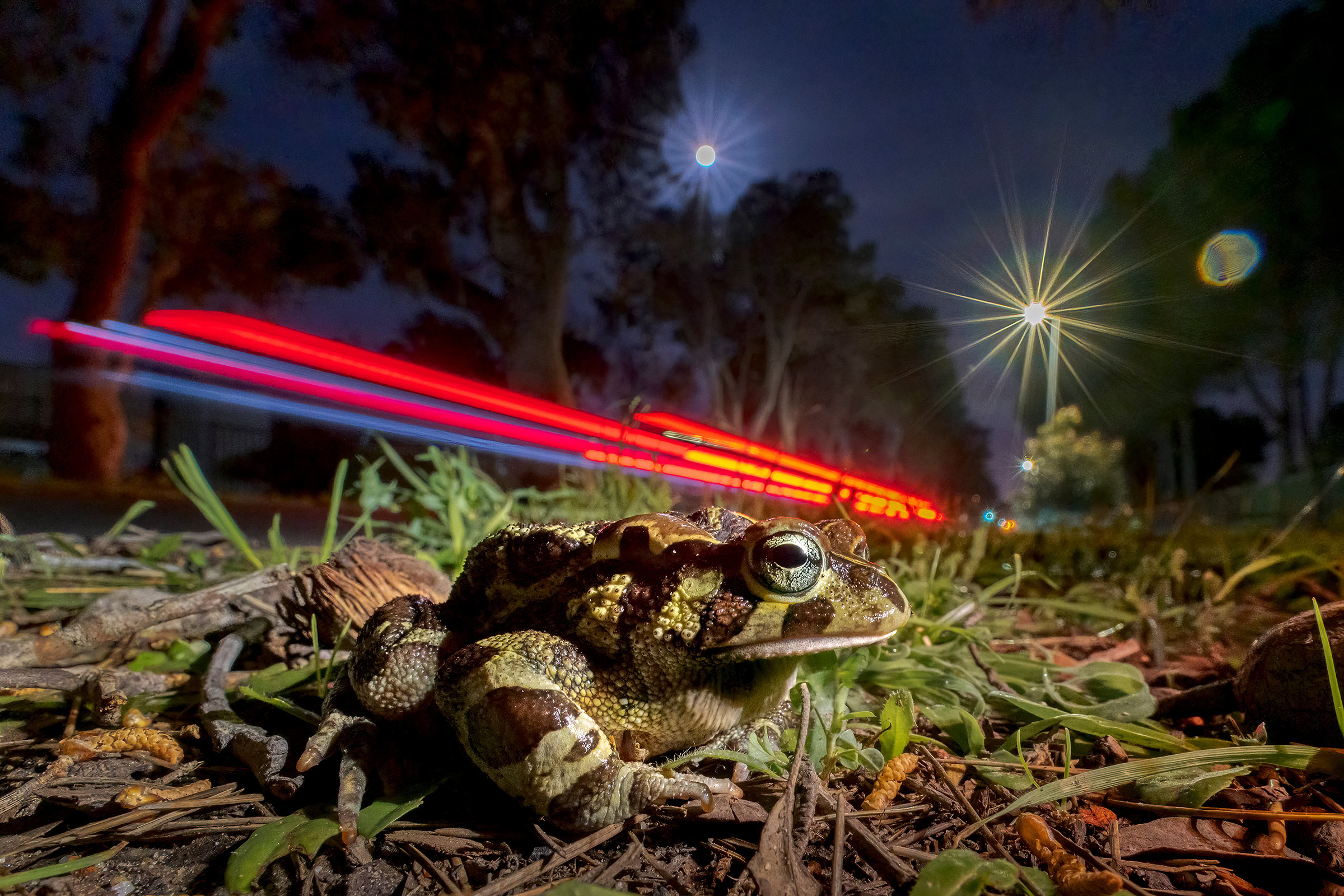
Photographs by Jeremy Shelton
When the rains of late austral winter slick the roads of South Africa’s Cape Peninsula, at the country’s far southwestern tip, a raucous, almost hypnotic amphibian symphony begins. The mating song of the male western leopard toad (Sclerophrys pantherina) echoes from the wetlands and ponds that freckle the urban sprawl radiating out from the city of Cape Town, on the northern end of the peninsula. The song draws the attention of female toads, who emerge from their hiding spots inside garden pots and underneath backyard sheds.
During breeding season, from late July to September, masses of toads migrate in search of a mate, and their journeys can be treacherous. The toads, which can grow up to 14 centimeters (5.5 inches) long, crawl and hop through brush, over cement, and in between racing headlights as they cross roads and highways in search of wetlands, ponds, and seasonal water bodies in which to breed. Many don’t survive.
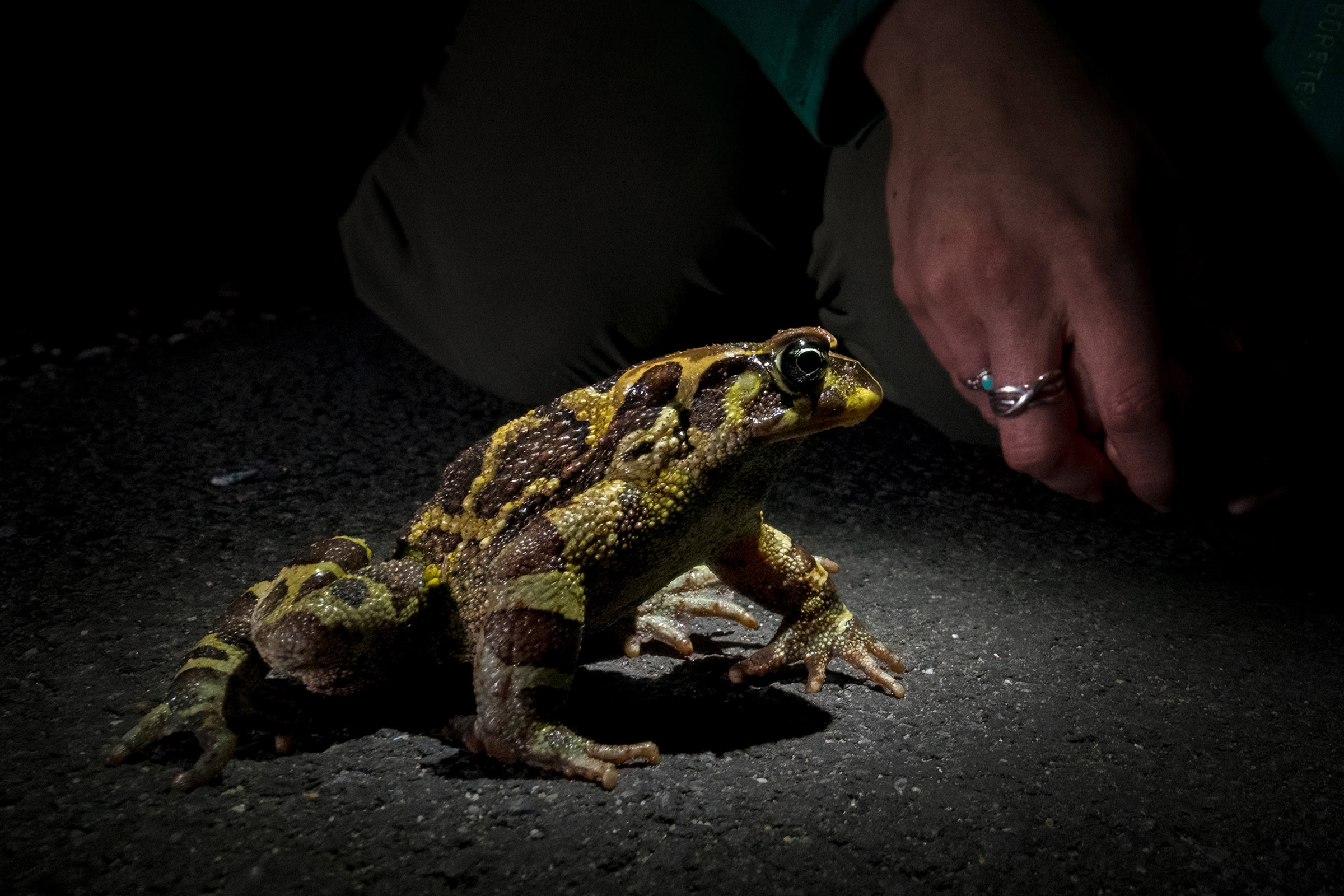
Western leopard toads, so named because of the chocolate-brown, leopard-like spots on their legs and backs, are one of at least 16 amphibian species that can be found nowhere in the world except this tiny corner of South Africa. As Cape Town has boomed, growing in population from around 170,000 people in 1901 to more than 4.7 million residents today, urbanization has jeopardized the future of the region’s amphibians, including the western leopard toad. Today, as much as 91 percent of the toad’s suitable habitat has been destroyed across large swaths of its range. While studies are ongoing and no hard population numbers are currently available, the International Union for Conservation of Nature, which first listed the toad as endangered in 2004, noted that the toad’s population is “severely fragmented” and “has undergone drastic declines from urban areas where it was once abundant.”
In hopes of halting those declines, a network of South African scientists, wildlife officials, conservation organizations, and everyday citizens is fighting to save the toad. The challenge is how to meaningfully conserve an animal that faces setbacks at almost every turn.
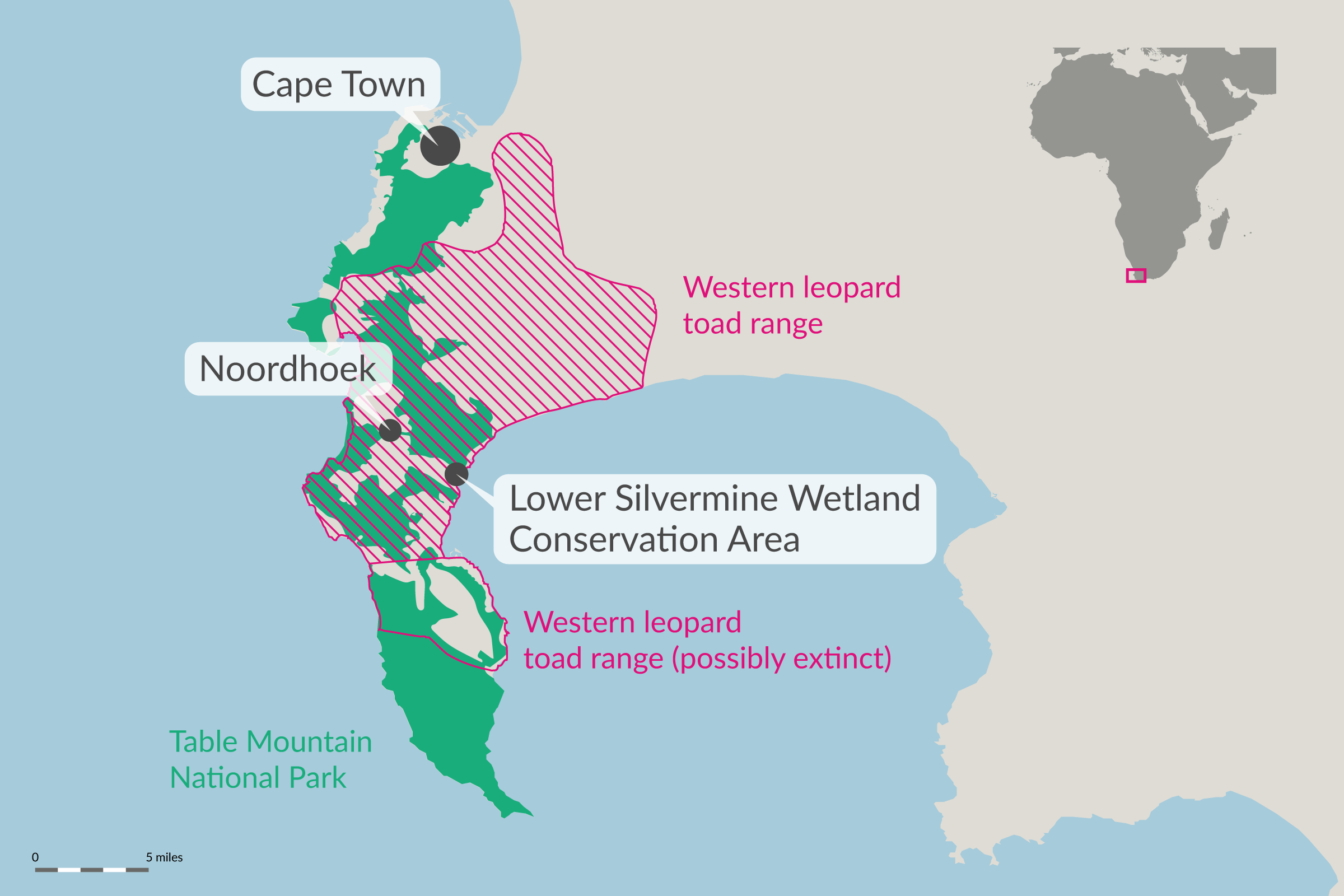
On stormy winter nights, Cape Town resident Suzie J’kul can be found cautiously patrolling Silvermine Road in the suburb of Noordhoek, on the western coast of the Cape Peninsula south of the city. She’s on the lookout for toads trying to cross the busy street.
J’kul never planned on being a toad rescuer. She stumbled into the gig. (By day she’s a Montessori teacher.) One night in 2007, as she drove home on Silvermine Road—which runs through Noordhoek and into a nature reserve where the toads breed—J’kul’s headlights caught the reflection of a toad-shaped lump on the asphalt. Then she saw another. And another. As any animal lover might, she pulled over and picked them up.
“I put them in my garden because I thought, you know, that’s obviously the safe place,” J’kul says. She was, she says, “totally unaware that this was the middle of a gigantic migration and they don’t want to be in my garden.” Silvermine Road, she later discovered, crosses a popular western leopard toad migration path, along which the toads travel en masse each winter from residential areas to the wetlands where they breed.
Western leopard toads are creatures of habit. They often follow the same routes to breeding ponds each year—even if those paths have since become golf courses, backyards, or streets—and after the breeding season, return to the same gardens, flower beds, woodpiles, and bushes where they spent the previous summer. Some Capetonians have learned to recognize the toads that dwell in their backyards by the unique leopard patterns on their backs.
“It’s very cute when you see the messages come on the group chat saying, ‘Oh, the same toad that normally comes to me every year is back again,’” says Kim Gordon, a stewardship program manager for Nature Connect, a conservation group that helps promote stewardship of nature and biodiversity throughout Africa. “Others are like, ‘Oh I haven’t seen my toad in ages!’ And then that’s when you worry that it got squished.”
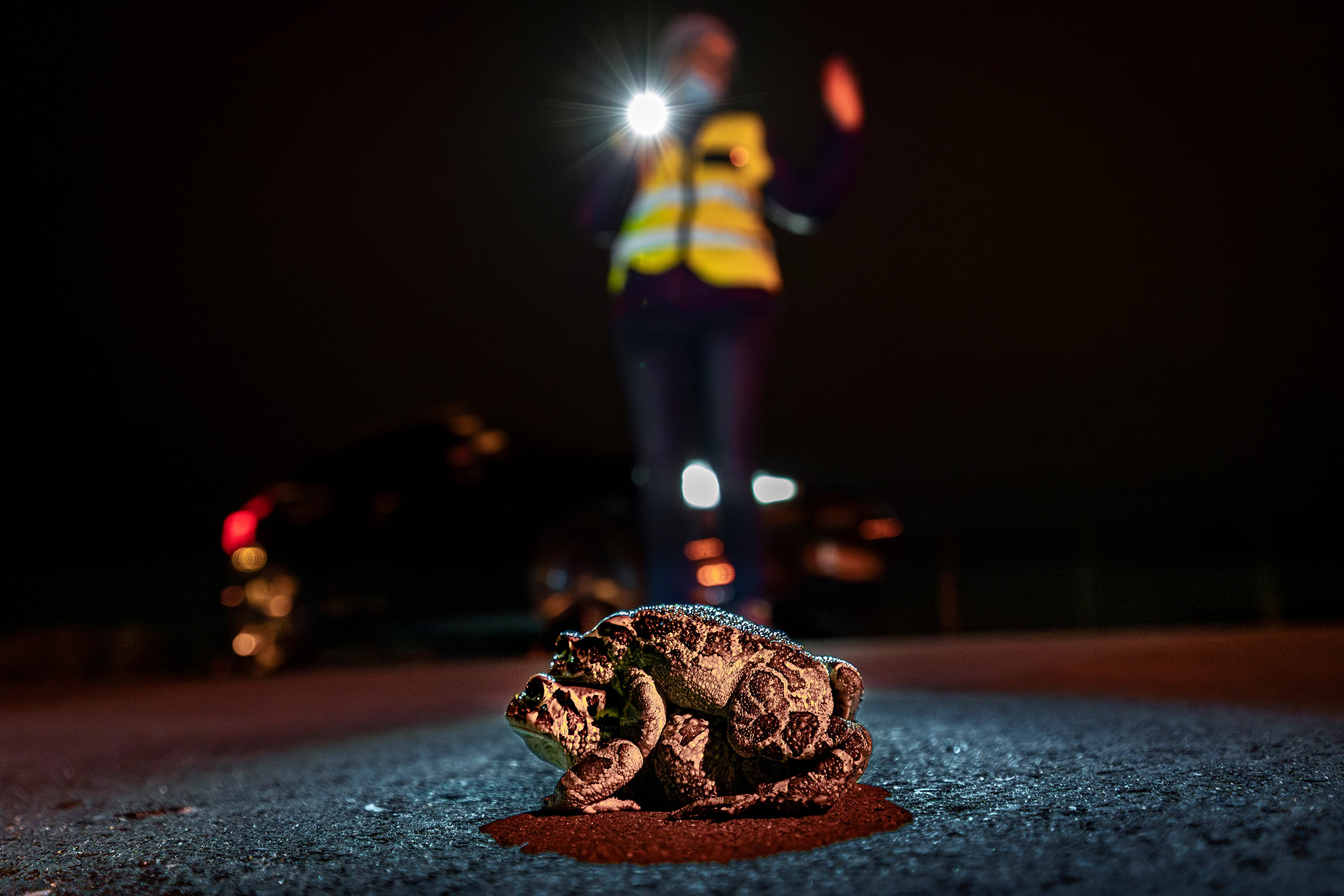
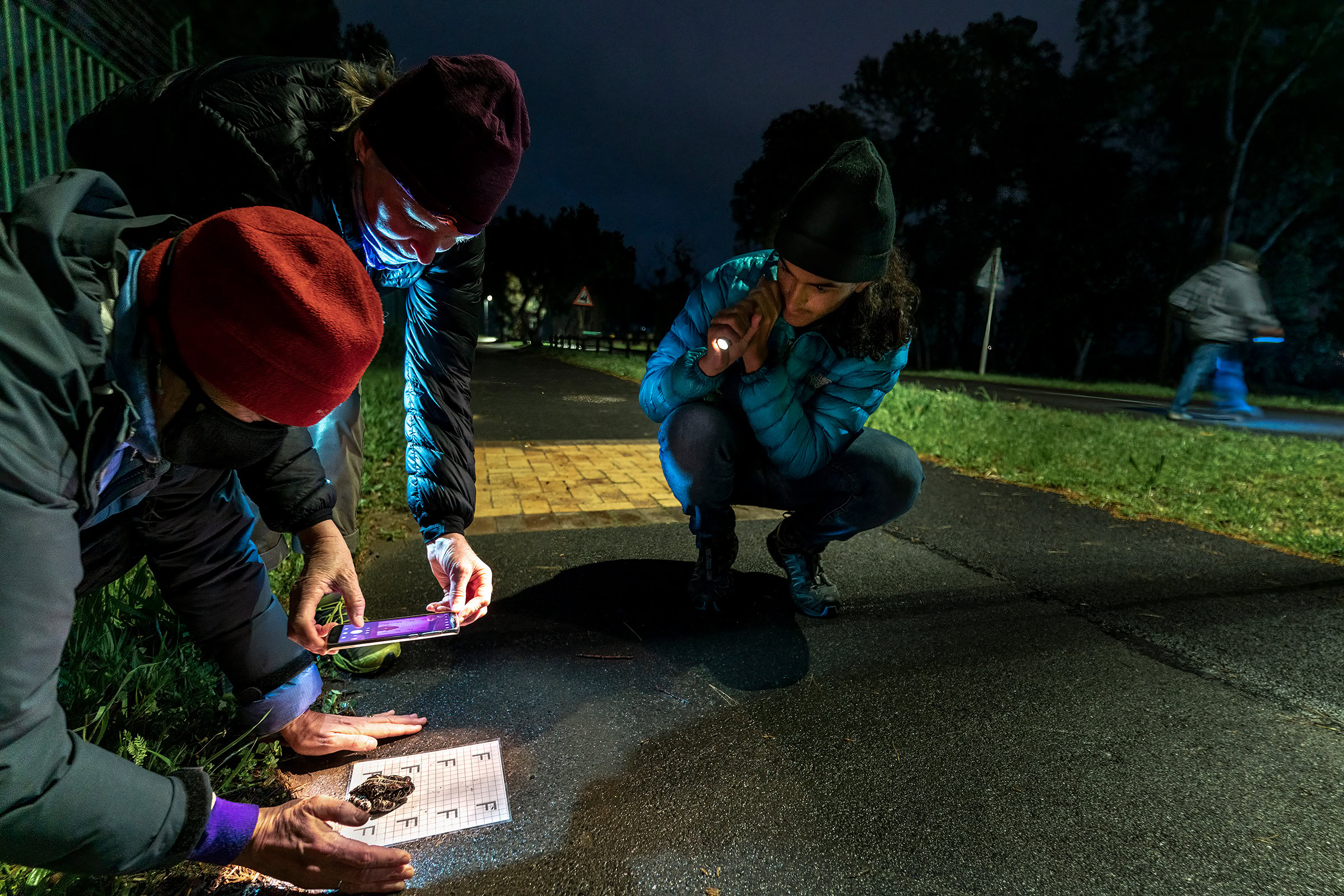
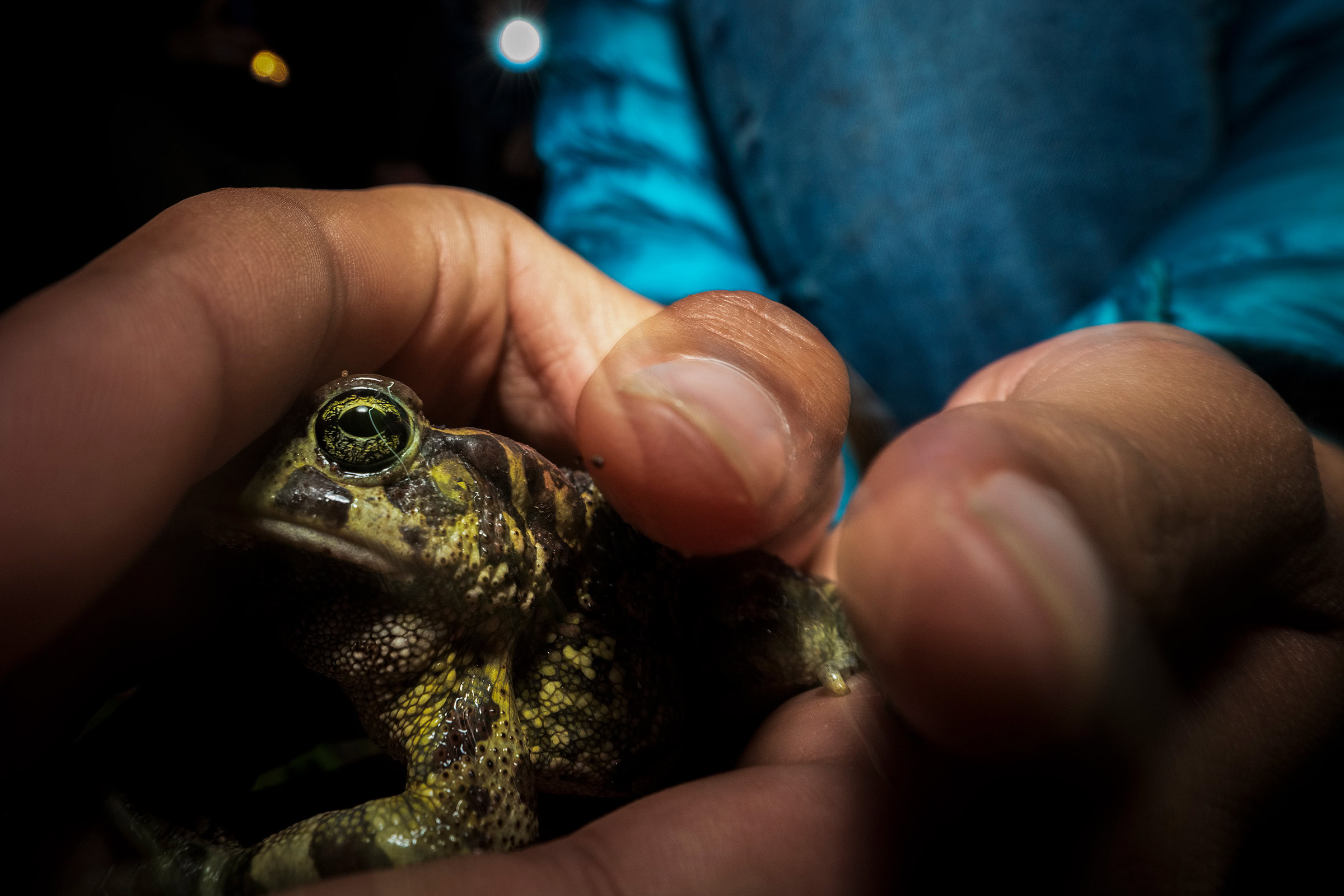
Today, J’kul helps run an amphibian rescue organization she cofounded called ToadNUTS. She says the operation—part of a collective of toad volunteer groups across the Cape Town area—has trained over 50 toad rescuers who have spent thousands of hours patrolling the city’s streets for toads in distress. But western leopard toads don’t make it easy to be a good Samaritan. The amphibians tend to migrate across the city on stormy winter nights. When J’kul spots a toad through the blur of her windshield wipers, she edges her car off the road, getting as close to the creature as she dares without spooking it. Then she jumps outside into the storm. Grabbing the toad itself isn’t difficult. The challenge, she says, is timing a toad grab safely in the pouring rain and darkness, against a backdrop of speeding traffic.
Toad secured, J’kul then races back to her car for quick data collection: When time allows, she measures the toad, snaps photos, and marks down the animal’s sex. Speed is crucial. “The more we spend with that particular toad, down the road we’re going to find more dead,” J’kul says. Then she runs outside, crosses the road, and leaves the amphibian pointed in the direction it seemed to be headed. On the busiest nights, she’ll handle 60 or 70 toads.
Roads like Silvermine sometimes feature signs warning drivers of the strange pedestrians that lie ahead: “Caution! Western Leopard Toads.” But as Cape Town’s dizzying network of roads has expanded, the streets continue to take a toll.
The Cape Town area used to be an excellent place to be a toad. The city nestles in and around Table Mountain National Park, a 221-square-kilometer (85-square-mile) preserve that stretches across most of the Cape Peninsula and comprises a small piece of the Cape Floral Region Protected Areas, a UNESCO World Heritage site. The region is home to a shrubland ecosystem not found anywhere else in the world, called fynbos—stout, scrubby vegetation, full of bushes and bulbous flowers. Nearly 6,000 endemic species can be found here: mostly plants, but also birds, reptiles, fish, arthropods, and amphibians such as the western leopard toad. The toad’s unique spotted pattern provides excellent camouflage against the dappled, shrubby landscape of the region.
“When you first look at fynbos, it doesn’t look particularly diverse or colorful. It’s not like a rainforest or a tropical biome,” says Cape Town photographer Jeremy Shelton, a freshwater conservation biologist, who shot the photographs for this story. “But once you start looking closely, you see—wow!—in a square meter of ground there are so many different kinds of plants. And almost all of them are found nowhere else.”
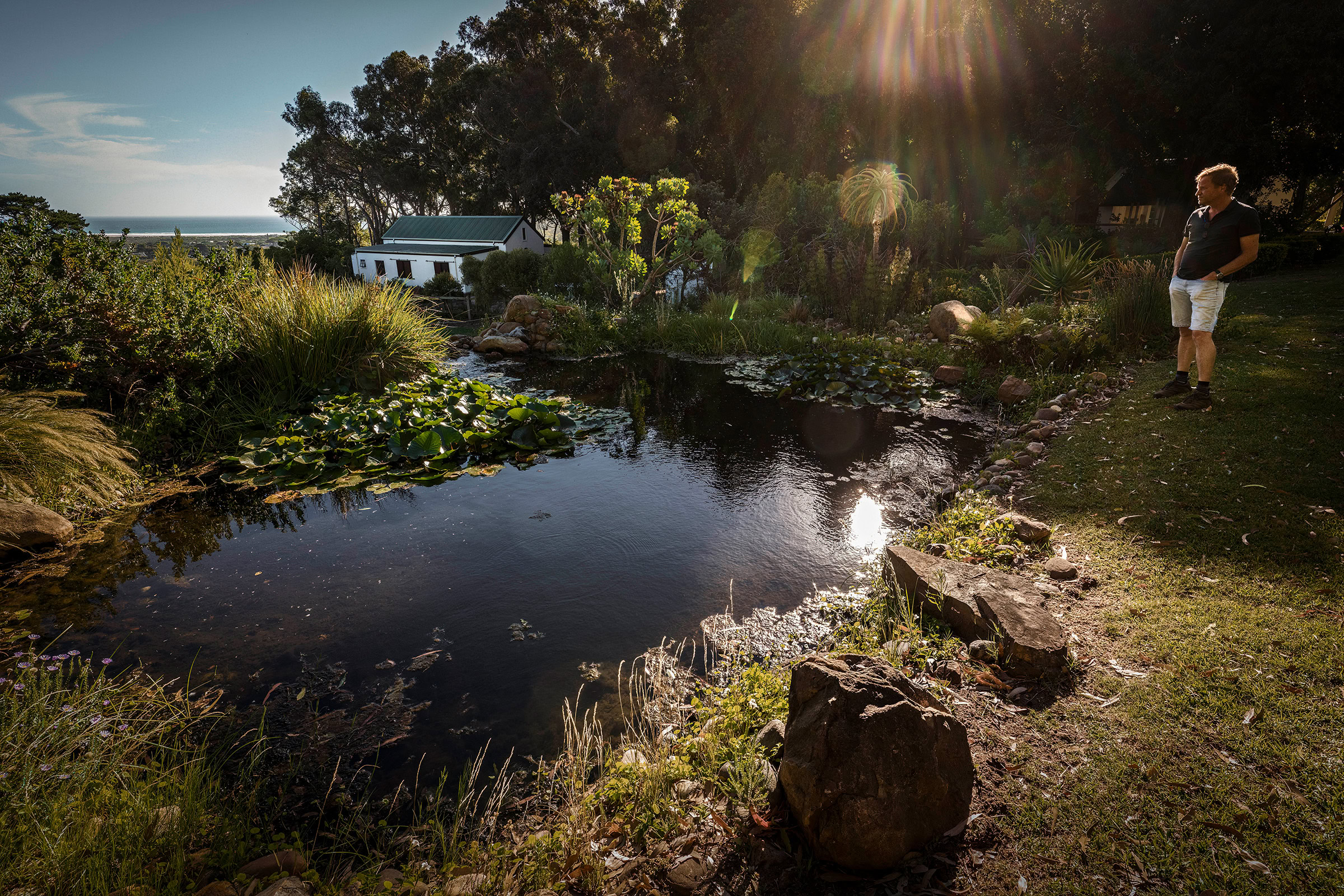
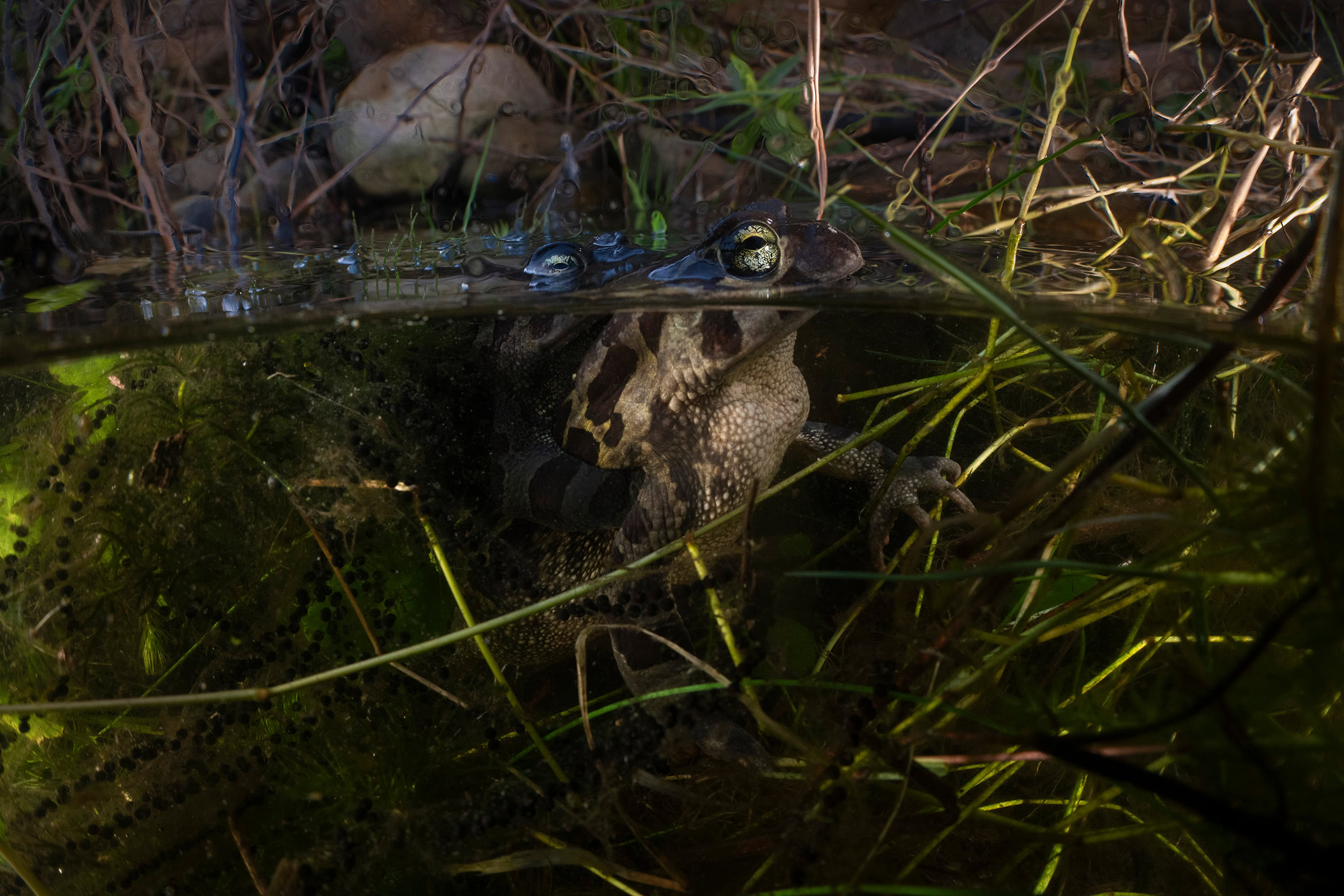
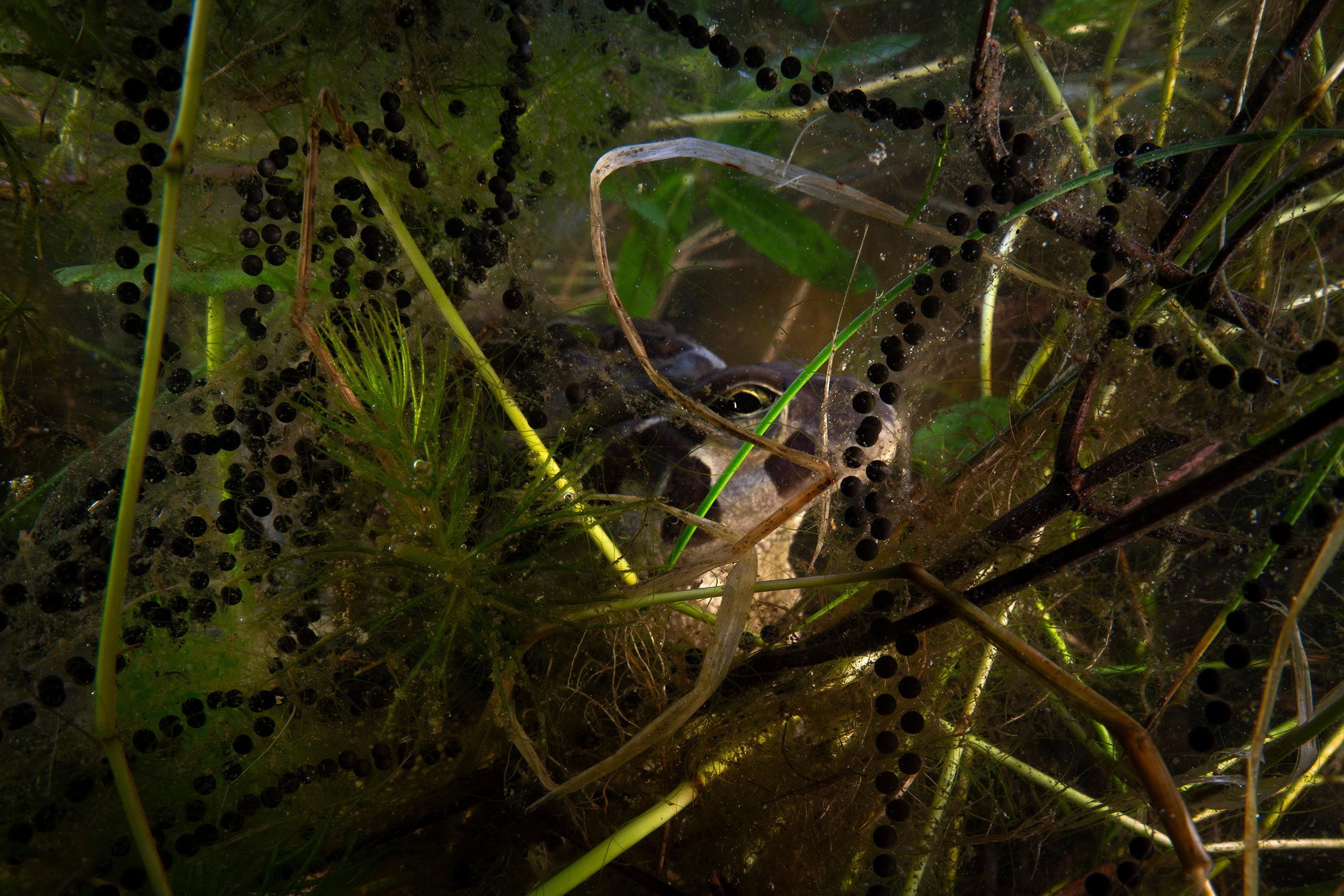
But over the past century, as Cape Town and the surrounding communities have grown, almost half of the region’s fynbos habitat has been swallowed by development. The creatures that depend on this biodiversity have also declined. In addition to the western leopard toad, the Rose’s mountain toadlet (Capensibufo rosei) and Table Mountain ghost frog (Heleophryne rosei), which also rely on healthy Cape Peninsula freshwater ecosystems to breed, have suffered. Both are now listed as critically endangered.
Beyond the risks associated with migrating to and from increasingly limited fynbos wetlands to breed, toads face a litany of additional threats. Pollutants, such as pesticides, fertilizers, and industrial waste, leech into wetlands, leading to reduced breeding success and higher mortality. Invasive amphibians and fish like guttural toads and carp compete with or prey on western leopard toads and tadpoles. Suburban swimming pools even pose a threat: the toads, usually so well adapted to water, can drown when they blunder into vertical-sided water bodies. “There are so many challenges and battles,” says evolutionary biologist Jessica da Silva, principal scientist at the South African National Biodiversity Institute in Cape Town.
“The roads were slick with dead toads because they just kept following the same path.”
—Jessica da Silva, South African National Biodiversity Institute
Critical genetic bottlenecks make the toad’s future all the more tenuous. In 2022, da Silva published a study examining genetic diversity across distinct populations of western leopard toads. When a species community is genetically diverse—with multiple gene variations present across a population of animals—they are better able to adapt to and fend off diseases, threats, or other environmental changes. But when da Silva assessed the genomes of 78 toads found in the Cape Town area, her findings were grim: western leopard toads had become increasingly inbred. Today, many toads are practically genetic clones. “Based on population numbers alone, they’re only listed as endangered, but if you looked at the genetic diversity of this species, they would be far more threatened,” she says. “It’s really a dire situation. We’re losing genetic diversity. We’re losing populations.”
Amid all the bad news for the imperiled amphibians, toad advocates have also seen some victories. With funding from international conservation authorities, a local organization called Friends of Tokai Park has begun work to restore fynbos habitats in Table Mountain National Park. The City of Cape Town also rehabilitated critical western leopard toad breeding habitat in the Lower Silvermine Wetland Conservation Area, near Noordhoek, with parallel efforts currently underway for other endangered amphibians in the region. Local conservation groups have also installed additional reflective road signs alerting motorists to the spotted creatures sharing their roads.
And in 2021, taking inspiration from wildlife crossings in North America and amphibian pathways under highways in Europe, Nature Connect installed two toad underpasses—small culverts beneath particularly perilous city roads that allow the toads to cross safely to the other side. In 2024, Nature Connect constructed four additional underpasses near Zeekoevlei, a lake in Cape Town. Preliminary data suggest that the tunnels are helping.
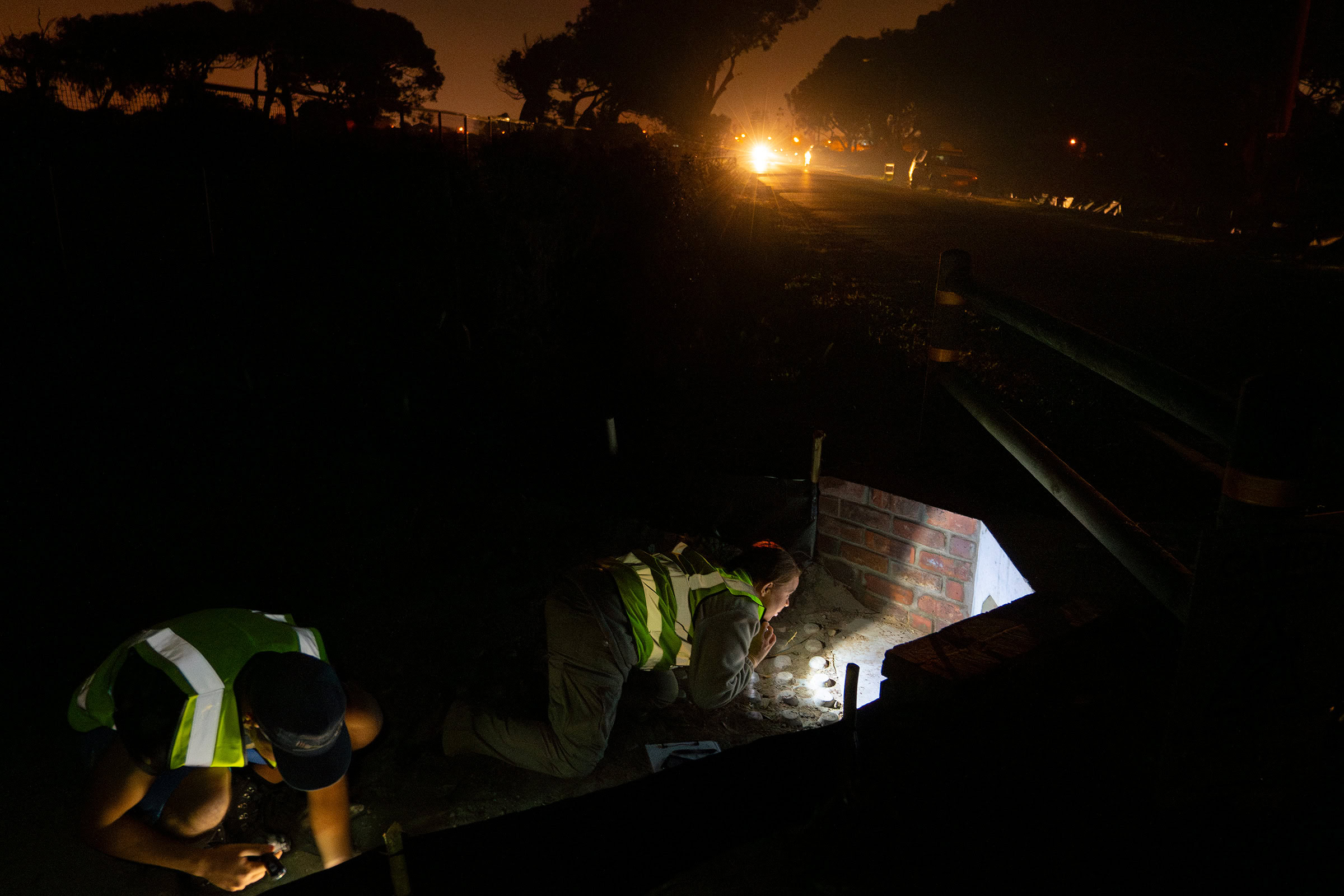
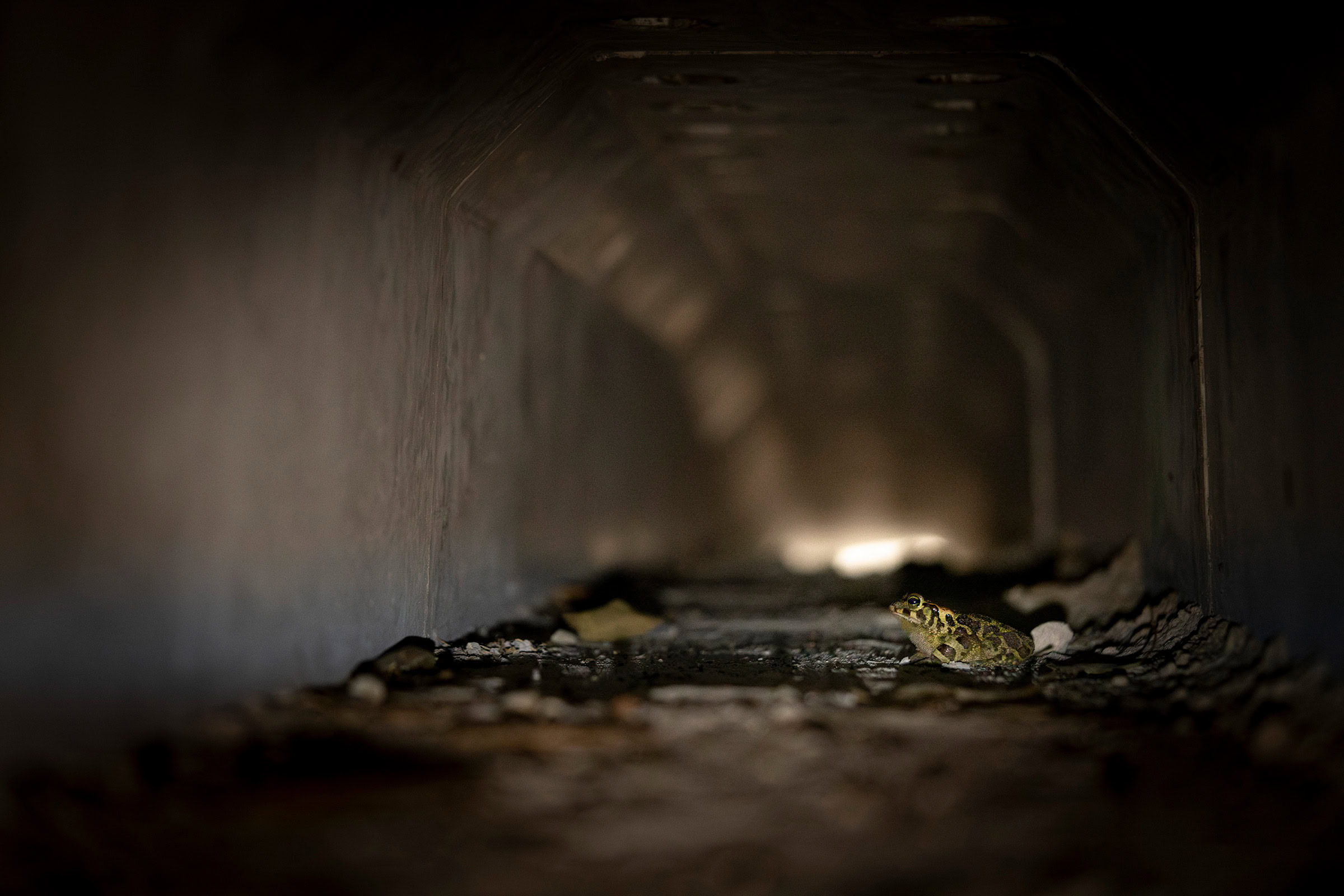
Still, the pace of development in the Cape region always seems to be one hop ahead of the toads and the people striving to help them. In 2017, the City of Cape Town revived an old proposal to build the Houmoed Avenue extension, a new stretch of road through a wetland to connect Masiphumelele, a growing and underserved township, to Noordhoek and Cape Town’s larger transportation corridors. Da Silva recalls reading that the last time a major road—the M3 expressway—was built through a migratory corridor in the toad-dense southern suburbs, in the 1970s, the effects were immediate and horrific. “The roads were slick with dead toads because they just kept following the same path,” she says.
ToadNUTS, working alongside the Noordhoek Environmental Action Group, filed a lawsuit to stop the Houmoed Avenue extension project. “We tried to fight it for seven years,” says J’kul. But in April 2024, the Western Cape High Court ruled in favor of the city, and the road is now set to begin construction.
While the city could have chosen another route, J’Kul, da Silva, and other toad volunteers and researchers fear that the western leopard toad may not have many options left. “It’s found nowhere else in the world, and if we get rid of it, it would just be absolutely devastating,” da Silva says of the toad. “That’s what worries me the most, and what makes me so determined. Once it’s gone, it’s gone.”
The city’s project plan acknowledges that adding underpasses and fences to the roadway could alleviate some of the risk to the toads. Now J’kul, da Silva, and other advocates have to wait and hope those measures materialize—and that they’ll help enough toads cross the road and back that the species can stay a leap ahead of extinction.
Hi, I’m Dave, the executive director of bioGraphic. (And that’s my dog, Finn.) Thanks for taking the time to read this story.
Stories like this simply don’t get produced without financial support from readers like you. bioGraphic is not backed by a private company or owned by a billionaire. It’s an independent, nonprofit magazine. And one-quarter of our annual budget comes directly from reader donations.
We need your support more than ever, as governments slash funding for conservation and scientific research, placing even more ecosystems and wildlife at risk around the world. At bioGraphic, we’re steadfastly shining a light on the threats to our planet’s incredible biodiversity. And we’re showcasing the hard work of people bravely taking action to protect at-risk species.
bioGraphic publishes environmental reporting that you can’t find anywhere else: deeply researched, trustworthy stories that are also beautiful and captivating to read. We offer an antidote to reader apathy and doom-and-gloom news by revealing the wonders of the natural world and focusing on real solutions to big problems. When you finish a bioGraphic story, we want to leave you feeling informed, delighted, and inspired.
We don’t run ads or hide our stories behind a paywall. The readers who generously support bioGraphic allow our work to remain free for everyone.
Will you help us keep telling these crucial stories?

Authors


Related Articles
The Wild Within the Walls
From antiquity to modern times, Rome has been entangled with the wild animals who creep, slither, scurry, and nest among its pillars and palaces.
From Weed to Wonder
Once dismissed as an underwater nuisance, scientists are beginning to see seagrass meadows as vital to marine and coastal health.
The Newt Normal
Droughts, wildfires, floods, and other extreme weather events are putting an unprecedented strain on California newts. With help, scientists think these remarkable animals will be able to persevere.