
Story by Ashley Braun
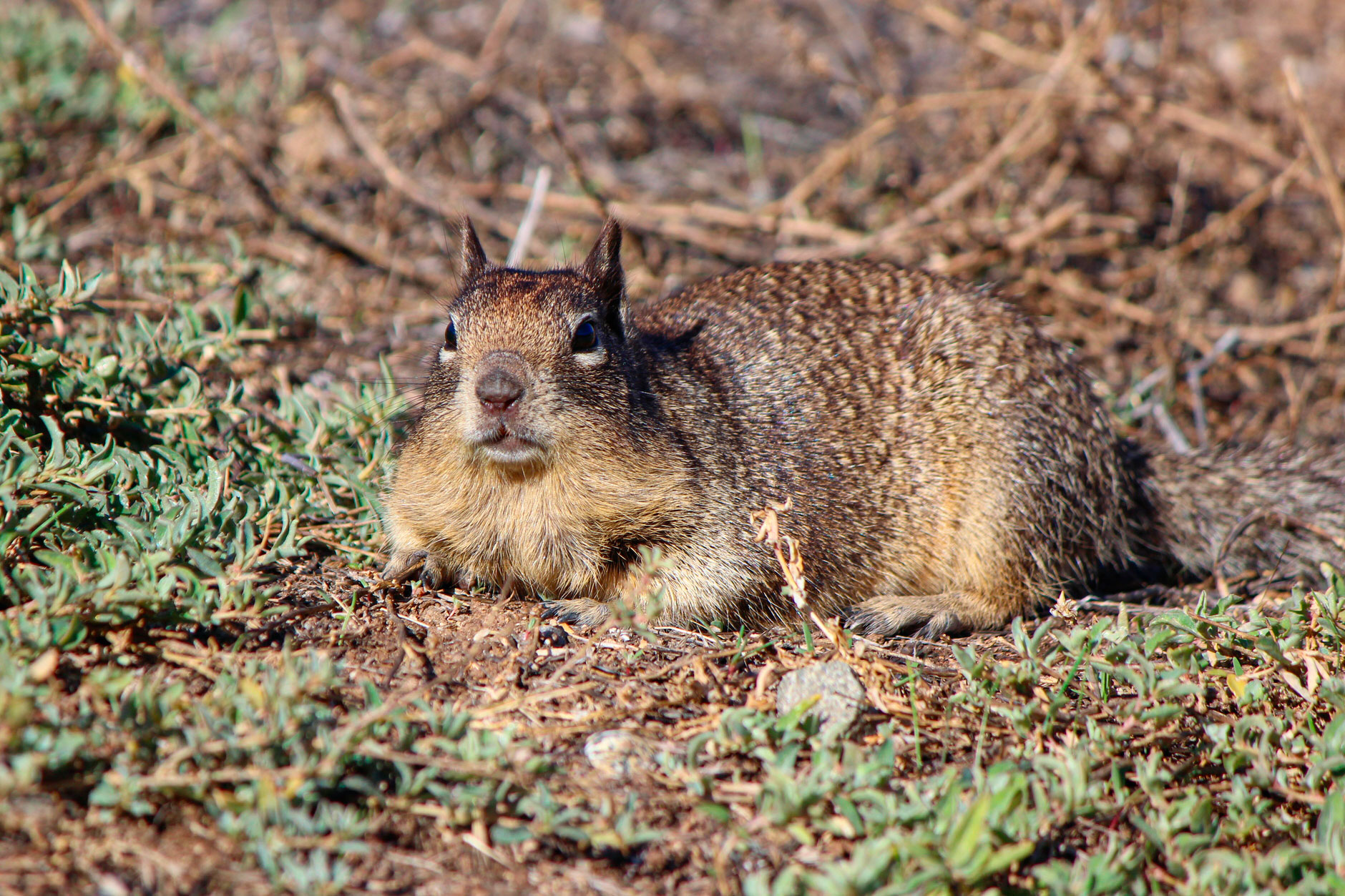
On California’s Santa Catalina Island, ground squirrels run riot across parks, roads, beaches, and high peaks. As far as squirrels go, that’s not unusual. Zoom out slightly, however, and it quickly becomes clear how out of place Santa Catalina’s ground squirrels really are.
Santa Catalina Island ground squirrels (Otospermophilus beecheyi nesioticus), with their adorable mottled coats of cinnamon, silver, and white, aren’t found on any of the other seven Channel Islands, which form an archipelago off California’s southern coast. So how did the ground squirrels manage to get to one island that lies more than 40 kilometers (25 miles) from shore—yet skip all the others?
According to Torben Rick, an archaeologist at the Smithsonian’s National Museum of Natural History, the ground squirrel’s ticket to island life could have taken two routes: Either a pregnant female or a breeding pair rafted across from the mainland on floating debris, landed on Santa Catalina, and became Squirrel Adam and Squirrel Eve. Or, the squirrels were brought over—perhaps intentionally—by the Indigenous Tongva (Gabrieliño/Gabrielino), the earliest known human inhabitants of the four southern Channel Islands and the Los Angeles Basin.
To the Tongva, Santa Catalina Island is known as Pimu, says Desireé Martinez, an archaeologist, Tongva community member, and codirector of the Pimu Catalina Island Archaeological Project (PCIAP). Pimu is a sacred island, she says, with archaeological evidence putting Tongva people there at least 8,000 years ago. “It was the place where the most powerful people lived,” she adds. That occupation persisted until around the 1830s, when Spanish missionaries in the newly independent Mexico forcibly removed the last of Martinez’s ancestors.
Rick, as curator of the Smithsonian’s department of North American archaeology, has spent the past 15 years studying how the Channel Islands’ ecosystem evolved independently of the mainland. While working on a larger project exploring the islands’ iconic wildlife, Rick approached Martinez and the PCIAP about getting to the bottom of the ground squirrels’ provenance. Since 2007, the PCIAP has been trying to understand Santa Catalina Island’s Indigenous history through archaeology. To ensure contemporary Tongva people have a voice in directing and producing research affecting their community, PCIAP brought into the project a Tongva tribal council with connections to the island. Acknowledging living Tongva perspectives was crucial, Martinez says, because “we were always thought of as extinct—that we didn’t exist anymore.”
To unravel the mystery of the squirrels’ arrival, the scientists plumbed for clues in the Catalina Island Conservancy’s preexisting collections of ancient squirrel bones, using radiocarbon dating to zero in on the timeframe of their island debut. They also performed genetic analyses on modern squirrels to determine when the island population broke off from its mainland relatives.
The results, Rick says, were surprising. While squirrel bones are common in Tongva archaeological sites, the bones themselves are, relatively speaking, very young. “They’re all less than 2,000 years old,” says Rick. The island’s modern squirrels and their mainland counterparts are also genetically quite similar. “This is clearly all starting to point to a human introduction,” he says.
And, in closely examining the squirrel bones, Rick, Martinez, and their colleagues found the distinctive marks of burning and butchering. That, along with the discovery of residual rodent protein in an ancient stone bowl, suggests squirrels were on the menu for Tongva people many generations ago. Martinez says she’s not aware of the Tongva community retaining any oral histories about the squirrels, but the Tongva were adept sailors, and she could imagine her ancestors intentionally bringing the squirrels over in their ti’at, or redwood plank canoes.
Taken together, the radiocarbon dating, the burn and cut marks, and the genetic analyses all suggest Santa Catalina Island’s squirrels were introduced at least 1,500 years ago. “Having these multiple lines of evidence that all converge on the same conclusion is really important,” says Christina Giovas, an environmental archaeologist at Simon Fraser University in British Columbia who was not involved in the study. The fact that fossilized ground squirrels are almost exclusively found near sites associated with humans further supports the idea of human introduction, she adds.
Today, ground squirrels are still dinner—though not for people. Instead, Pimu’s squirrels support a threatened population of Santa Catalina Island foxes, as well as snakes and raptors. It’s just one of the many ecological legacies left by Indigenous stewardship of the Channel Islands, Martinez says.
The discovery builds on a broader trend within archaeology showing how Indigenous communities have long shaped and tended their environments. Along the West Coast of North America, for instance, Indigenous peoples have spent millennia maintaining sea gardens that boost the productivity and biodiversity of clams and other marine life. And, from Australia to North America, Indigenous peoples have used techniques such as pruning and controlled, low-intensity fires to bolster the abundance of food, medicine, and useful fibers, and lower the risk of catastrophic wildfires. In the Caribbean, similar research suggests the Lucayan people moved hutias—capybara-like rodents—across the Bahamas roughly 1,300 years ago.
Today, when Martinez returns to Pimu, she reflects on her ancestors’ intimacy with the land—while sidestepping the abundant squirrels’ burrows. She says traditional Tongva values about human responsibility to recognize, respect, and protect the land’s other inhabitants offer crucial messages for today’s changing world. “We’re trying to strike a balance of how humans can coexist with everything that’s around us,” she says.
To Rick, the study not only answers a scientific question about the Channel Islands’ distinctive wildlife, but also provides an opportunity “to reinvigorate those relationships between Tongva and their island homelands,” he says. “And to me, that’s one of the most important things we can do with archaeology.”
Author

Related Articles
Shrimp Shell Slurry to the Rescue?
A new, multistep chemical process can turn bits of organic waste into “carbon-negative” fuel, food, and construction material.
The Lonely Race to Save Ukraine’s Past
In a country ravaged by war, Ukraine’s conservators are torn between protecting the country’s past and fighting for its future.
No One Knows How to Handle Nurdle Spills
A year after a shipwreck flooded India’s beaches with tiny plastic pieces, scientists fear the environmental damage has just begun.