
A Jealous, Leggy Lover
For female millipedes, mating comes with a lot of baggage.
Photograph by Lucas Bustamante
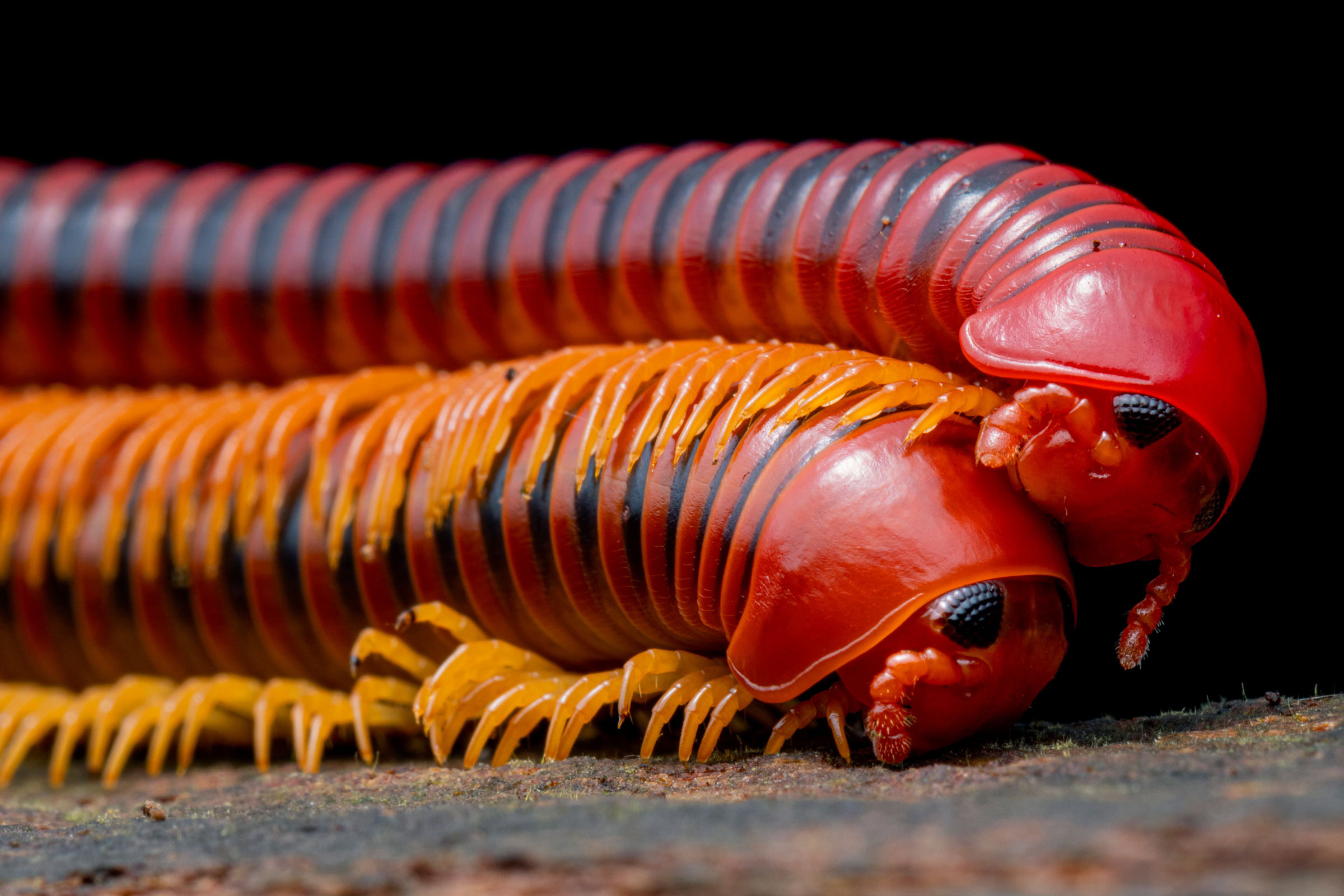
As twilight fades into inky black in Malaysia’s Gunung Mulu National Park, on Borneo, the rainforest floor starts to writhe. Thousands of nocturnal creatures scurry and slither and crawl and creep across the leaf litter, looking for shelter, sustenance, and sex. Millipedes, such as those in the family Julidae, seen here, are part of Mulu’s nightly menagerie. They strike out from underground burrows and woody crevices in search of delicious plant detritus and companionship.
For those who find a mate, the night will soon take a turn, as millipedes can be jealous lovers.
Millipedes are one of the most diverse groups of animals on Earth and scientists have studied relatively few species. From research on other families, we know that mating is often a leggy affair that involves the millipedes intertwining, belly to belly, as the female everts her reproductive organs outside her body to accept a male’s sperm packet. Afterward, the male will often climb atop the female’s back. However, this is no tender postcoital embrace; it’s a protective behavior called mate guarding. Just his presence will be enough to fend off most other millipedes interested in mating with the female. But should another male attempt to woo her anyway, the passenger will arch his body, pushing the female down and preventing access to her reproductive parts, found on the underside near her head.
Mate guarding can last for days, with males using their many legs to hold fast while the female goes about her business—eating, walking, resting. In an early study of the behavior that looked at the family Platyrhacidae, researchers tallied all of the millipedes they came across while walking the trails of a Costa Rican rainforest. They found that, out of 134 females, most had mate-guarding males in tow. And it appeared that a number of the solitary females had been left with a parting gift from recent beaus—fecal remains on their backs.
Scientists believe mate guarding is a response to the female millipede’s ability to delay fertilization. After mating, female millipedes store the male’s sperm in chambers called spermathecae, keeping them separated from her eggs. This allows her to hold off on fertilizing her eggs until she finds a safe place to reproduce. Or in case she comes across someone she better fancies.
In other arthropods—the phylum to which insects, spiders, millipedes, and crustaceans belong—females with spermathecae mate with multiple males, and sperm from the last mate takes precedence when it comes time for fertilization.
Mate guarding, then, is not totally unjustified. But as is often the case, too much jealousy can be self-defeating. In the same Costa Rican study mentioned above, the researchers posit that females must exert significantly more energy when schlepping around their ex-lovers, possibly making them less likely to survive and give birth to the very offspring the male is trying to protect.
In all likelihood, the particular female shown here eventually shook off her clingy suitor, nestled into the soil, and laid dozens of eggs. Several weeks later, the young millipedes would have emerged, each sporting just a few pairs of spindly legs. Over the next few years, those that survived adolescence would have molt, growing four-legged segment by four-legged segment until they were mature enough to seek out their own mate to laboriously bear or jealously burden.

Hi, I’m Dave, the executive director of bioGraphic. (And that’s my dog, Finn.) Thanks for taking the time to read this story.
Stories like this simply don’t get produced without financial support from readers like you. bioGraphic is an independent non-profit—we’re not backed by a private company or owned by a billionaire. One-quarter of our budget comes directly from reader donations.
bioGraphic publishes environmental reporting that you can’t find anywhere else: deeply researched, trustworthy stories that are also beautiful and captivating to read. Right now, we need your help to raise $30,000 by October 2. Every dollar will go directly to more crucial reporting projects.
Around the world, governments are slashing funding for conservation and scientific research, placing even more ecosystems and wildlife at risk. At bioGraphic, we’re steadfastly shining a light on the threats to our planet’s incredible biodiversity. And we’re showcasing the hard work of people bravely taking action to protect at-risk species.
bioGraphic offers an antidote to apathy and doom-and-gloom news by revealing the wonders of the natural world and focusing on real solutions to big problems. When you finish a bioGraphic story, we want to leave you feeling informed, delighted, and inspired.
We don’t run ads or hide our stories behind a paywall. The readers who generously support bioGraphic allow our work to remain free for everyone.
We reached our goal, but there’s time left. Will you help us smash our original goal and reach a new goal of $30,000 by October 2?

Related Articles
The Art of the Catch
To bulk up for winter hibernation, Alaska’s brown bears employ a range of techniques for snaring salmon.
The Wonder of a Pale Whale
A curious calf with an atypical birthday suit is a good sign for southern right whales.
Saying “Ah!” at the Shrimp Spa
On coral reefs, an army of tiny cleaners eat their clients’ parasites, food particles, and dead skin, boosting biodiversity in the process.
