
The Art of the Catch
To bulk up for winter hibernation, Alaska’s brown bears employ a range of techniques for snaring salmon.
Photograph by Pål Hermansen
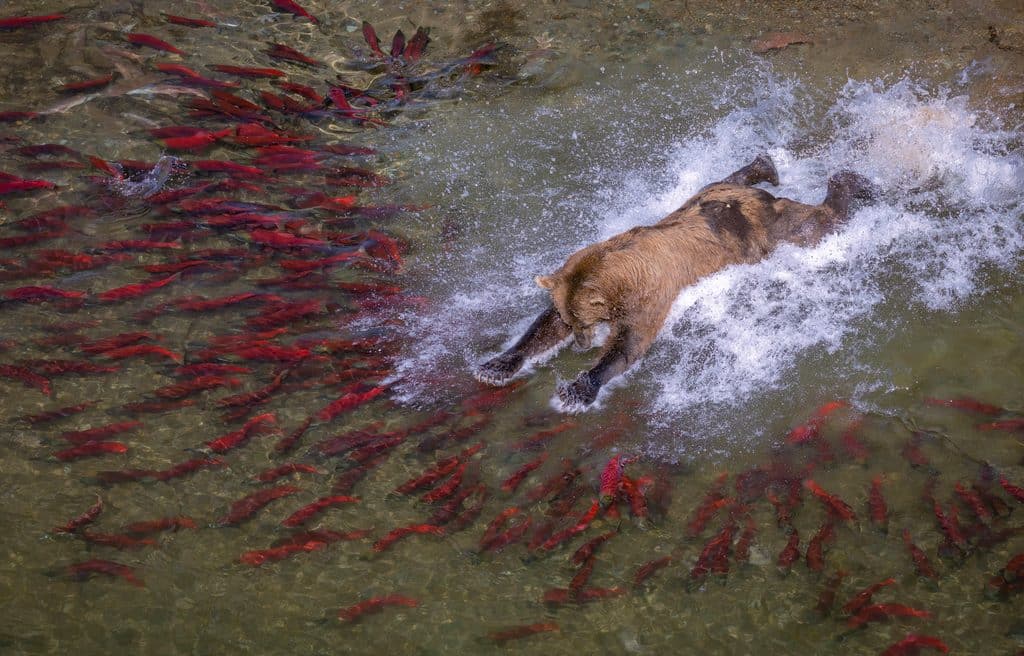
Brown bears (Ursus arctos) are formidable adversaries for salmon. Armed with curved claws and sizable canines, a brown bear can quickly tear the brain or eggs from a wriggling fish, and can charge as quickly as a crash-test vehicle zooms down a track, roughly 56 kilometers per hour (35 miles per hour). But bears aren’t born knowing how to use their tools for fishing; it’s something they learn as cubs by watching their mothers and later hone on their own through trial and error.
In places where salmon congregate en route to spawning grounds, like the famed Brooks Falls in Katmai National Park and Preserve on the Alaska Peninsula, dominant bears simply plant themselves in a pool below the waterfall and snatch fish journeying upstream. When lots of salmon are jumping at once, bears also stand at the lip of the falls and attempt to grab fish from the air—a feat one former park ranger equates to trying to catch a sack of flour coated in slippery oil. Yet before they master such skills, cubs must start out by scavenging and stealing salmon scraps—first from their mothers and then, after striking out on their own at about 2.5 years old, from other bears. When young bears eventually start fishing on their own, it’s in less desirable locations farther from the falls, or in smaller streams with less competition. The novices tend to employ high-energy approaches at first, like barreling into a school of fish and indiscriminately reaching, swiping, and chomping.
Salmon are highly attuned to any disturbance and will spook and swim off almost instantaneously when a bear strikes. Even the most capable bears can plunge into a dense school of fish and come up empty. When photographer Pål Hermansen observed this adult male pouncing on a group of bright-red sockeye salmon (Oncorhynchus nerka) in the Alagnak River, north of Brooks Falls, “the fish school had already sensed the danger,” he says, and darted away before claws met water.
Over time, bears often learn to slow down and target a specific fish. “Snorkelling” with their face underwater is one common technique for searching. Sometimes the largest males even choose to plant themselves in a pool and wait until salmon bump into them. As young bears grow into veteran hunters, they settle on their preferred techniques, with many favoring the approaches they picked up from watching their mothers as cubs. And at the end of the spawning season, when salmon die en masse, bears of all ages scavenge the carcasses for an easy meal.
Gorging on salmon helps bears pack on winter weight—a single sockeye fresh from the ocean represents roughly 4,500 calories of digestible energy. Two per day would be enough to maintain most bears, but when the fishing is good, a big bruin might consume 40—the caloric equivalent of 57 bricks of butter. The National Park Service and its partner organizations in Katmai host an annual competition that lets online spectators vote for the fattest-looking brown bear around Brooks Falls. The 2026 winner, Backpack, weighed an estimated 544 kilograms (1,200 pounds), more than two double-doored industrial refrigerators.
But despite what fitness influencers might preach, there’s more to bulking up than eating protein alone. Brown bears who nosh on both fruit and salmon may gain weight more rapidly than those who eat just salmon, and scientists in Alaska found that brown bears typically spend hours a day supplementing their fish meals with berries, even when salmon are abundant. A well-balanced diet, it seems, makes for the bulkiest of bruins.

Hi, I’m Dave, the executive director of bioGraphic. (And that’s my dog, Finn.) Thanks for taking the time to read this story.
Stories like this simply don’t get produced without financial support from readers like you. bioGraphic is not backed by a private company or owned by a billionaire. It’s an independent, nonprofit magazine. And one-quarter of our annual budget comes directly from reader donations.
We need your support more than ever, as governments slash funding for conservation and scientific research, placing even more ecosystems and wildlife at risk around the world. At bioGraphic, we’re steadfastly shining a light on the threats to our planet’s incredible biodiversity. And we’re showcasing the hard work of people bravely taking action to protect at-risk species.
bioGraphic publishes environmental reporting that you can’t find anywhere else: deeply researched, trustworthy stories that are also beautiful and captivating to read. We offer an antidote to reader apathy and doom-and-gloom news by revealing the wonders of the natural world and focusing on real solutions to big problems. When you finish a bioGraphic story, we want to leave you feeling informed, delighted, and inspired.
We don’t run ads or hide our stories behind a paywall. The readers who generously support bioGraphic allow our work to remain free for everyone.
Will you help us keep telling these crucial stories?

Authors


Related Articles
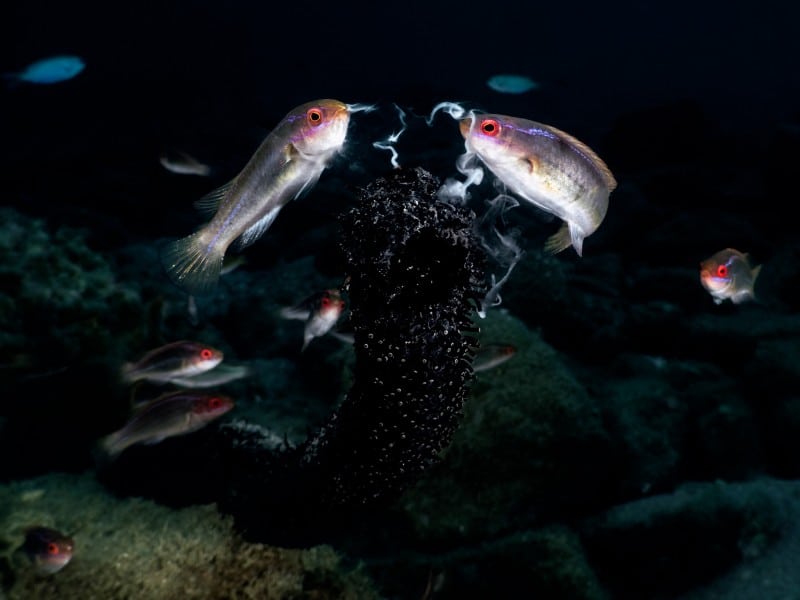
Milt Meal
Marine creatures will do almost anything for a meal—including feasting on the sperm and eggs of spawning invertebrates.
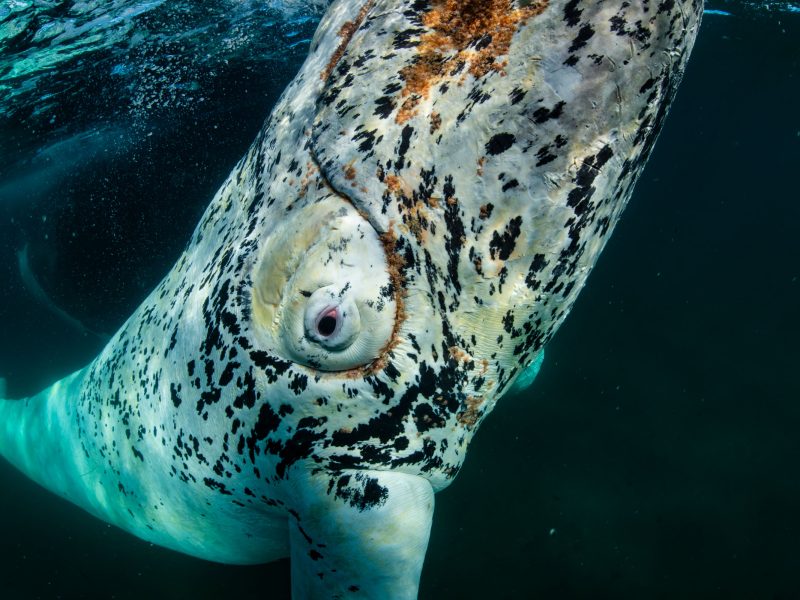
The Wonder of a Pale Whale
A curious calf with an atypical birthday suit is a good sign for southern right whales.
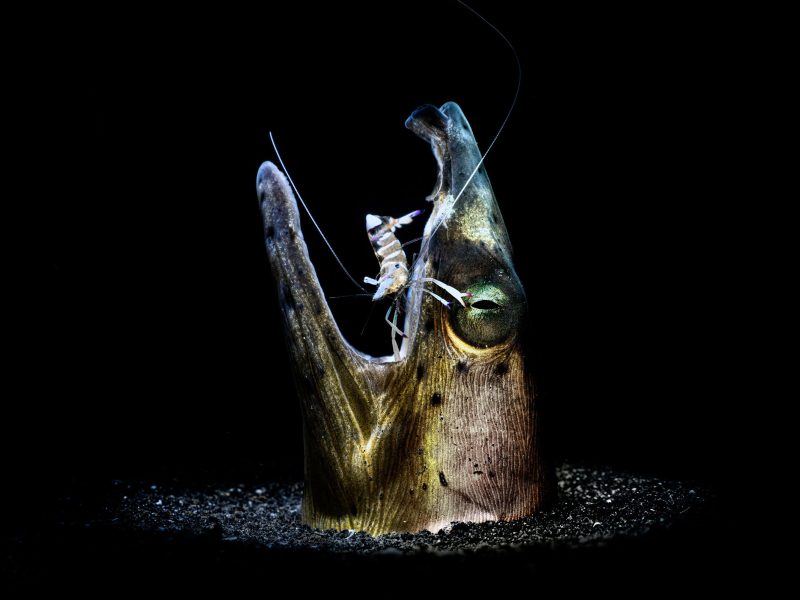
Saying “Ah!” at the Shrimp Spa
On coral reefs, an army of tiny cleaners eat their clients’ parasites, food particles, and dead skin, boosting biodiversity in the process.