
Photograph by Nick Garbutt
Story by Shanna Baker
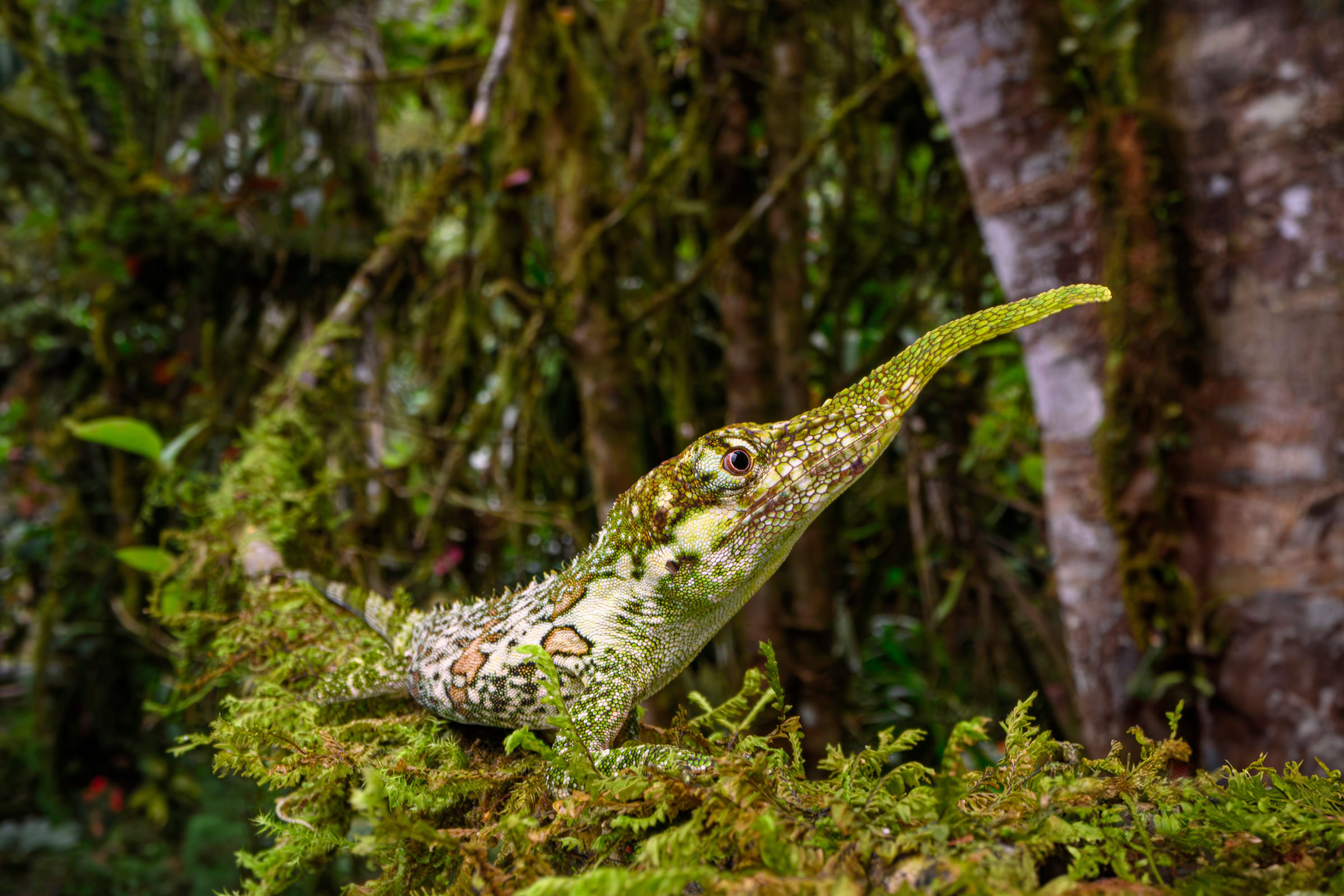
Along the northwestern slopes of the Ecuadorian Andes lives a little lizard with a striking silhouette. Males of the species Anolis proboscis—called the Pinocchio lizard, among other common names—sport long, nose-like proboscises off the tips of their snouts. Such appendages are rare on reptiles, and the Pinocchio may be the only species that wriggles out of its egg with its “horn” already developed. By the time a male is fully grown to about the length of a green bean, its horn is nearly as long as its head.
Despite their distinctive profiles, Pinocchio lizards are difficult to find—they typically move slowly, perch on skinny tree branches or twigs meters off the ground, and blend in with the surrounding vegetation. The first known Pinocchio lizard, a male, was documented in 1953; over the next 13 years, researchers discovered another handful. Then the species seemingly vanished for nearly four decades. Conservationists feared it might be extinct—a casualty of deforestation in the area. But in 2005, a group of birdwatchers happened to spot one crossing a road near Mindo, Ecuador. It turned out Pinocchio lizards were still real—just rare and incredibly hard to spot.
After the species re-emerged from the ranks of the possibly extinct, scientists got busy trying to learn more about it. One of the most compelling questions was, “What the heck is that proboscis for?” In 2014, researchers captured eight males and five females near Mindo and released pairs of them in a tree to observe their behavior. They learned that the lizard’s horn (which is not a nose—the lizard’s nostrils are on the top of its snout near the base of the proboscis) is primarily a tool de amor. When a male spots a potential mate, he puts his ornament on display, sometimes sweeping it back and forth through the air and flicking it upward like a fairy godmother’s wand, sometimes tipping it up and down while doing a pushup. He adds even more charm to his amorous display by revealing an extensible flap on his throat, called a dewlap.
Soft and flexible, the proboscis has much less utility as a weapon. The researchers also observed that when two male lizards square off, they might nudge each other with their horns, but typically hoist them out of the way before lunging forward to lock jaws. They also lift their appendages when they eat. Exactly how they move the proboscis is still not understood.
Another unknown is how the species—which has been confirmed in only four locations, all near Mindo—is faring overall. The International Union for Conservation of Nature’s Red List of Threatened Species designates the lizard as endangered and notes that it is susceptible to habitat degradation. But we at least know that Pinocchio lizards are real, and they’re spectacular. And that’s no lie.

Mindo, Ecuador
Authors


Related Articles

The Wonder of a Pale Whale
A curious calf with an atypical birthday suit is a good sign for southern right whales.
Saying “Ah!” at the Shrimp Spa
On coral reefs, an army of tiny cleaners eat their clients’ parasites, food particles, and dead skin, boosting biodiversity in the process.
Friends or Foes?
A flatworm and a sea squirt mingle in the tropical waters of West Papua, offering a glimpse into the complexity of interspecies relationships.