
Battle of the Beaks
Hummingbirds often use their bills for fighting, but some species’ outsized appendages are equally useful in finding food.
Photograph by Maxime Aliaga
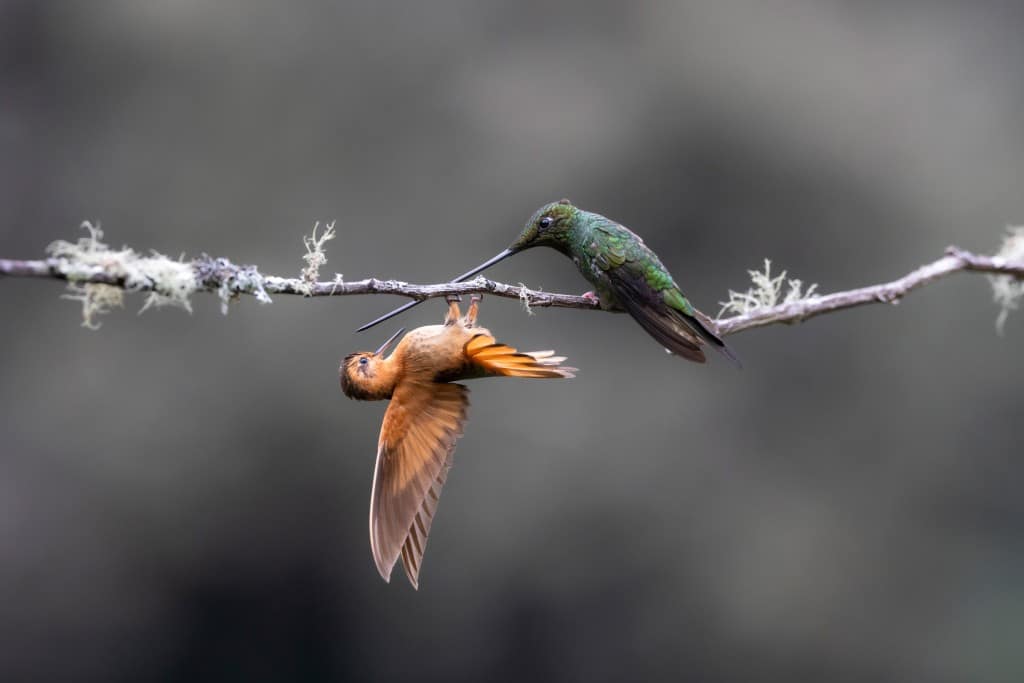
Despite their diminutive size and zany colors, many hummingbird species are downright ferocious when they encounter one another at a food source. That’s likely because of the demands of their lightning-fast metabolisms. In flight, a hummingbird may flap its wings 62 times per second, and some species have heart rates that top out at over 1,200 beats per minute. Hummingbirds’ small bodies have a high surface-area-to-volume ratio and they lack insulating down, so they also lose heat quickly. They must consume two to three times’ their body weight per day in high-sugar flower nectar.
Given that flowers bloom only for a short while, that makes each meal more like a high-stakes operation than a companionable feast. Even at feeders with abundant nectar supplied by humans, hummers of both sexes often joust—chasing and stabbing at each other with long, sharp bills, among other aggressive tactics and displays. The shining sunbeam (Aglaeactis cupripennis)—on the left in this image by conservation biologist and photographer Maxime Aliaga—is no exception. Researchers tracking the species in the Andes Mountains of Peru and Ecuador found that it regularly defended flowers within its territory from hummingbirds of both its own and other species, including sword-billed hummingbirds (Ensifera ensifera) like the one pictured on the right.
Sword-billed hummingbirds, for their part, aren’t slouches. They wield their beaks—which are longer than their bodies—exactly as their name suggests. But the primary purpose of the species’ outsized appendage may be to get food, rather than defend it.
Scientists believe that the sword-billed hummingbird’s unique morphology evolved in tandem with long-tubed passionflowers. That subgroup within the Passiflora genus, called Tacsonia, contains more than 60 species with flower nectar tubes 6 to 14 centimeters (2 to 5 inches) long. That’s a close match with the sword-billed hummingbird’s beak, which can reach up to 11 centimeters (4 inches). The birds and flowers also overlap in range, with 37 Tacsonia species pollinated exclusively by sword-billed hummingbirds. They are the only hummingbird species with the correct proportions to deposit pollen grains on the stigmas of these dangling, downward-opening flowers, poking into them from below to drink nectar.
In intact cloud forests, this highly specialized mutualism is a boon to both plants and pollinators. But in fragmented forests, it becomes a vulnerability: Research suggests that sword-billed hummingbirds don’t frequent deforested areas. Scientists speculate that may be partly because the long-tubed passionflowers that they observed in these zones often lose their nectar to “robber” species like bees, which drill into the flowers from the side, skipping pollination and draining the hummingbirds’ food source. With the connection to the passionflowers’ primary pollinator severed, at least four species of the plant have likely gone locally extinct in landscapes fragmented by forest-clearing. Those passionflower species that have evolved shorter nectar tubes, though, are more resilient. They can rely on other hummingbirds and bats for pollination, even when the habitat becomes less suitable for sword-billed hummingbirds.
Hi, I’m Dave, the executive director of bioGraphic. (And that’s my dog, Finn.) Thanks for taking the time to read this story.
Stories like this simply don’t get produced without financial support from readers like you. bioGraphic is not backed by a private company or owned by a billionaire. It’s an independent, nonprofit magazine. And one-quarter of our annual budget comes directly from reader donations.
We need your support more than ever, as governments slash funding for conservation and scientific research, placing even more ecosystems and wildlife at risk around the world. At bioGraphic, we’re steadfastly shining a light on the threats to our planet’s incredible biodiversity. And we’re showcasing the hard work of people bravely taking action to protect at-risk species.
bioGraphic publishes environmental reporting that you can’t find anywhere else: deeply researched, trustworthy stories that are also beautiful and captivating to read. We offer an antidote to reader apathy and doom-and-gloom news by revealing the wonders of the natural world and focusing on real solutions to big problems. When you finish a bioGraphic story, we want to leave you feeling informed, delighted, and inspired.
We don’t run ads or hide our stories behind a paywall. The readers who generously support bioGraphic allow our work to remain free for everyone.
Will you help us keep telling these crucial stories?

Authors

Related Articles
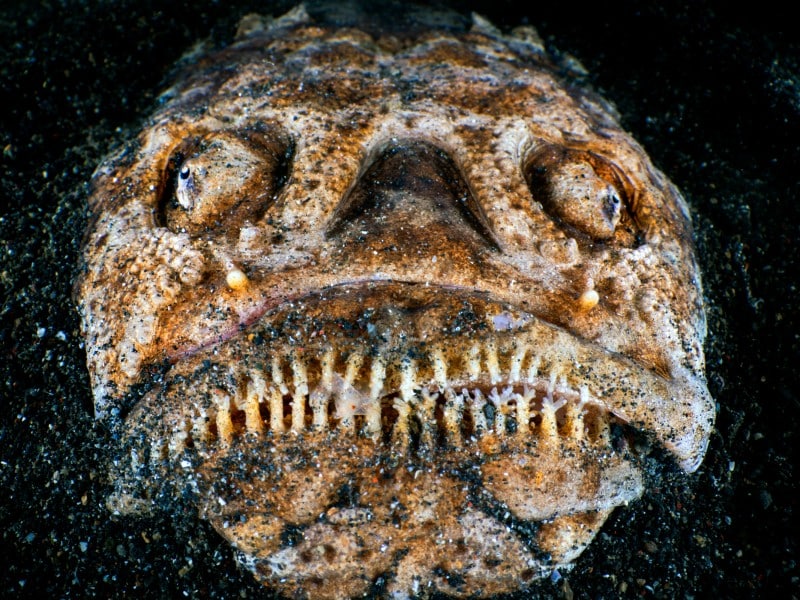
Burial at Sea
The whitemargin stargazer’s ghoulish, upturned face allows the fish to bury its body in sand and nearly disappear—while watching for its next unsuspecting meal.
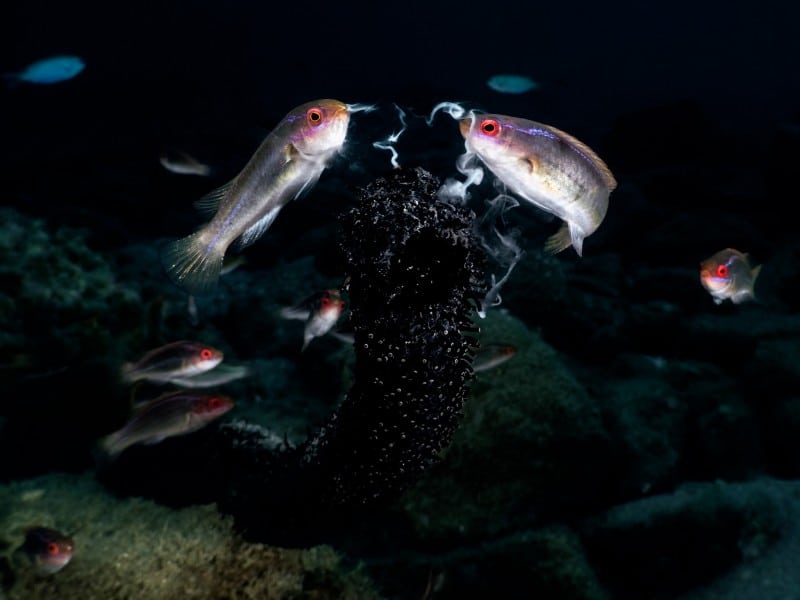
Milt Meal
Marine creatures will do almost anything for a meal—including feasting on the sperm and eggs of spawning invertebrates.
The Art of the Catch
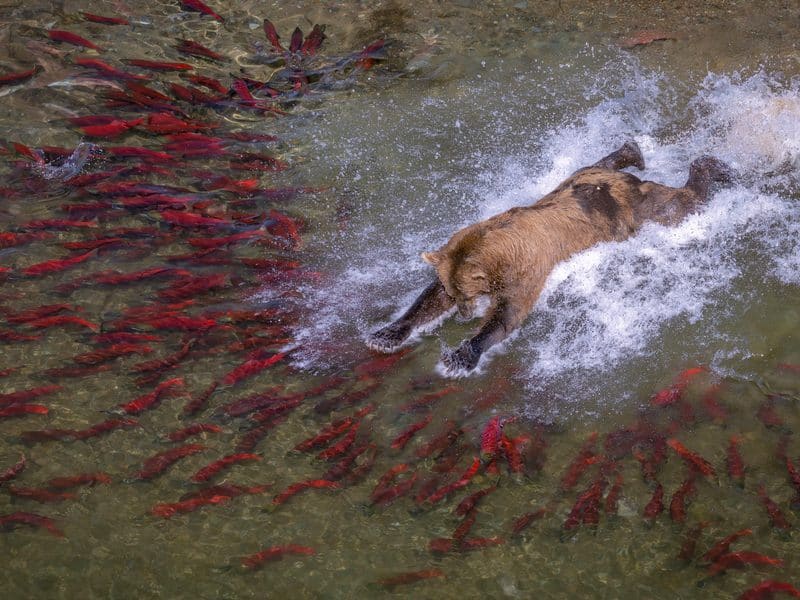
To bulk up for winter hibernation, Alaska’s brown bears employ a range of techniques for snaring salmon.