
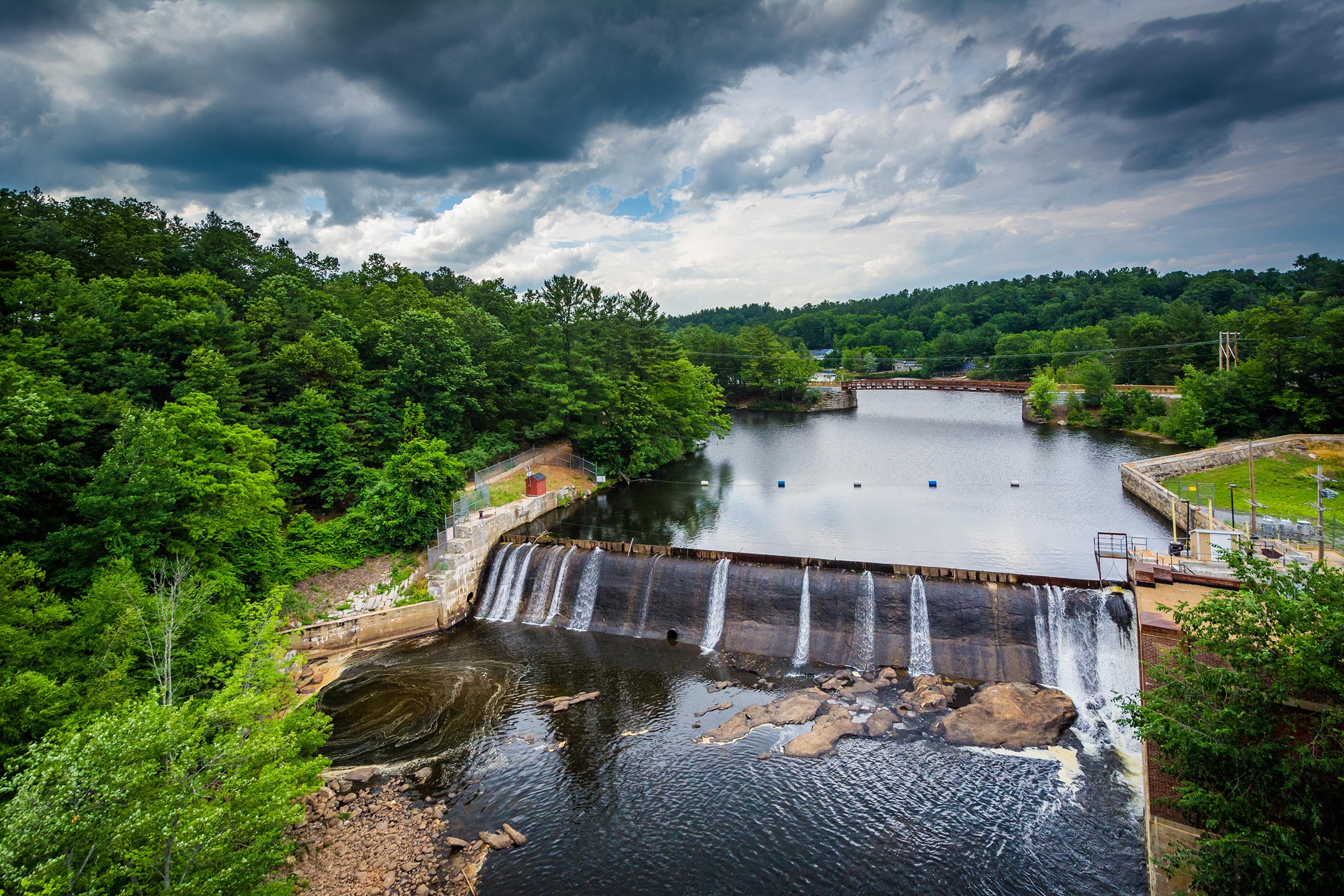
This story is part of our Wildlife at the Crossroads series, which explores the intersection between human infrastructure and wildlife—and what can be done about the resulting impacts. It was funded in part by The Bernard Osher Foundation. Find all of the stories in the series here: Wildlife at the Crossroads.
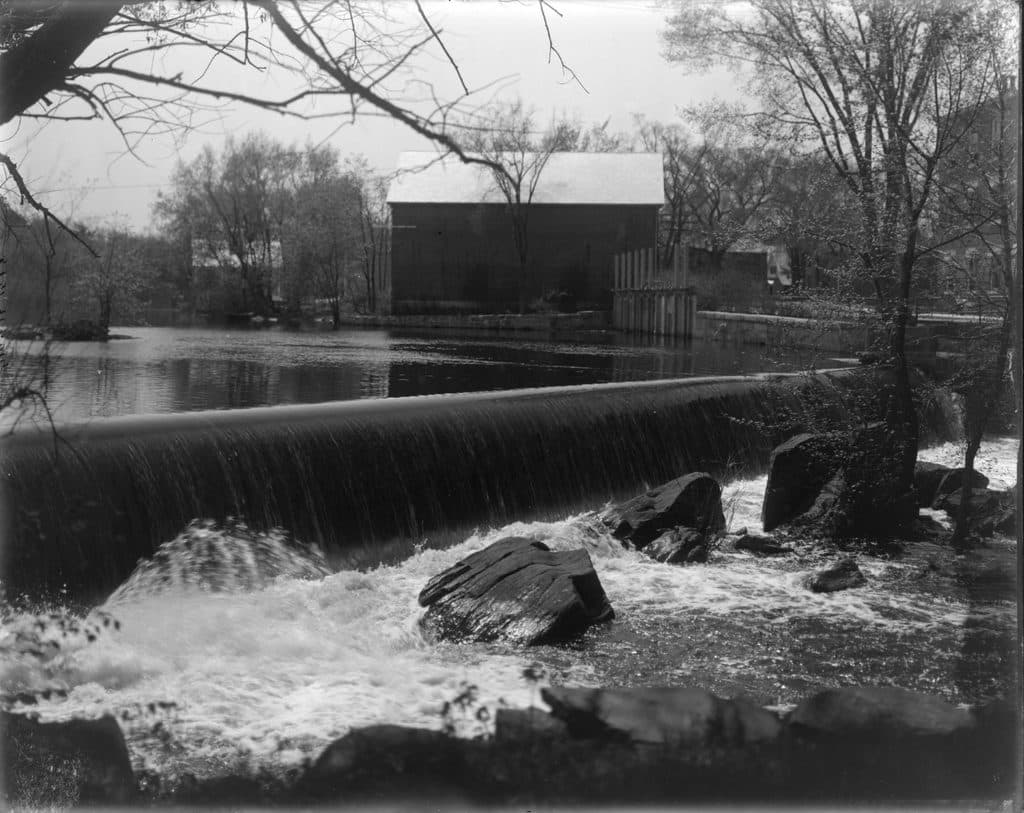
In 1859, a committee of farmers in Billerica, Massachusetts, having grown irked by a dam on the Concord River, hired a surveyor to justify its destruction. The dam, which powered a textile factory owned by an industrialist named Charles Talbot, was allegedly flooding their fields and spoiling their hay; now they wanted the wall and its reservoir gone. They hoped the surveyor’s evidence would persuade a court to order its obliteration. The surveyor—a conscientious, lushly bearded man of good repute—set about plumbing the Concord’s bottom, measuring its bridges, and scrutinizing high-water marks. In truth he didn’t love the work, describing surveying as “drudgery” and “barren” in his journals. Henry David Thoreau’s truest passion, of course, wasn’t surveying land, but writing about it.
Aside from the paycheck, the now-legendary author had another motivation to take the Concord job: He despised the Talbot Mills Dam. A decade earlier, Thoreau had published the travelogue A Week on the Concord and Merrimack Rivers, in which he inveighed against the dam for blocking the passage of spawning fish, especially American shad (Alosa sapidissima). “Poor shad! where is thy redress?” Thoreau demanded. Although Thoreau’s surveys eventually proved the farmers’ case, reparations to agrarians and shad didn’t follow. On appeal, the state of Massachusetts permitted the dam to remain. This can’t have surprised Thoreau, who knew that dams made for intractable opponents. “Perchance, after a few thousands of years, if the fishes will be patient, and pass their summers elsewhere meanwhile, nature will have leveled the Billerica dam,” he wrote.
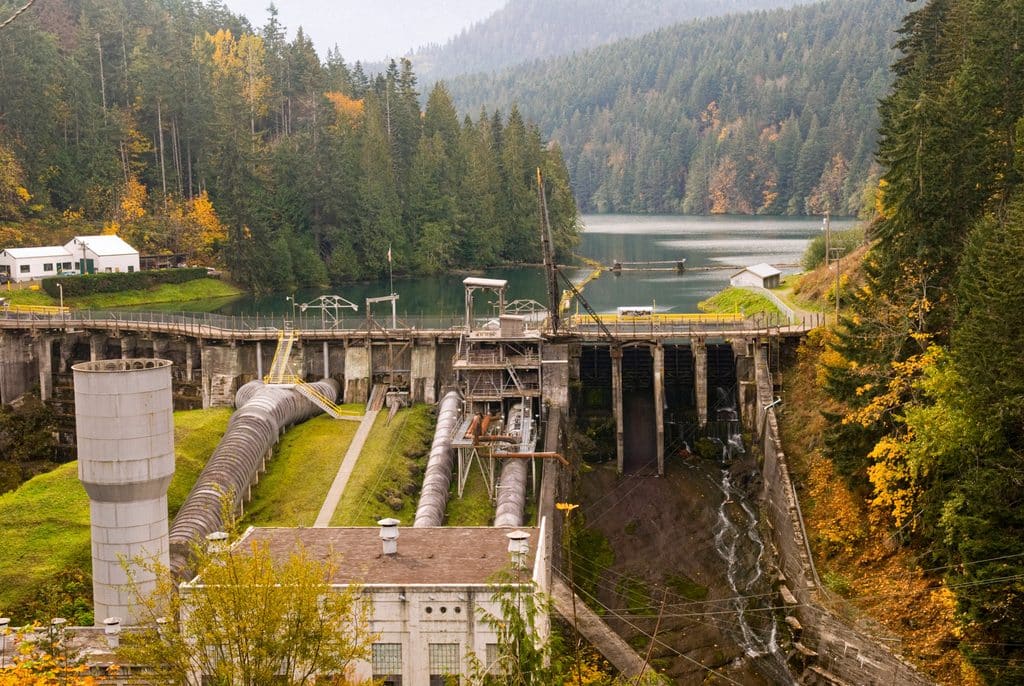
Happily, he was wrong: It hasn’t taken “a few thousands of years” to level many fish-blocking dams after all. Since 1912, more than 2,300 dams have been purged from waterways in the United States, most in the last quarter-century. The dam-removal movement hit its apogee in 2024, when, by the accounting of the nonprofit American Rivers, 108 dam removals reconnected more than 4,000 kilometers (2,500 miles) of once-fragmented waterways. The year’s biggest and best publicized dam obliteration occurred on the Klamath River, where the dismantling of four aging hydroelectric dams opened more than 645 kilometers (400 miles) of spawning habitat in California and Oregon to chinook salmon, who recolonized the watershed so rapidly that conservationists described the resurrection as “magical.” Prior to the Klamath, the nation’s largest undamming took place on Washington State’s Elwha River, where two fish-blocking walls were obliterated on behalf of chinook, coho, steelhead, and other salmonids.
Yet it would be a mistake to presume that dam removals primarily benefit western salmon rivers. Though they’re typically smaller in scale and receive less fanfare, the majority occur in eastern states, where more than 1,100 demolitions have unblocked over 32,000 kilometers (20,000 miles) of river. In 2024, Blake Higgins Dam came tumbling down in Vermont; the Edes Falls Dam departed the Crooked River in Maine; and the Kimball Brook Dam vanished from New Hampshire’s Kimball Brook. The previous year, Pennsylvania alone tore out 27 obsolete barriers, none taller than around 6 meters (20 feet). Even the three-century-old Talbot Mills Dam that so vexed Thoreau may soon be torn down.
“We’re in this dam-removal renaissance, where we’re losing barriers faster than we’re putting them up for the first time in history,” Nathan Furey, a fish biologist at the University of New Hampshire, told me. Per one inventory, however, at least 35,000 dams still truncate eastern fish runs, including more than 3,000 in Massachusetts, 5,000 in Connecticut, and 9,000 in New York—barriers that continue to hamper the recovery of Thoreau’s beloved shad and many other migratory fish, whose runs collectively occupy a sad fraction of their historical habitat. Can government agencies and conservation groups pick up the pace of dam removal while fish are still around to benefit?
Photograph by Yingna Cai/Shutterstock
Among the states destroying dams, albeit gradually, is New Hampshire, and one late-April morning I climbed into a car with Furey to tour a few of its newly free-flowing rivers. Furey—slim, thoughtful, trimly goateed—had come to the Granite State in 2018 a neophyte to dam removal, having done most of his graduate research on relatively undeveloped Pacific salmon rivers in British Columbia. “But when you’re the fish guy at the University of New Hampshire, people want you to tell them what happens when a dam comes out,” he said as he navigated Durham’s leafy streets. “There’s a lot of people looking to you for answers.”
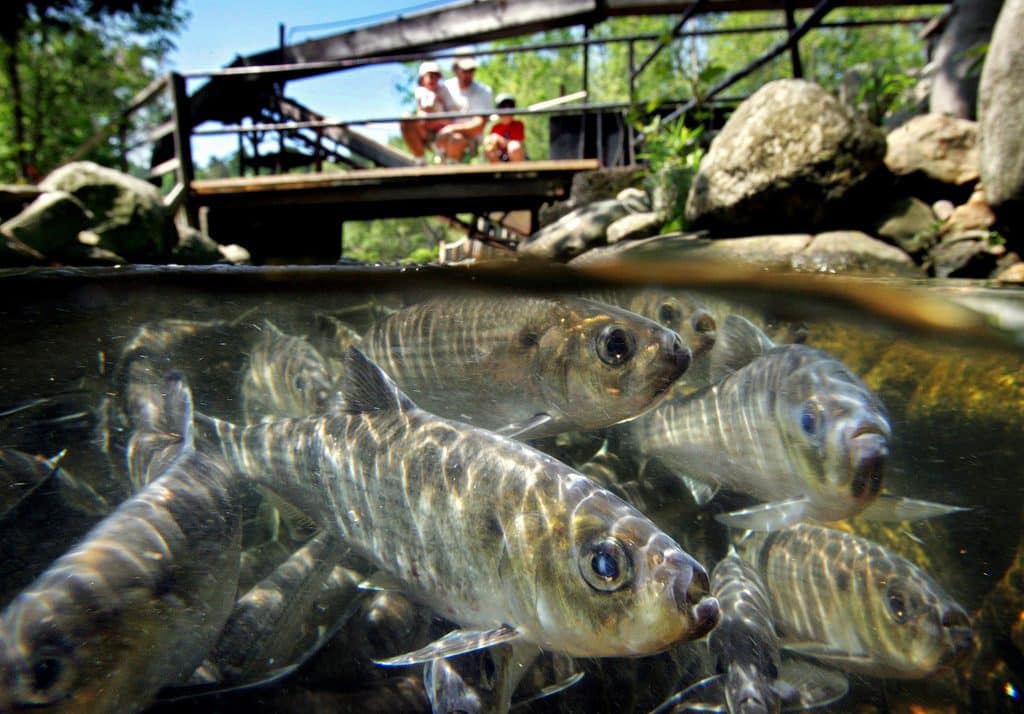
Furey’s domain is the Great Bay watershed, a tidal estuary fed by an arterial network of seven rivers. Historically those waterways teemed with a roster of diadromous fishes: species that split their lives between freshwater and the ocean. That included Atlantic salmon, shad, sea lamprey, American eels, tomcod, sturgeon, and, most numerous of all, alewives and bluebacks, a pair of silvery, foot-long fish collectively known as river herring. Sharks, striped bass, cod, seals, seabirds, and other predators devoured river herring as they approached the estuary each spring, and juvenile Atlantic salmon may even have timed their departure from river to ocean to coincide with alewives’ return, a strategy called prey buffering. While cormorants and otters gorged on alewives, young salmon slipped downstream undetected. There’s safety in numbers, and alewives (Alosa pseudoharengus) supplied such prodigious numbers that one historian deemed them “passenger pigeons of the sea.”
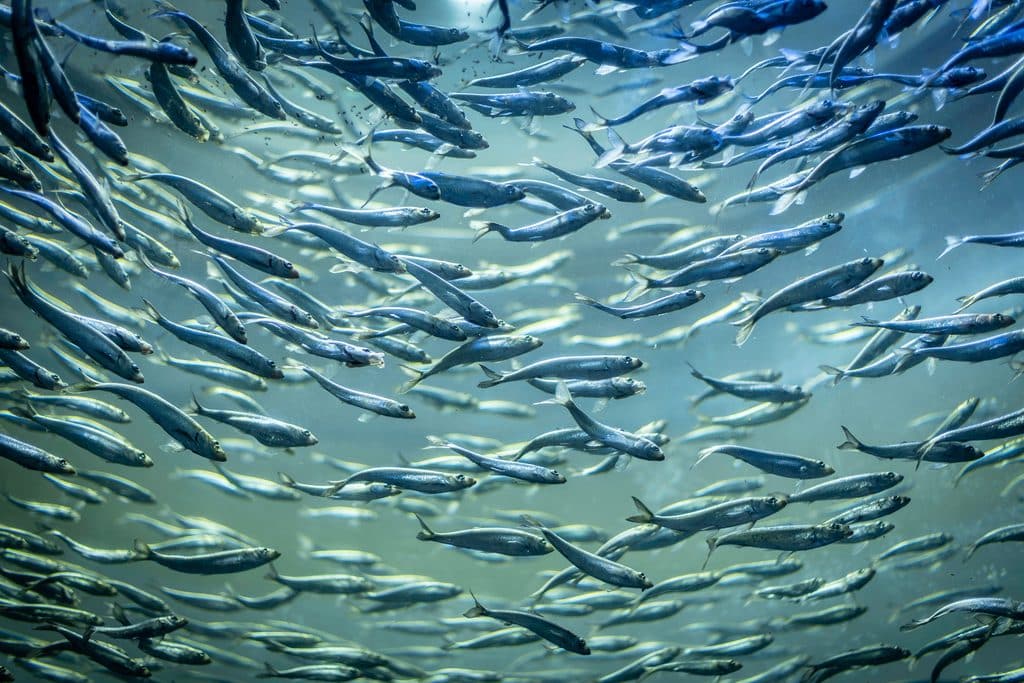
Like their avian analogues, alewives fared dismally during North America’s colonization. Beginning in the mid-1600s, eastern colonists launched a maniacal dam-building spree, impounding and harnessing streams to spin waterwheels and power mills—gristmills for grinding corn, sawmills for hewing logs, paper mills for pulping wood, textile mills for spinning fabric. To say that small mill dams killed fish by a thousand cuts dramatically understates the injury: By the mid-1800s, more than 65,000 mills stapled eastern creeks, with catastrophic consequences. Over the past four centuries, scientists have calculated that New England’s dams have deprived its ecosystems of more than 9 million metric tons (20 billion pounds) of alewives—roughly the weight of 300,000 humpback whales.
To show me what happens when one of those fish-blocking walls comes down, Furey took me to the Bellamy River, whose frothing course was straddled by a sprawling brick compound, former headquarters of Sawyer Woolen Mills. The textile mill, long defunct, had been converted to apartments in the 1980s, but its two dams had lingered, funneling the Bellamy through a narrow, fish-stopping pipe. As they aged, the dams also became flood hazards, and in 2019 and 2020 a coalition of agencies, nonprofits, and the apartment complex’s owner demolished them. Now the unfettered river churned beneath the brick colossus, ripping over a recontoured bottom of bouldery pools and pockets.
The dams were long gone, but could the herring navigate the obstacle course they’d left behind? “Alewives are not salmon—they can’t jump,” Furey explained over the Bellamy’s roar. “They’re not big powerful swimmers like sturgeon; they’re not eels that can climb and crawl.” After the dams came out, the state attempted to count returning alewives with visual surveys—in other words, staring at the stream and tallying fish, an obviously imprecise method. “We have no idea how many fish come back here,” Furey said.
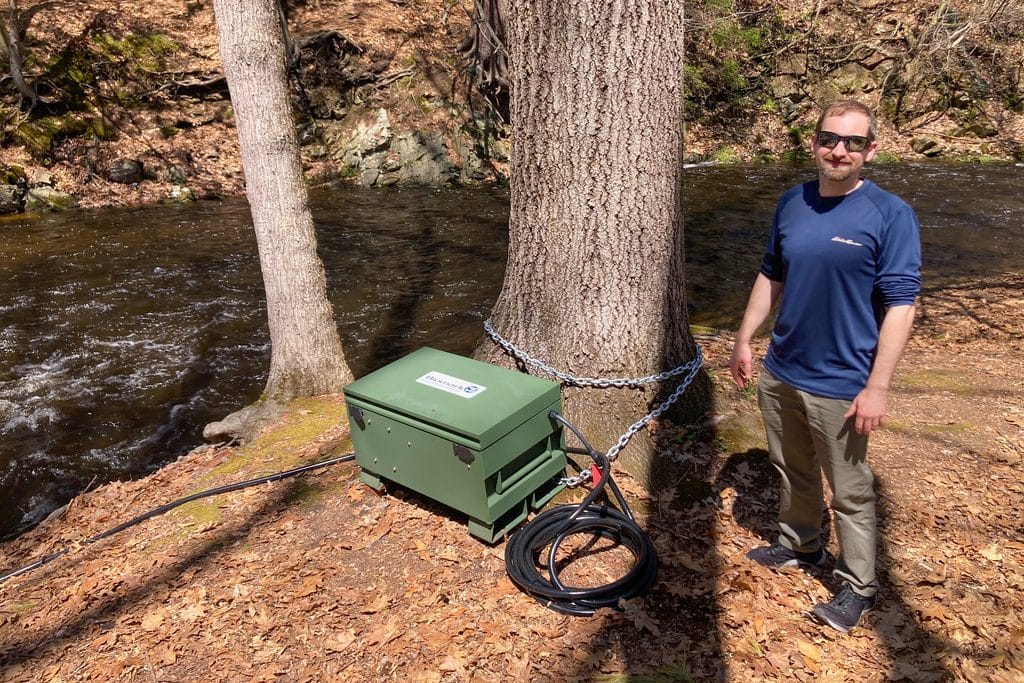
Furey was now tasked with answering that question. He and his students would soon capture alewives as they entered the Bellamy and implant them with a couple of different trackers, including rice-grain-sized microchips known as PIT tags, or passive integrated transponders, a cheap and easy way of figuring out what percentage of returning herring managed to skitter through the rapids. We strolled past the apartment complex and upstream to watch Furey’s lab members set up the PIT tag reader that would register each fish. A metal box, containing batteries and a recorder, was chained to a tree near the bank; from it, a cable ran to a riffle, ready to log the serial number of any tagged alewife who wriggled past: a modern technology to surveil an ancient fish.
As Furey’s colleagues fiddled with the PIT tag array, they were observed with curiosity by the residents of the Sawyer Mills apartments, many of whom had taken their lunches outside to savor the balmy spring day. Whereas other wildlife migrations, like the trans-hemispheric flights of Arctic terns, unfold largely beyond human ken, New England’s diadromous fish often pass through neighborhoods and backyards. “They don’t need pristine environments—they can be right here,” Furey said. A woman in a lawn chair, cigarette dangling from fingers, asked us what we were doing, and Furey mentioned herring. “I had one out my bedroom window all winter,” she rasped. “I love seeing how still and graceful they are.” Herring, heron—same difference.
It was a funny moment that hinted at a genuine problem. Whereas many West Coast salmon runs collapsed within the span of human memory, New England’s rivers have been plugged for so long that few residents know that they once ran silver with bluebacks, alewives, and shad. “It’s a challenge to talk to people about these fish, because they don’t have any cultural memory,” Furey said. Fish depletion, alas, is often a self-reinforcing cycle. The fewer fish there are, the less the public cares about them, a feedback loop the biologists John Waldman and Karin Limburg dubbed eco-social anomie.
Dam removal is often described as rewilding rivers, but it also liberates the human imagination. In 2025, 12 years after the demolition of two dams, an astonishing 6 million river herring returned to Maine’s Penobscot River—double the figure from just two years prior. In the Kennebec River watershed, herring counts swelled more than 14-fold in the decade after dam destruction, though upriver barriers still thwart Atlantic salmon. In a 2014 paper, the ecologist Loren McClenachan and colleagues published interviews with Mainers living along rivers where alewife runs had been restored, among them the Sebasticook, up which nearly 2 million herring swam immediately after a dam came out in 2008. McClenachan’s subjects were jubilant: The return of herring had instilled pride, generated revenue from fishing and tourism, and solidified social bonds as kids and lobstermen gathered to watch fish ascend. If eco-social anomie describes a societal forgetting, dam removal achieves the opposite—a “collective remembering,” as McClenachan put it, that cures our amnesia and unshifts our baselines.
While knocking out major dams on main stems like the Penobscot achieves dramatic results, plenty of smaller obstacles require redress, too. Although the Penobscot’s lower main stem runs free for 64 kilometers (40 miles), its capillary networks of tributaries remain “somewhat overlooked,” according to Joshua Royte, senior conservation scientist at The Nature Conservancy. While the Penobscot Nation and others have removed many barriers, dozens of mill dams and undersized culverts still choke the watershed’s dendritic headwaters, thwarting migratory fish from accessing some of the basin’s most ecologically important areas—spawning grounds for sea lamprey and salmon, chilly climate refugia for brook trout, grottos overhung with leaves that feed aquatic invertebrates.
“If you protect and connect massive networks of these headwaters, you can maintain productivity all the way downstream,” Royte says. “A coldwater tributary just a quarter-mile long could be really important.”
Consider Sedgeunkedunk Stream, a Penobscot tributary where dam removal reopened around 4.5 kilometers (2.8 miles) of creek and boosted populations of native sea lamprey. Sea lamprey, like Pacific salmon, accumulate nitrogen and phosphorous during their time at sea, then die after migrating into rivers to breed. Their carcasses feed animals from snapping turtles to raccoons, and the marine-derived nutrients in their flesh fertilize algae and forests. Ecologist Steve Coghlan, who studied lamprey’s recovery in Sedgeunkedunk, once described to me watching the eel-shaped fish spawn, seizing rock after rock with their mouths and positioning them with utmost care in their redds, or nests. Behind the amorous lamprey hovered shoals of shiners, dace, and fallfish, waiting as though on a buffet line for eggs and the drifting aquatic insects the lamprey dislodged—a delicate symbiosis that rose when a wall fell.
Photograph by Nick Hawkins/Alamy Stock Photo
Despite the manifest virtues of free-flowing rivers, however, many New Englanders remain as attached to their dams as they were during Thoreau’s day. After stopping at the Bellamy, Furey took me to the Oyster River, where a century-old wall called Mill Pond Dam spread and slowed the river’s flow—just one in a series of dams that had stoppered the river since the 1600s. Water sheeted gracefully over the dam’s lip and frothed at its base, a scene I had to admit was picturesque. We inspected the fishway, a sloping ramp via which river herring and other species surmounted the dam—though, as Furey pointed out, large fish such as sturgeon likely couldn’t navigate the ladder’s tight corners or even fit into its narrow channel. Nor did the fishway prevent the pond from becoming a warm, low-oxygen puddle in summer, or stop herons and other predators from picking off out-migrating juvenile herring as they struggled through the pond’s slack water.
Tearing down the dam, which hadn’t served any industrial purpose in decades, struck me as an obvious decision. But not everyone agreed. On a lawn across the Oyster’s mirrored surface, an all-caps sign insisted that we “HELP SAVE MILL POND DAM.” Dozens of worthy removals have been thwarted or delayed by local dam enthusiasts, who are sometimes described as NOOMBYs—Not Out of My Backyard. Many NOOMBYs consider local dams indispensable ties to their community’s past; in Billerica, some town officials have objected to the demolition of the Talbot Mills dam so despised by Thoreau on the grounds that “it has long served as a symbol of the Industrial Revolution” that remains “unquestionably one of the major focal points in the area.” Dams and reservoirs also accrue recreational value: They’re the scenic, still-water backdrops against which people paddle kayaks, feed ducks, and teach their children to catch sunfish. Eric Hutchins, a retired restoration biologist at the National Oceanic and Atmospheric Administration (NOAA), told me he once butted heads with a guy who wanted to preserve the impoundment where his golden retriever played fetch. (To that, Hutchins countered that the dog was stirring up toxic sediments and probably poisoning himself.)
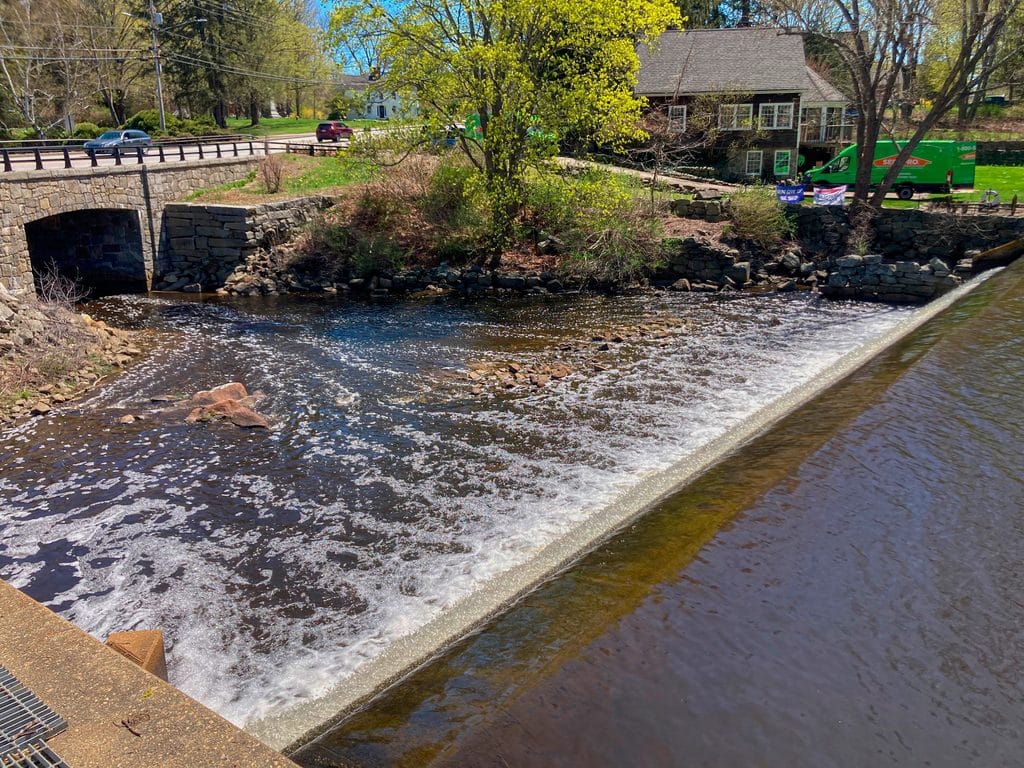
These days, the sentimental attachment to defunct dams appears to be waning—and the Oyster River is Exhibit A. In 2002, the state of New Hampshire declared the dam structurally deficient and ordered the city of Durham to repair it, a process that engineers estimated would cost far more than simply tearing it down. After residents protested the possibility of removal, the city temporarily dropped the idea. But the ecological and financial logic was too overwhelming to ignore, and, in 2022, the issue was put before a ballot initiative, in which Durham voters elected to destroy the dam by nearly a three-to-one margin. The US $3.1 million demolition project began in the summer of 2026 and will conclude in 2027 with the planting of native vegetation around the now-drained reservoir.
“Historically the Oyster would’ve boiled with river herring,” Furey said as we gazed at the doomed dam. “That’s the history I’m interested in.”
Yet history is only one factor preserving old dams—current events play a role, too. Although many northeastern dams are obsolete granite-block affairs, hundreds are of 20th-century vintage and still feed hydroelectricity to regional grids. Some are owned by towns, some by utilities; still others are the property of corporations, private landowners, or investors who acquire them within renewable energy portfolios. Though they’re hardly major suppliers of energy—some only power a handful of homes—it can be difficult to justify taking any electrons offline in a world of spiking energy prices and explosive data-center construction. Still, as small-scale hydroelectric dams age, the cost of repairing them, and the flood risk they pose in the event of failure, can make them economic liabilities that their owners are eager to offload—often as significant a motivator for dam removal as fish passage.
Unfortunately, making progress will be difficult under the Trump Administration, which is hampering dam removal efforts in almost too many ways to count. NOAA, the federal agency that has spearheaded dozens of dam removals around New England, faces dramatic cuts to its staff and budget. The Aquatic Organism Passage Program, a Bipartisan Infrastructure Law initiative that earmarked a billion dollars to remove culverts, dams, and other fish barriers, has fallen into an administrative void, leaving some applications unreviewed and funding unspent. And President Donald Trump’s war on solar and wind energy has deprived grids of power sources that could replace hydroelectric dams.
“The lack of belief that government can be an important partner, the reductions in funding, the assault on the staffing of partner agencies—it’s not making this work any easier at all,” says Andrew Fisk, northeast regional director for American Rivers.
Photograph by Cami Johnson/Shutterstock
The Eastern Seaboard’s most enthusiastic purger of dams has long been Plymouth, Massachusetts, and one weekend I visited during its Herring Festival, a celebration of the resurgent alewife population that annually runs up Town Brook, the stream at Plymouth’s heart. The day was cool and damp, and I followed a posse of dads in Red Sox sweatshirts and kids in rainboots up the path that paralleled the creek. Someone had chalked “LOOK FISH” on the asphalt, and I glanced streamward to find alewives holding in small pods, weaving around each other in their effortless way.
The higher I walked, the thicker the fish got, until I reached the base of the Plimoth Grist Mill, the last dam left in Town Brook, where they queued up to enter a ladder in an aggregation as thick and black as tar. A guy holding a Dunkin’ cup eyed a belly-up alewife and quipped, “He ain’t doing so hot.”
Above the dam, the Herring Festival was in full swing: an acoustic guitarist jamming, kids grinding corn at the antique mill, enviros tabling for fish-adjacent causes. “My family looks forward to the herring run every year,” Malissa Costa, a Mashpee Wampanoag cultural leader, told me when I stopped at her Tribe’s kiosk. “We consider these fish our ancestors, connected beings to us.” Though Massachusetts has prohibited alewife harvest since 2005, the Wampanoag are understandably exempt, and Costa takes around 20 each spring with nets and sometimes her bare hands. She and other women gut the fish and salt them, inside and out; poke sticks through their eyes to hang them in drying and smoking shacks; and bake them in ovens.
Funny enough, Costa doesn’t much like the taste herself: “You ever smelled herring?” she said, wrinkling her nose. “It’s like the fishiest fish.” Instead, she gifts her catch to elders and tribal members in need. “Every year I feel an obligation to go out there and get the herring,” Costa said.
As they emerged from the gristmill’s ladder, alewives slid through a camera box to be counted by volunteers monitoring the feed from home, a literal live stream. For two centuries, these fish would have faced six additional dams along a span of just 2.5 kilometers (1.5 miles), which powered the production of grain, textiles, leather shoes, anchors, and other miscellany, en route to their headwater spawning pond. Now their journey was free and clear, and I couldn’t blame the gawkers applauding each fish who emerged from the ladder. “It’s hard not to root them on after all we’ve done to them,” agreed David Gould, director of the town’s environment department, as we fish-watched.
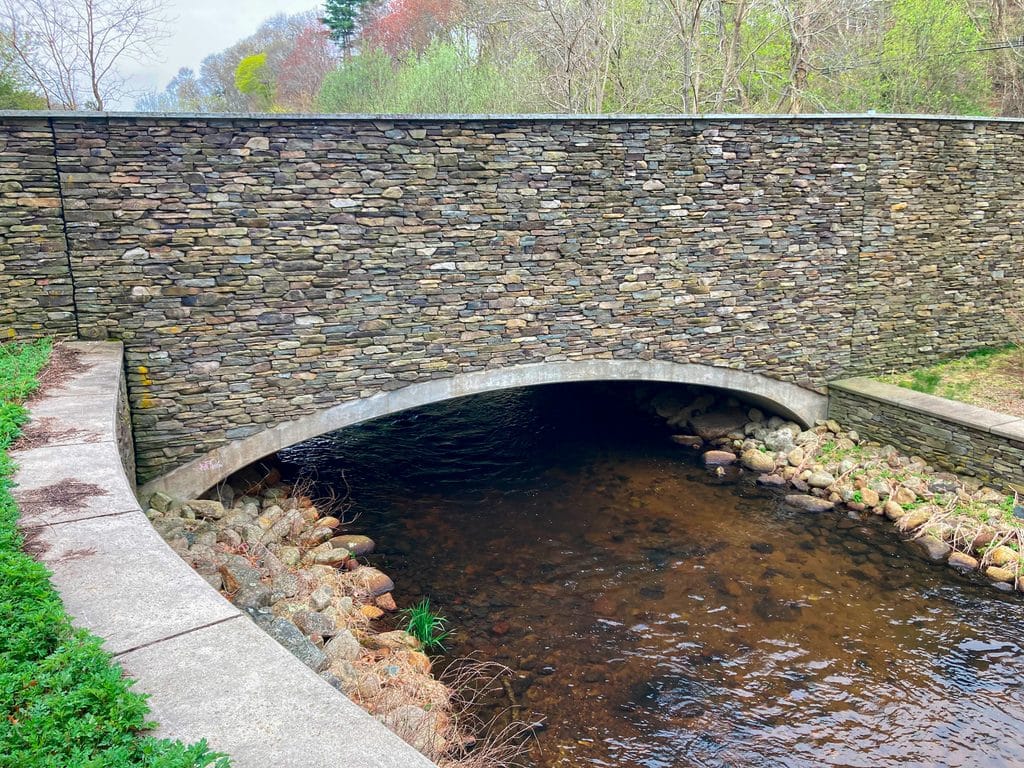
Gould, genial and ruddy, was the person most responsible for Town Brook’s transformation, and I suggested we walk upstream to see what he’d accomplished. We followed the creek up a trail, packed by the feet of untold Wampanoag fishermen, that seemed to crawl through a century of history each quarter-mile, past stately Victorians and brick millhouses and cranberry bogs and into pine and oak forest. “This used to be underwater,” Gould said every few minutes, gesturing at some field or park or woodlot once submerged by a reservoir. Occasionally we saw vestiges of former impoundments: a dock’s rotting skeleton, a high-water stain on a glacial erratic. The masonry of a couple of old dams, whose crests had doubled as town streets, had been artfully converted into bridges; the ruins of others faded into the greenery.
Though Town Brook’s dams had been outfitted with fish ladders, the passages were shoddy, overlong, and hard for fish to find amid turbulent pools. “You’d see thousands of fish washing back down, just bruised and battered and cut up,” Gould said. Among the most egregious offenders was the Billington Street Dam, and in the early 2000s the town of Plymouth sought federal assistance to repair its faulty ladder. The request reached Eric Hutchins at NOAA, who proposed removing the dam altogether instead of fixing it. In 2002 the destruction, overseen by Gould, was carried out by an Army Reserve engineering battalion, which clawed the dam apart with excavators in exchange for food, fuel, and lodging.
Energized, Gould began to pick off the brook’s other dams—Water Street, Plymco, Holmes—with various pots of funding. In a town whose history is as layered as Plymouth’s, he discovered, so much of dam removal turned out not to be dam removal. Asbestos shingles had to be peeled off mill buildings; rights of way had to be extinguished; contaminated sediment had to be landfilled. The stream itself had to be rebuilt, boulders and bends and riparian plants restored to destitute reservoir bottoms. And the permits—so many permits. “You’re using the same regulatory framework that permits, like, a Walmart,” Gould said.
By the time I visited Plymouth, Gould had attained almost mythic status among river restorationists. “Dave has probably removed more dams single-handedly than anybody east of the Mississippi, and maybe west,” Hutchins told me. Gould didn’t seem entirely comfortable with being a living legend. He’d recently spoken at a fish-passage conference alongside delegates from the Klamath and other massive western watersheds. “All these people are talking about opening up 50 miles of habitat for these giant salmon, and I’m talking about these projects where we opened up like a third of a mile at a time for these little herring,” he recalled sheepishly. Yet few dam removals could rival Town Brook for sheer production. Before Gould began ripping out dams, around 25,000 herring returned to the brook annually. Now, many runs exceed 200,000.
Replicating such success on a nationwide scale will require a raft of reforms: We need vastly more funding, smoother permitting processes, more solar energy to replace hydropower. To achieve American Rivers’ goal of removing 30,000 dams by mid-century, the pace of dam removal would have to accelerate by roughly an order of magnitude. Yet all of those policy changes must be preceded by social transformation—by humans, millions of them, witnessing Town Brook and other free-flowing streams again running chock full of fish. As American Rivers’ Andrew Fisk put it to me later: “Proximity to abundance is transformational.”
Forty minutes of walking brought me and Gould to the freshwater pond where the alewives swarming in Town Brook would soon spawn. Often, Gould pushed out a kayak to watch breeding fish swirl in the lakeshore willows, his own private celebration of a herring run that had fed pilgrims and sustained the Wampanoag since the end of the last ice age. “To me, the single most historic thing in Plymouth is this brook,” he said. Rather than being a force acting against history, fish were history—and unlike mill dams, they had a future.
Correction: A previous version of this story incorrectly stated that the Blake Higgins Dam, Edes Falls Dam, and Kimball Brook Dam were removed in 2025. The dams actually came down in 2024. We regret the error.
Photograph by Capt’ Tom/Shutterstock
Hi, I’m Dave, the executive director of bioGraphic. (And that’s my dog, Finn.) Thanks for taking the time to read this story.
Stories like this simply don’t get produced without financial support from readers like you. bioGraphic is not backed by a private company or owned by a billionaire. It’s an independent, nonprofit magazine. And one-quarter of our annual budget comes directly from reader donations.
We need your support more than ever, as governments slash funding for conservation and scientific research, placing even more ecosystems and wildlife at risk around the world. At bioGraphic, we’re steadfastly shining a light on the threats to our planet’s incredible biodiversity. And we’re showcasing the hard work of people bravely taking action to protect at-risk species.
bioGraphic publishes environmental reporting that you can’t find anywhere else: deeply researched, trustworthy stories that are also beautiful and captivating to read. We offer an antidote to reader apathy and doom-and-gloom news by revealing the wonders of the natural world and focusing on real solutions to big problems. When you finish a bioGraphic story, we want to leave you feeling informed, delighted, and inspired.
We don’t run ads or hide our stories behind a paywall. The readers who generously support bioGraphic allow our work to remain free for everyone.
Will you help us keep telling these crucial stories?

Author

Related Articles

Ethiopia’s Grand Tree-Planting Plan
Efforts to restore lost forests often fail, but Ethiopians are betting big: planting billions of saplings to revive habitat, regenerate soil, and stabilize the land.
The Trouble with Tamarisk
Twenty-five years ago, land managers unleashed a beetle to control an invasive tree sucking rivers dry. But water levels haven’t risen—and the real villains are still causing trouble.
The Unwilding of Patagonia’s Pollinators
In a region synonymous with wilderness, native bumblebees are being replaced by industrial worker bees—and ecosystems are paying the price.