
At 7:30 on a clear morning in December 2025, I arrived at the marina in Oxnard, California, in search of Mikey Volaski, one of the only commercial fishers in North America whose operation is dedicated to brown box crab.
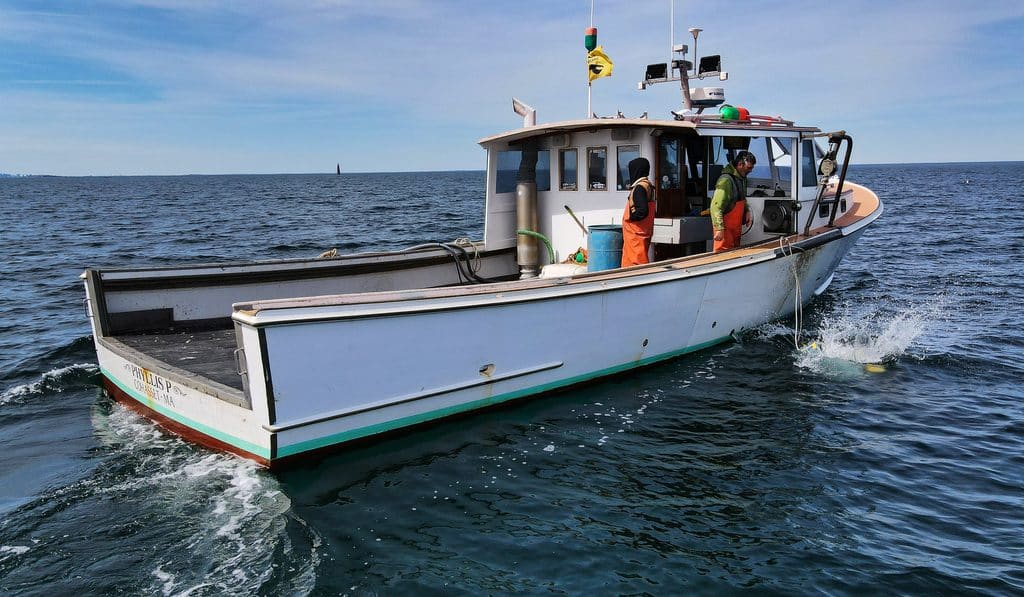
His crew met me at the marina gate and escorted me to Volaski’s boat, the Coastal Reign—a pearly New England-style fishing vessel with a V-shaped hull for cutting through rough waters. Justin Harrison-Muñoz, the more experienced of Volaski’s two deck hands, had fished in Alaska before moving to California in 2020. Gerardo Barrera had never boarded a boat until he got a job with Volaski about five years ago. But he loved the work. “The ocean is my office, and I like that,” he told me. As the two loaded bait—a plastic trash can full of frozen mackerel—the rubbery sound of a barking sea lion rang through the marina.
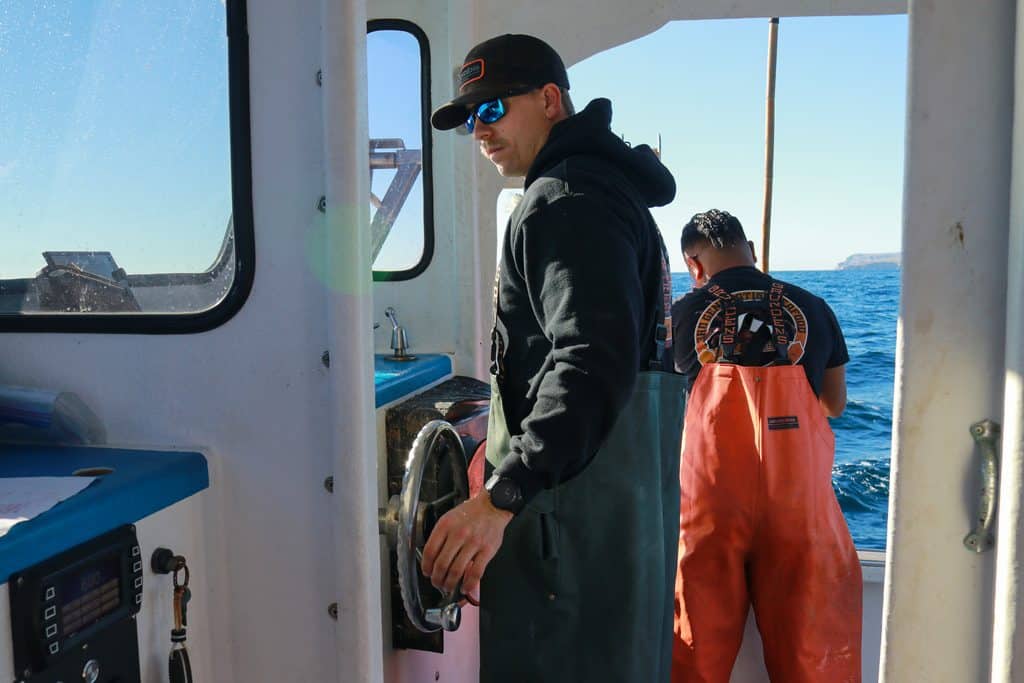
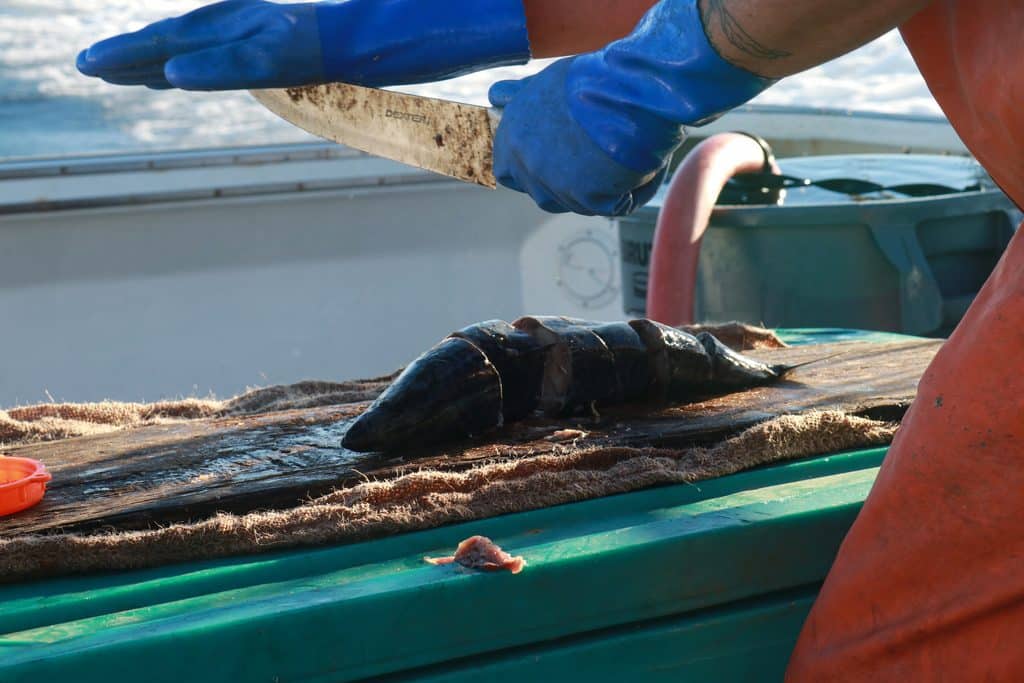
Volaski showed up at 8, after finishing an all-night shift at the fire station, a job that helped support his fishing. He had grown up in a fishing family, and now was building his own operation. Wiry, with a neatly trimmed blonde mustache, he leapt aboard, and, with an air of efficiency, immediately fired up the motor and pulled away from the dock. On the way out to trap sites near California’s Channel Islands, Harrison-Muñoz chopped the mackerel and Barrera loaded chunks of it into small, bright-orange canisters with slits that would allow the crabs to sense the bait but not eat it.
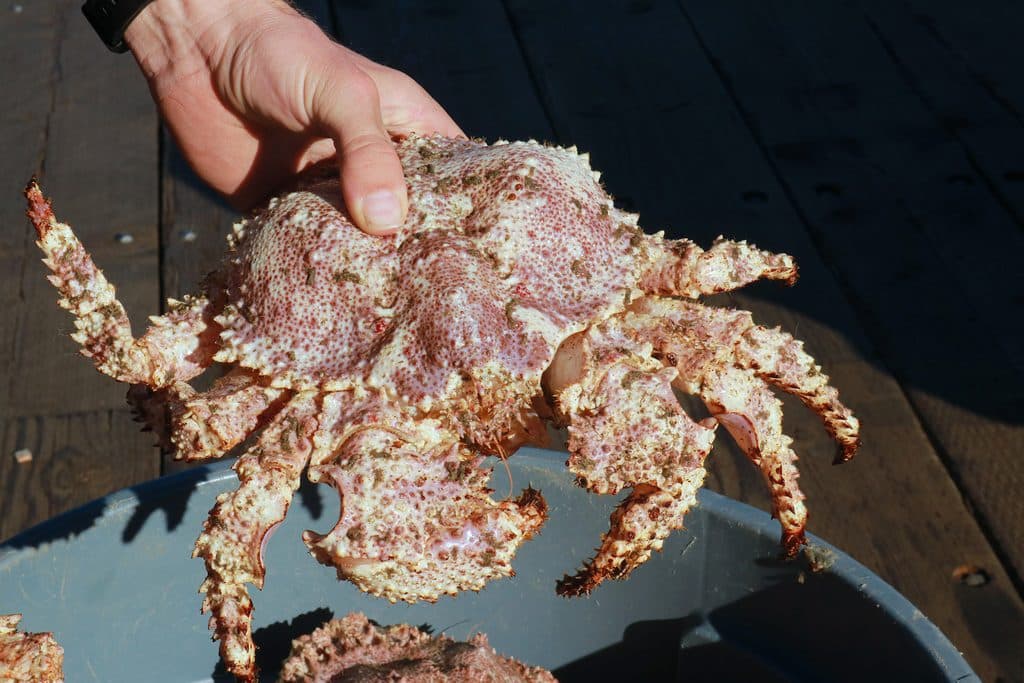
Their target was the brown box crab (Lopholithodes foraminatus), an oddly charismatic crustacean with a spiky, mottled, peachy-pink shell. It looks like a cross between a pine cone and a dish scrubber. When alarmed, instead of snapping its claws at antagonists, the crab tucks its legs tightly against its body, forming the protective, boxy shape for which it is named.
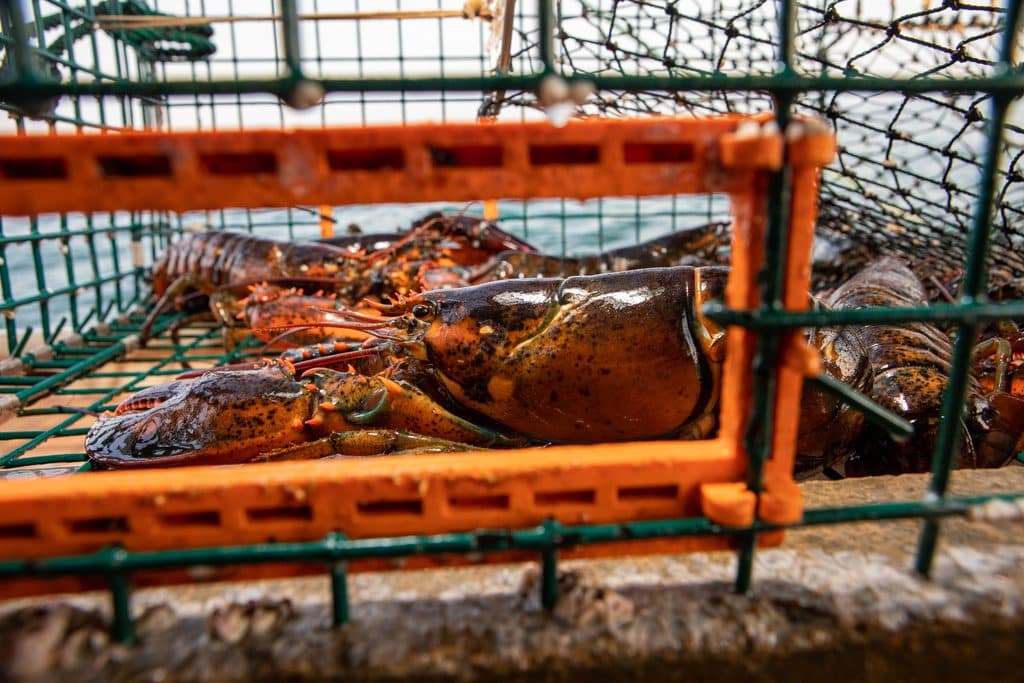
Box crabs aren’t widely known as seafood. Unlike the more popular Dungeness crabs (Metacarcinus magister), which live in the shallows and the intertidal, box crabs can venture 600 meters (nearly 2,000 feet) below the surface—deeper than the tallest Los Angeles skyscraper is high. Partly because they are harder to reach, they have never sustained a commercial fishery long-term. But Volaski is part of a small but growing experiment to change that—and in the process demonstrate that commercial crab and lobster fishers can make a living without endangering whales.
Traditional shellfish operations rely on underwater traps marked with floating buoys. The heavy ropes and lines that attach the buoys to the traps dangle vertically through the water, creating hazards for swimming animals. Once entangled, a whale can swim thousands of miles with fishing lines, nets, or metal tearing into its skin. Entanglement is one of the leading causes of injury and death to whales worldwide. Because of this threat, some fishers have been working with researchers and conservationists to develop an alternative—a technology called “ropeless” or “pop-up gear.” Ropeless gear allows fishers to keep their traps secure on the seafloor—without any vertical lines—until they are ready to retrieve them.
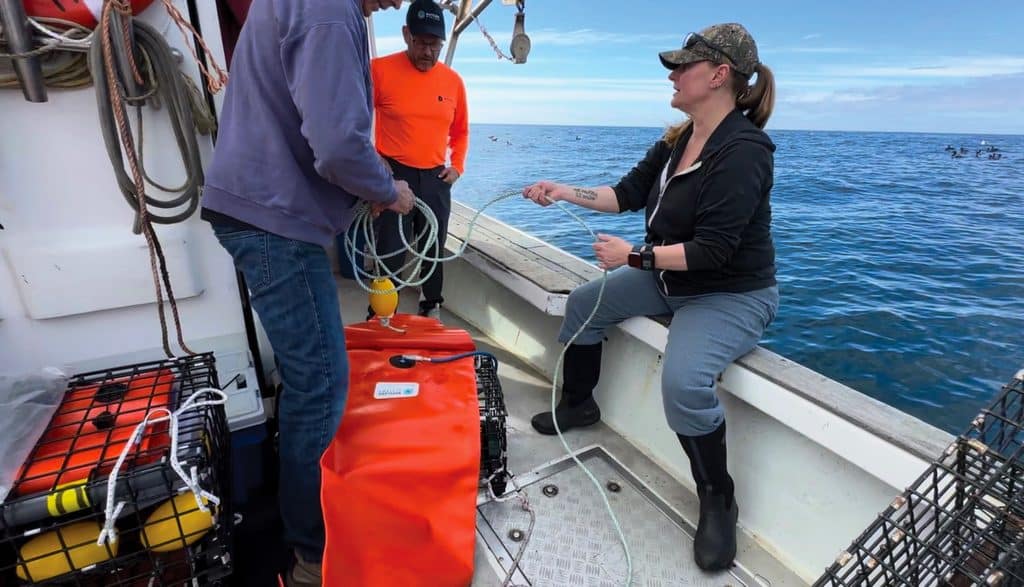
As we approached the first trap site, Volaski showed me how his setup worked. He had chosen gear designed by two West Coast companies, Sub Sea Sonics and Guardian Ropeless Systems, and aimed specifically at affordability: about US $1,500 per unit, a fifth of the cost of higher-end models. In this system, a box called a “sled” sits on the sea floor attached by a long horizontal rope (or line) to a set of crab traps. Volaski used an app on his smartphone to trigger the sled to release an orange buoy about the size of a basketball, which soon popped up at the surface with the line in tow. He then maneuvered the boat until the buoy was at the starboard side, and the crew lifted it from the water with a long pole. They attached the buoy’s line to a pulley system, called a pincher-puller, which began reeling in the sled and the seven traps that trailed behind into the boat. It made a horrific whine. To position the traps at the depths where the crabs live, the crew needed more than 200 meters (over 700 feet) or more of line.
In the beginning, “all that line coming off at once” was scary, said Harrison-Muñoz. “You get tangled up on it, that’s going to take you right overboard.”
By this point, however, the three men had found a rhythm. Harrison-Muñoz had a carefully choreographed method for turning the rope to make sure it stacked neatly back in the sled as it came aboard. He often persuaded the younger Barrera to do much of the heavy lifting, hoisting each trap onto the deck. “Keeps him off his phone,” Harrison-Muñoz joked. The men sorted dozens of crabs, storing some in a plastic bin and tossing back the smaller ones. One of the traps held a box crab nearly 18 centimeters (7 inches) across, the biggest they had ever caught. The crew repeated this process with a second set of traps near Anacapa Island, then sailed another half-hour to the west side of Santa Cruz Island, the largest of the Channel Islands, where they retrieved and reloaded a third set. The whole process consumed about half of the day, even though Volaski had to set aside his original plan to retrieve a fourth and fifth set of traps when the ocean whipped up intense tidal currents. By the end, everyone’s overalls were dripping from the waist down, and we all reeked of mackerel.
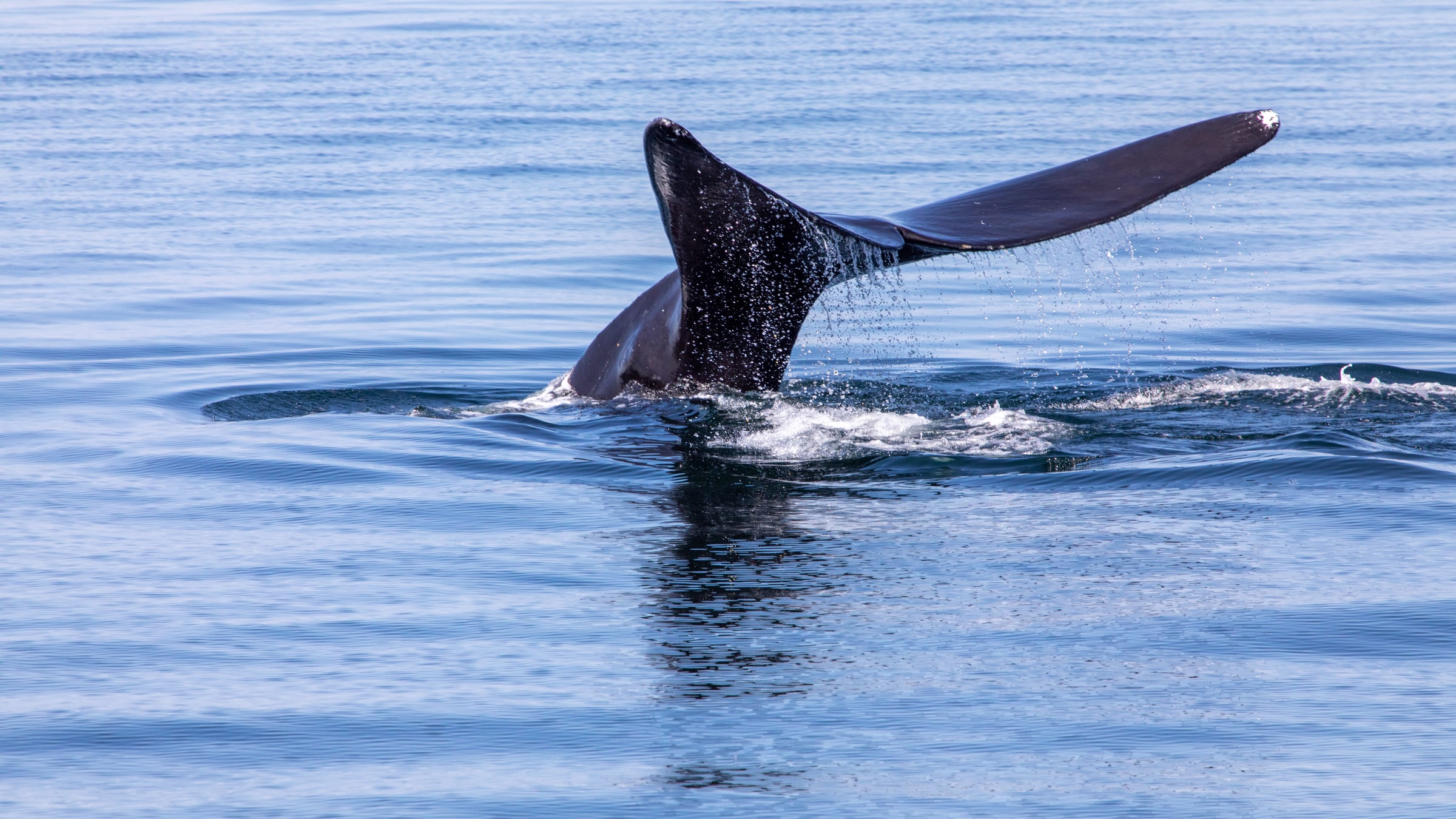
About halfway back to the marina, whitecaps and ripples appeared on the ocean surface. Then dozens of dolphins arced into the air on both sides of the boat. A squabble of gulls hovered above. But Volaski had seen something else. A humpback fluke lifted up a hundred meters or so away, then sank into the water. Then more whales—10 or 15 swimming in the distance. Then closer. He stopped and turned off the engine. Volaski’s pointed finger followed a shape under the water. We heard the low-pitched blast of a whale spout, its back rounding out just a few meters behind the boat, then immediately beside us. It was examining us. We were almost close enough to touch.
Video by Madeline Ostrander
I first learned about Volaski through Kim Sawicki, a marine tech researcher from Connecticut who set up the fishery that gave Volaski his shot at the box crab market. Sawicki had spent the past several years wrangling scientists, regulators, tech manufacturers, and commercial fishers to collaborate on the development and deployment of ropeless gear.
It’s been challenging to get fishers to adopt the gear. The systems can be expensive, even though prices are coming down as the technology evolves. Some fishing industry groups have also claimed the gear is unproven and potentially unsafe and suggested it could eventually put fishers out of business. Sawicki learned how fierce the resistance could be while working on this issue in New England, where the critically endangered North Atlantic right whale (Eubalaena glacialis), which migrates along the Atlantic Coast between Florida and Canada, has been the public face of the whale entanglement crisis for decades. Deaths and injuries from fishing gear and collisions with ships have exacted a heavy toll on the right whale population. In response, federal and state regulatory agencies have taken serious steps, including shutting down some fishing grounds when whales are likely to visit. In some cases, this tactic has a benign effect on fishing, potentially even boosting fish stocks and reducing fishers’ costs. But in others, closures have cut into fishers’ income and threatened to undermine local economies in fishing communities that were already struggling.
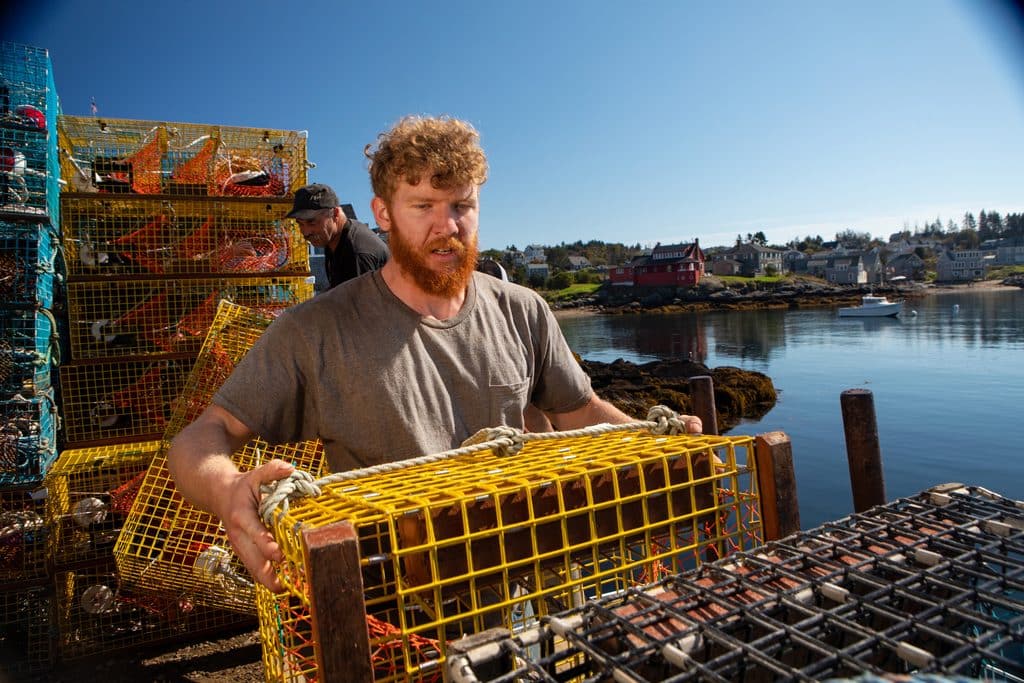
Sawicki said she spent “thousands of hours a year” trying to build acceptance of ropeless technology among New England’s lobster fishers because she was “tired of seeing fishing communities lose access to their livelihoods.” But the lobster industry has long been on edge, resentful of the litany of mandated gear changes, unrelated to ropeless, and other requirements that have been imposed over the years by both state and federal governments. Some fishers refused to participate even in voluntary trials of ropeless gear, fearing that this would lead to more regulation later. Those who did cooperate sometimes risked angering their peers. When a few lobster fishers petitioned the state of Massachusetts to allow ropeless testing in 2022, fellow fishers threatened to burn their boats.
“Nobody in New England was ever going to test the gear with me,” Sawicki said.
So in 2022, when the California Department of Fish and Wildlife asked Sawicki to establish an all-ropeless box crab fishery, she saw it as an opportunity to start fresh, away from the controversies that had roiled the Northeast lobster industry.
Brown box crab had long been considered an “incidental catch” along the West Coast. In California, you could sell it if you accidentally snagged some, but you couldn’t build a business around it. In 2018, the state had permitted a small experimental fishery for brown box crabs off the central and southern coasts, in response to pleas from fishers eager for a new revenue stream. Box crab is prized by chefs for its unusually rich, creamy flavor, and buyers and restaurants were willing to pay premium prices for it.
Then, in 2021, a humpback was found tangled up in box-crab gear, putting both the whale and the upstart fishery in jeopardy. Instead of shutting it down, though, state officials summoned Sawicki. They put her in touch with several fishers who had wanted to try box crab with ropeless gear. She brought six of them to the East Coast in 2023 for training, but they all ultimately backed out of the permitting process, fearing the same kind of retribution some New England gear testers had faced. Frustrated but determined to seize the opportunity, Sawicki asked the state to put the experimental fishery permit in her name, even though this meant she would need to relocate to the West Coast and acquire a boat. When California officials asked what vessel she’d be using, she wrote “to be determined.”
In June 2024, she packed herself and her four dogs into a van, said goodbye to her husband, who would remain at their home in Connecticut, and drove to Oxnard, on the coast north of Los Angeles, where she rented an apartment within walking distance of the harbor. A retiring local fisherman donated a 9.8-meter (32-foot) boat, robust enough for deep-sea work. Sawicki renamed it the To Be Determined.
“I was not near—not in any way, shape, or form—prepared to be a captain,” she told me. But she was committed to proving the gear could work and the fishery could succeed. If “some scientist lady,” as she called herself, could make ropeless box crab fishing successful, maybe the community of fishers would come around.
Photograph by Lauren Owens Lambert
The primary design feature of ropeless gear—the underwater release—has been around for decades, used in oil and gas exploration and oceanographic research. Prototypes of ropeless fishing gear emerged in the 1990s in both the United States and internationally. In 1998, a Rhode Island marine biologist devised the first version for lobstering. Starting in 2010, a California company had some success testing and marketing ropeless gear in Australian fisheries. But the early designs were expensive. Along the crowded U.S. Atlantic Coast, it also wasn’t clear how fishers would avoid accidentally piling their traps onto someone else’s lobster pots when they couldn’t see buoys on the surface—a problem called “gear conflict.” For these reasons, the technology was largely ignored in the U.S. for most of the next 20 years.
By the mid-2010s, though, both whales and the U.S. fishing industry faced a new set of problems. Along the West Coast, the Pacific “Blob”—a mass of unusually warm water driven by climate change—conjured toxic algal blooms in 2015 and 2016 that poisoned shellfish from California to Alaska. This disaster hit the California Dungeness and rock crab fisheries especially hard, shuttering them for months at a time. When crabbing was open, another problem appeared. Krill, normally a reliable food for whales, had also suffered during the heat wave. So humpbacks swam closer to shore—and to fishing operations—looking for sardines instead. Overall, 71 whales (54 of them humpbacks) were found entangled in fishing gear that year along the West Coast, a record number and almost certainly a fraction of the true total.
Around the same time on the East Coast, climate change was rapidly warming the Gulf of Maine, sending many right whales searching for food in Canada’s Gulf of St. Lawrence, where they wandered into the path of more shipping routes and fishing operations. In 2017, when the number of North Atlantic right whale deaths spiked, the National Oceanic and Atmospheric Administration (NOAA) declared an “unusual mortality event”—a legal designation that requires federal scientists to investigate and plan ways to reduce the threat. That designation—and the crisis that precipitated it—continues still, with no end in sight. In total, 43 right whales have died over the past nine years, and 133 have been sickened or injured from a combination of entanglement, collisions with shipping vessels, and other stressors, out of a population of approximately 380 today.
Conservation groups such as the Center for Biological Diversity have sued state and federal agencies involved in fisheries and whale protection along both U.S. coasts. In response, California began shortening the Dungeness crab season, typically by about four months, depending on the results of marine animal surveys. Along the Northeast Atlantic coast, federal officials and the state of Massachusetts have constricted lobster and Jonah crab fishing from specific areas and seasons. These regulations have prompted numerous legal and political challenges from the fishing industry, including an extraordinary intervention four years ago, when the Maine delegation and other Congress members appended a rider to a federal budget bill halting regulations on the Maine lobster industry until 2028.
Meanwhile, a network of fishers, scientists, and entrepreneurs have converged around the promise of ropeless gear: What if this technology could actually save whales and commercial fishers’ livelihoods at the same time? In 2017, Massachusetts lobster fishers Michael Lane, Lori Karon, and Rob Martin reached out to EdgeTech, a company that made oceanographic gear, to see if it would design and market something with input from the fishing community. At the same time, researchers at the Woods Hole Oceanographic Institution (WHOI)—including renowned veterinary scientist Michael Moore—also began working on new designs.
In 2018, Sawicki, then in her early 40s, was pursuing a career change from the paramedical field and emergency management. She had enrolled in a Ph.D. program at the University of Connecticut, where she hoped to study marine animal health, because “humans make terrible patients,” she said. She visited Moore at his office at Woods Hole, seeking his expertise. He drew her a diagram of lobster traps and buoy lines and explained how whales got stuck in them. “This,” he said, “would be a great way you could help.”
“Then I’m just pretty much like a dog with a bone,” Sawicki said. “Once you give me a job or a problem to solve, I just want to stick with it until it’s solved.”
That year, WHOI researchers and other experts held the first Ropeless Consortium in New Bedford, Massachusetts (now an annual gathering of international stakeholders seeking to make the gear more viable). Shortly thereafter, Sawicki helped assemble a collaboration among nine gear manufacturers in the U.S., Australia, and Canada. In 2021, they won a grant from the U.S. Marine Mammal Commission to solve gear conflict, using a GPS mapping system that lets a fisher avoid bumping into someone else’s traps underwater. One abiding concern: Many fishers still viewed ropeless gear as too cumbersome and costly—up to $8,000 for one system, tens of thousands of dollars for a whole boatload of traps. To overcome that barrier, NOAA assembled a gear library on Cape Cod to loan new ropeless designs to fishers willing to try them in locations where fishing was otherwise closed for whale season.
Sawicki soon realized, though, that the biggest obstacle wasn’t tech or money; it was rooted in the fishing communities’ distrust of outside interference and the unintended consequences it can have in their industry. “Finally, I just started walking up to fishermen and asking them to take me fishing, and they did,” she said. She gained credibility this way, along with a sense of the practical constraints. Then she began organizing ropeless trials in locations that felt, to her, less adversarial than New England. In 2019 and 2020, she began leading trials in Scotland, Ireland, and the U.S. Atlantic black sea bass fishery off the southeastern coast (which had, since 2009, been closed during the winter seasons to protect whales). She founded an organization called Sustainable Seas Technology, which became the basis of a full-time effort to promote ropeless. Then she turned her attention to California.
Photograph by Madeline Ostrander
As on the East Coast, a group of conservationists, scientists, fishers, and tech manufacturers had coalesced to solve the entanglement problem. And between 2019 and 2022, nonprofits including the Natural Resources Defense Council, the National Marine Sanctuary Foundation, and other groups partnered with marine tech companies such as Sub Sea Sonics on a set of ropeless demonstrations and gear trials in the California Dungeness crab fishery.
But California fishers were sometimes as skeptical as their New England counterparts. In 2020, fisherman Ben Platt, president of the California Coast Crab Association, co-authored an op-ed in the magazine National Fisherman with Kristan Porter, then-president of the Maine Lobstermen’s Association. They claimed that ropeless advocates and environmentalists were pushing “expensive, impractical, and unworkable new fishing gear, which would force most crab fishermen out of business.” Crabbers also had technical issues to figure out. While New England lobster fishers string multiple traps together on a rope along the seafloor, a method called longlining, West Coast crabbers have typically worked with single traps, a practice written into state regulations. Attaching a ropeless receiver to every single trap “was going to cost hundreds of thousands of dollars,” said Nick Krieger, a San Francisco crab fisher.
So in the late spring of 2023, when crabbing was otherwise closed for whale protection, California allowed two fishers to try New-England-style longlining with ropeless gear. No whales were hurt, and both participants caught crabs. But the trial drew the ire of some in the fishing community. Brand Little, one of the two ropeless-testers, said his tires were slashed and his gear vandalized. “I was the most hated guy on the West Coast, all because of pop-up gear,” he said.
It wasn’t exactly a warm reception. But perspectives seemed to shift in the face of a larger set of challenges confronting the fishing industry. Around the same time as the ropeless trials, the California fishing industry suffered another economic hit. Most Dungeness crabbers use the off-season to focus on other fisheries, such as salmon, black cod, or albacore. But the Chinook salmon population tanked because of drought, algal blooms, wildfires, and other climate-related calamities; and the market for species like black cod, which relies on exports to Asia, has been unstable during both of president Donald Trump’s terms because of tariffs and trade wars.
West Coast fishers needed alternatives, and ropeless gear began to look more appealing. A wide range of models had also become available (including more affordable designs like the one Volaski would eventually use). In 2024, California opened late-spring Dungeness ropeless trials to 19 fishers, some of whom became converts. “We’ve got our life back,” said Steve Melz, who has been fishing Dungeness crab for 40 years. “We’ve got our opportunity back. We’re not sitting at the dock waiting for nothing.”
Perhaps the brown box crab could offer another alternative.
Photograph by SST
Sawicki launched her ropeless box crab endeavor in a location where fishers had previously found success before the 2021 entanglement—California’s Channel Islands, where the Volaski family ran its operations. The waters around the northern islands are protected as a national marine sanctuary, and are frequented by gray, blue, fin, and humpback whales, as well as the world’s largest gathering of blue whales and a small city of dolphins: up to 50,000 animals. The area also supports hundreds of commercial boats seeking sardines, lobsters, rockfish, shrimp, and squid. All of this made it an ideal place to test-drive ropeless gear.
Sawicki needed the operation to be financially viable. The To Be Determined required thousands of dollars of work, including new electronics and coats of teal and white paint. She had raised money for ropeless gear purchases and the costs of running demonstrations. But the boat expenses were her own. To cover them, she would have to sell some crabs.
Her initial crew included a Dungeness crab fisher from Northern California and a transplanted Maine lobster fisher, both of whom wanted to train with the gear—along with Steve, a miniature “Pinscher-Pekingese-Pomeranian mutt” who slept in a bucket on deck. The gear itself performed well. Still, for the first few months, she couldn’t find crabs. Locals heaped advice on her, but the box crab population seemed to have moved with ocean currents, and she kept snagging crabs smaller than the state’s allowable limit. She would toss them back and fume. “I was super angry with myself,” she said.
On one winter outing, she spent long hours tracing the coast of Anacapa Island, searching for better trapping locations. But one of her crew became impatient as dusk approached. In frustration, she chose an arbitrary spot and dropped the traps into the water. When she returned a few days later, her traps were full of mature box crabs. “I was finally in the crab after literally months of driving around the ocean,” she said. “Totally by accident.”
Sawicki went from almost nothing to a regular catch of about 140 kilograms (more than 300 pounds) of crab per trip, which she sold to a restaurant called the Santa Barbara Shellfish Company for $10 per pound, about five times the going price for Dungeness—because of a combination of its rarity and its enthusiastic reception among chefs and foodies. By then it was obvious why the gear was important in this location. Some days the whales were “exploding out of the water everywhere around us,” Sawicki said, “which was super cool because you’re like, hey, we can all be out here together and you guys aren’t going to get hurt.”
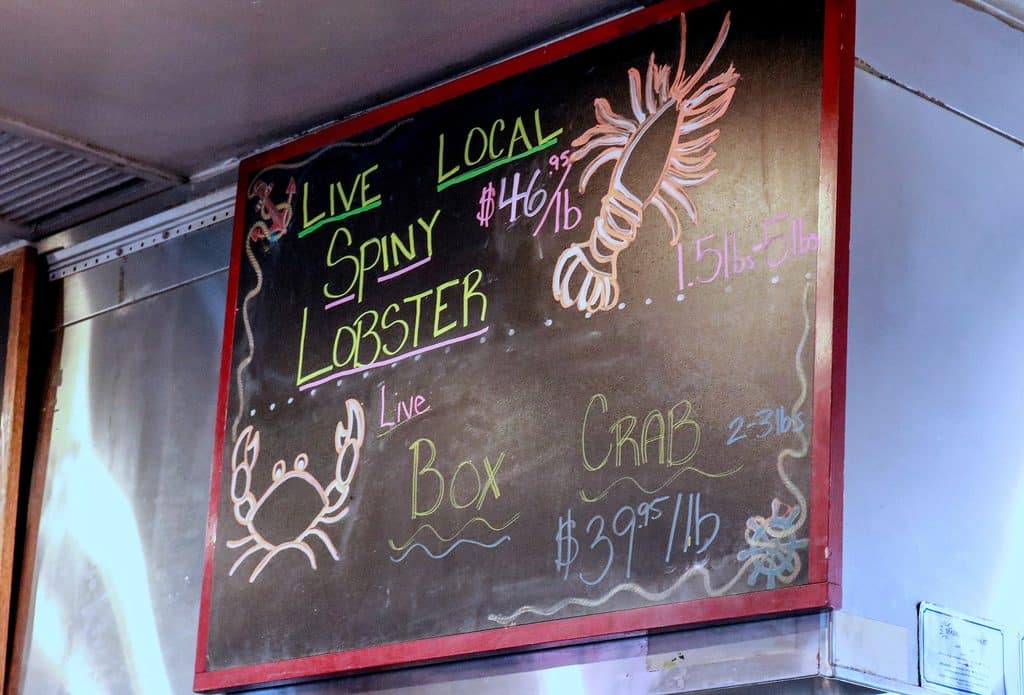
Because the wholesale price of box crab was so high, the fishery was, Sawicki knew, an opening for younger fishers who could only afford to pursue the business part-time. In the summer of 2025, just as he bought the Coastal Reign, Mikey Volaski reached out to Sawicki and asked to train on her boat. Volaski had been focused on spiny lobster, like his father and grandfather, along with a fish called California sheephead. He had also spent a couple of years working for a whale watching company. He wasn’t convinced whales faced a crisis; he said and his family had “never seen a wildlife entanglement in as many years and hours as we’ve had on the water.” But he was intrigued by ropeless technology; his father had tested an older version of the gear, equipped with a timer rather than sonar, in 2021. Volaski saw that the gear gave him a chance to diversify his business. In June, he boarded the To Be Determined and learned how to cue the transponder, release the buoy, and haul in the crabs.
He became one of about 20 new fishers Sawicki trained with ropeless gear and box crabs that year. But the state only allowed five of them to have spots on Sawicki’s permit. Volaski got one, and he and his two deckhands began setting up their own gear and building crab traps. He was hopeful that he could use box crab to help him transition from moonlighting as a firefighter to full-time fishing.
Photograph by Madeline Ostrander
By that December day when I joined Volaski on his boat, he had been fishing box crabs—along with lobster and sheephead—for six months, and the venture was going well. After we watched the whale disappear beneath the waves, Volaski reignited the engine and we motored back to the harbor, where he and his crew loaded the crab into his truck.
I rode with him up the picturesque arc of coastline west of Oxnard to the same restaurant on the historic Santa Barbara pier where Sawicki sold her crab. He weighed out and sold nearly 50 kilograms (108 pounds) of still-wriggling box crab. A few days later I had a chance to return and taste the crab—boiled in its shell, the meat tender and creamy and plated with a generous serving of onion rings. In that moment, I found the idea of the box crab fishery almost irresistible: The fishers could make money and the whales would be protected—and people could enjoy this extraordinary seafood.
But a few months after our trip, Volaski told me that state regulators had removed him from the box crab permit for what he insists were primarily a series of administrative mix-ups, including a problem with the state’s vessel registration system and a record-keeping incident involving traps that he officially reported lost after a storm but that the state later claimed he negligently abandoned.
When I asked the California Department of Fish and Wildlife about Volaski, Eric Kord, marine enforcement district assistant chief, said he could not provide details on a pending case but that the department “takes all fishing violations seriously, and all fishers, including experimental fishing participants, are expected to adhere to state laws and regulations as well as the terms of their permit.” However, other sources, including Jamie O’Neill, a consultant and advocate who works with the fishing industry, suggest that California has a reputation for imposing steeper penalties over minor fishing infractions than other Western states. Volaski had invested around $100,000 in box crab gear; the penalty was going to cost him months of income, and he could no longer provide reliable work for his crew. He also was forced to put the Coastal Reign up for sale. Still, he vowed to fight for reinstatement. “I really believe in ropeless gear,” he said. “Now the rug just got pulled out from under me.”
In the larger world of ropeless fishing, distrust keeps muddying the waters, getting in the way of the kind of collaboration required for this effort to succeed. Across the United States, I have heard repeated complaints that when fisheries enforcement becomes too heavy-handed, it’s difficult to convince fishers to support gear trials.
At the same time, such efforts can’t succeed without the backing of federal and state fisheries programs. In the Northeast, approximately 85 fishing vessels have participated in ropeless trials led by NOAA’s Northeast Fisheries Science Center, with about 65 enrolled in 2026. About 30 more are enrolled in a state gear-testing program in Maine. This is still a small fraction of the thousands of permitted lobster vessels operating in the region with conventional gear.
Last spring, a University of Maine study found that consumers would willingly pay a premium for lobster caught with ropeless gear. But the Trump administration is actively dismantling or thwarting programs that support the gear and marine mammal conservation efforts overall. A recent letter from a Trump appointee at NOAA instructs the New England Fishery Management Council, which oversees regional fisheries planning, to “deprioritize” requirements for ropeless gear. More ominously, in September, the administration announced that it would weaken the fundamental legal definition of “harm” to an endangered species, a move that threatens to derail every effort to protect species at risk across the United States.
But at least at the state and international level, it’s possible that the efforts made to solve whale entanglement have enough momentum now to outlast this kind of political and legal unraveling.
Beginning in April 2026, California successfully opened late-spring Dungeness season as all-ropeless, accessible to anyone willing to adopt the new gear. About 30 fishers participated. While their opinions about it remain mixed, many fishers I spoke with seemed to like using the gear—both to protect whales and to prevent gear theft, especially in heavily trafficked waterways. The state of Oregon also plans to test ropeless in 2027, and the Canadian government has announced new investments in whale-safe gear research.
Interest in the box crab fishery is growing, too. In February, California expanded the permit to allow 20 operations to participate, and Sawicki has a long waiting list of fishers eager to join. In April, in San Francisco Bay, she hosted a three-day gear training with 70-some participants on a boat belonging to Brand Little, whose gear had been vandalized two years before by ropeless opponents. This time, the conversation focused more on new opportunities and less on fear. Steve Melz, a seasoned Dungeness fisher who uses ropeless gear, helped lead the training and has also joined the box crab permit.
Melz plans to search for the crabs around the Farallon Islands, off the coast of San Francisco, during the winter months when he used to fish Dungeness. “We’re just moving forward. We’re trying to see where this all fits,” he said. “And, you know, we’re looking forward to just fine-tuning it, fine-tuning the fishery.”
Photograph by Lauren Owens Lambert and taken under the Center for Coastal Studies / NOAA permit 25740-02
Hi, I’m Dave, the executive director of bioGraphic. (And that’s my dog, Finn.) Thanks for taking the time to read this story.
Stories like this simply don’t get produced without financial support from readers like you. bioGraphic is not backed by a private company or owned by a billionaire. It’s an independent, nonprofit magazine. And one-quarter of our annual budget comes directly from reader donations.
We need your support more than ever, as governments slash funding for conservation and scientific research, placing even more ecosystems and wildlife at risk around the world. At bioGraphic, we’re steadfastly shining a light on the threats to our planet’s incredible biodiversity. And we’re showcasing the hard work of people bravely taking action to protect at-risk species.
bioGraphic publishes environmental reporting that you can’t find anywhere else: deeply researched, trustworthy stories that are also beautiful and captivating to read. We offer an antidote to reader apathy and doom-and-gloom news by revealing the wonders of the natural world and focusing on real solutions to big problems. When you finish a bioGraphic story, we want to leave you feeling informed, delighted, and inspired.
We don’t run ads or hide our stories behind a paywall. The readers who generously support bioGraphic allow our work to remain free for everyone.
Will you help us keep telling these crucial stories?

Author

Related Articles
Trial by Fire
In the burn-scarred mountains of Southern California, a team of biologists fights to help an imperiled frog.
Ethiopia’s Grand Tree-Planting Plan
Efforts to restore lost forests often fail, but Ethiopians are betting big: planting billions of saplings to revive habitat, regenerate soil, and stabilize the land.
The Trouble with Tamarisk
Twenty-five years ago, land managers unleashed a beetle to control an invasive tree sucking rivers dry. But water levels haven’t risen—and the real villains are still causing trouble.