
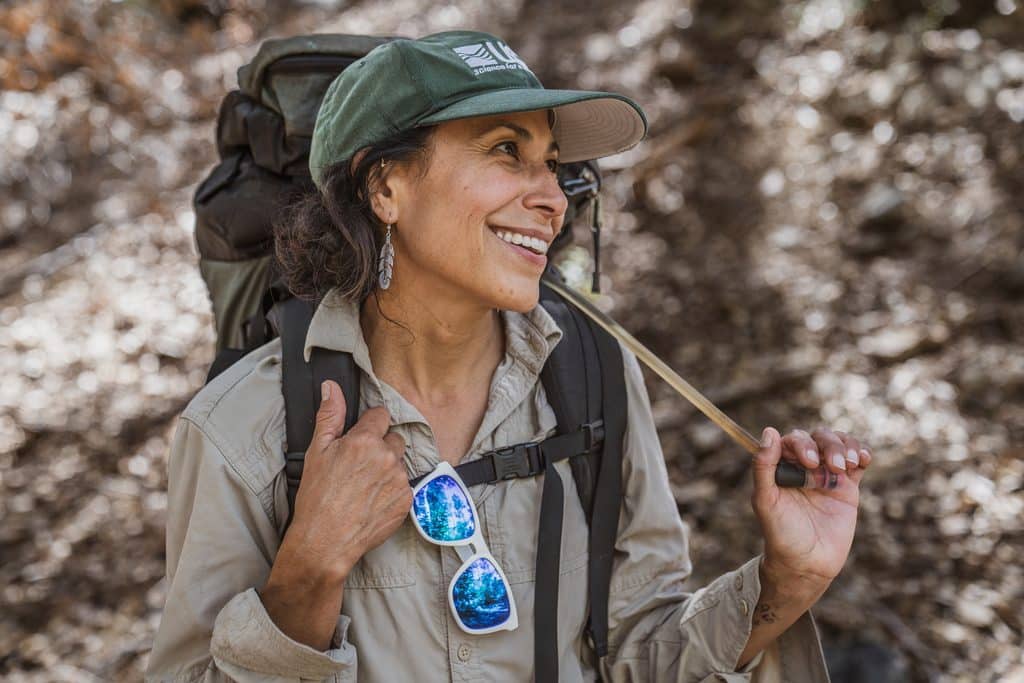
Biologist Elizabeth Gallegos stops beneath the scant shade of a blackened pine tree and checks a temperature gauge on her teammate’s pack. The pack doesn’t look like much—large and dark blue, with yellow straps—but the insulation it offers is the difference between life and death for what’s inside.
It’s August in California, just past 10 a.m. in the San Gabriel Mountains outside Los Angeles, and already the sun feels relentless. Temperatures have soared past 32 degrees Celsius (90 degrees Fahrenheit) every day this week. Gallegos’s fellow biologist Adam Backlin, four field crew, and a gaggle of representatives from state and federal wildlife agencies stand in an overcooked riverbed. The winding valley of red sand and cobble is flanked by skeletons of scorched trees and remnant pockets of sage, yucca, and fragrant manzanita that climb the mountains on all sides. Almost three years earlier, the Bobcat Fire, a “megafire” that burned roughly 47,000 hectares (116,000 acres), raged through this area and became the second-largest fire recorded in Los Angeles County. Roughly 1.7 million hectares (4.3 million acres) burned across the state that year, marking 2020 as the biggest wildfire season in California history.
The thermometer measuring the conditions inside the pack reads below 21 degrees Celsius (70 degrees Fahrenheit). That’s good. Anything above 23 would spell trouble. Within this pack and two others carried by the crew are some of the rarest amphibians on Earth—dozens of endangered mountain yellow-legged frogs (Rana mucosa). Raised in captivity and now floating in the embryonic darkness of plastic containers, this precious cargo will give the wild population of mountain yellow-legged frogs a major boost in number.
Gallegos, a lead scientist working on mountain yellow-legged frog conservation for the U.S. Geological Survey (USGS), takes a quick sip of water, and the team resumes its high-speed bushwhack up the canyon. Packs are cool at the moment, but the crew must still cover 6.5 trail-less kilometers (4 miles), gaining significant elevation over several hours before they reach the site where they will release these frogs into a series of crystalline blue pools staggered below a waterfall.
Photograph by Morgan Heim
Mountain yellow-legged frogs, affectionately called MYLFs, favor the cold, unlike most amphibians. You’re not going to find this species in swampy jungles. As the name suggests, this frog likes mountains, living in bodies of water at altitudes from 300 to 3,700 meters (985 to 12,000 feet). For much of the year, a mountain yellow-legged frog hibernates at the bottom of streams or in rock crevices beneath deep snowbanks. “Even though it’s a frog, and people don’t give it a lot of credit, it is the apex stream predator for the Southern California mountains,” says Backlin, also a USGS biologist working on MYLF conservation. MYLFs are the bosses of their small stretches of stream. “They know the little pond they’re in and kind of own it.”
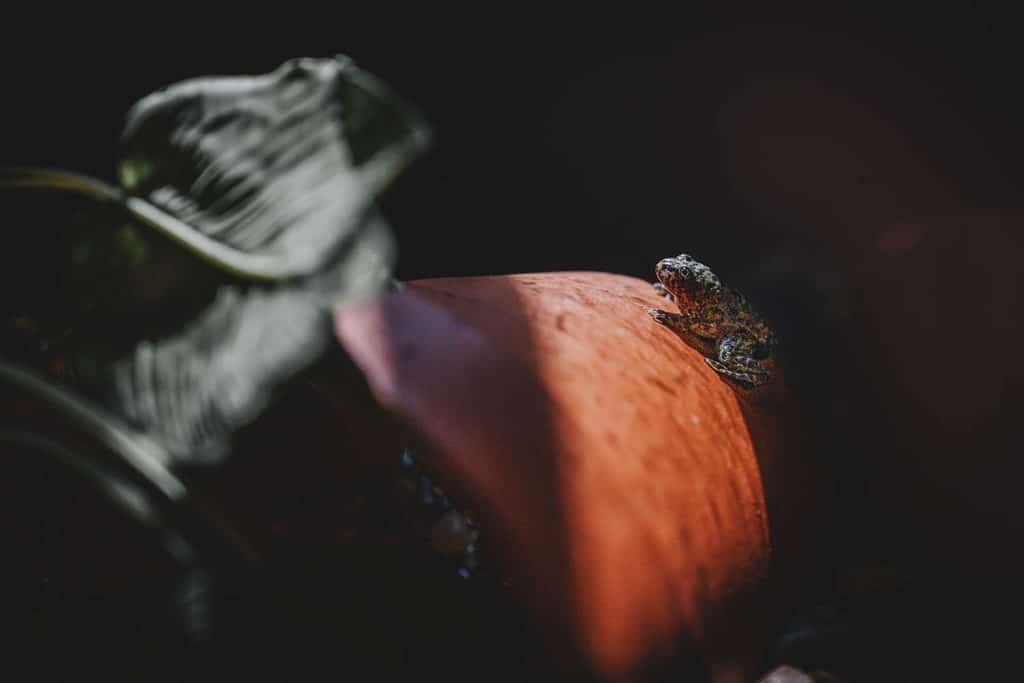
When people think of frogs, they often visualize colorful poison dart frogs or red-eyed tree frogs. MYLFs toss those expectations out the window. “They’re probably the least sexy amphibian that we work with,” says Ian Recchio, former curator of amphibians, reptiles, and fish at the Los Angeles Zoo and Botanical Gardens, or L.A. Zoo for short. “I mean, there’s kind of a hint of yellow on them. They’re pretty bland. They’re not the most agile,” he adds, “Their personalities are pretty dull.”
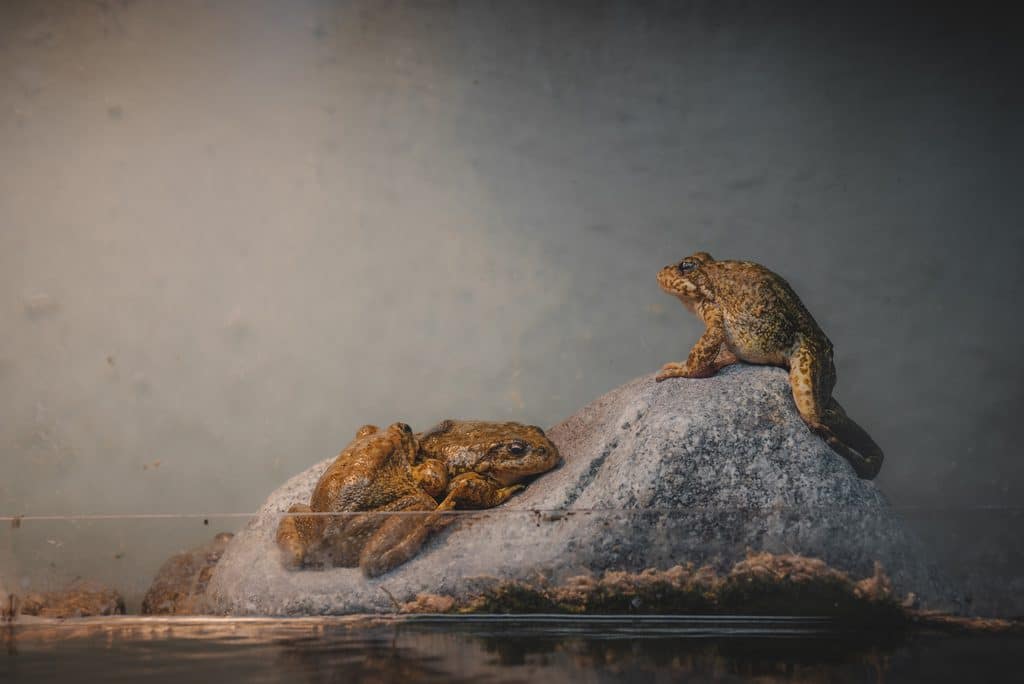
Still, Recchio talks about the frogs with the exuberance of a kid describing his favorite baseball player. Perhaps because the same characteristics that make MYLFs seem dull in captivity—their bland appearance, sedentary nature, and unflappable calm—are key to their success in the wild.
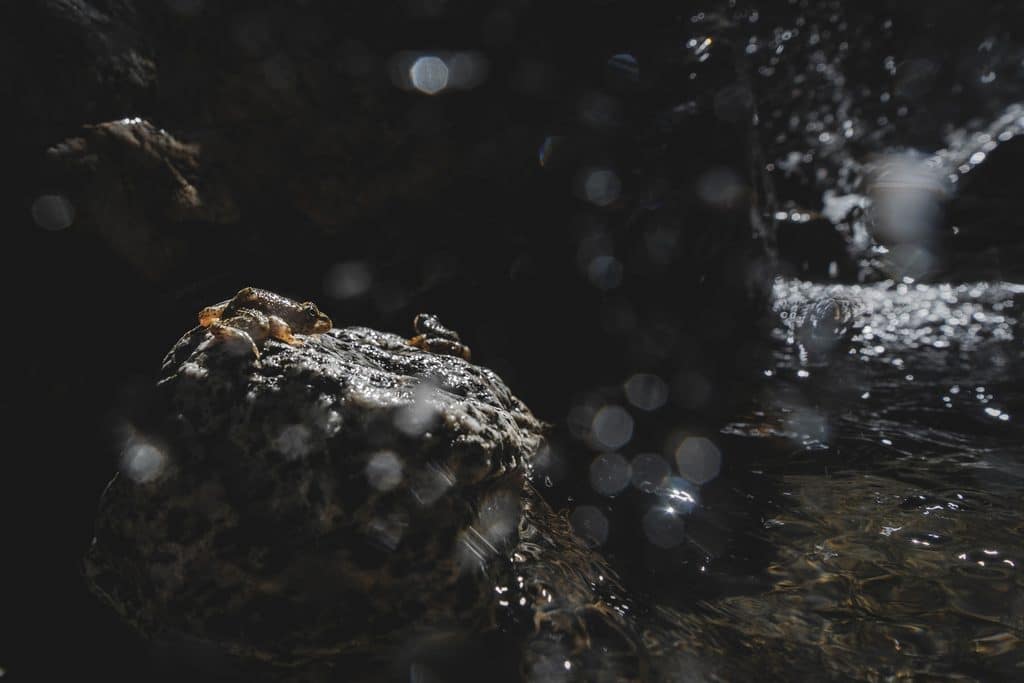
What they lack in color, MYLFs make up for in camouflage, with a speckled pattern and slight yellowing that mimics the algae-coated granite surfaces they frequent in the wild. Adults max out at about the size of a lemon, and you can stare at one for long stretches and not realize you’re looking at a frog until it snatches a passing mosquito. MYLFs also practice patience that could put a Zen master to the test. Backlin describes one impressively sedentary frog. “I probably saw it for 10 years in a row at the same pool at the same site,” he says. A decade in one place might sound long for a frog, but MYLFs can live more than 20 years.
Though the species is known for its supreme ability to do nothing, it can put even rock climbers the likes of Alex Honnold to the test. Backlin once watched as a frog free-soloed a rock wall alongside a raging waterfall maybe 15 meters high (50 feet), slick with moss and algae. “This frog had no problem with water pounding on its head,” Backlin says.
Despite the MYLFs’ impressive staying power, the species now faces an onslaught of pressures that threaten its survival. Mountain yellow-legged frogs used to be common. “They were considered a generalist species,” says Gallegos. But starting in the 1960s, habitat loss, human recreation, non-native species such as trout introduced for fly-fishing, and a fungus called chytrid have virtually wiped the species out. Chytrid, which has decimated amphibian populations throughout the world, attacks the skin, which the animals use to breathe and take up water. In 2002, the U.S. Fish and Wildlife Service (USFWS) listed the MYLF as endangered in the southern part of its range, which includes the San Gabriels, and added northern populations to the list in 2013. Today, somewhere between 100 to 200 adult southern mountain yellow-legged frogs exist in just a handful of locations across the San Gabriel, San Bernardino, and San Jacinto Mountains—and nowhere else. The population is “so low that they could disappear in a single year,” says Backlin.
Fearing the frog’s extinction, wildlife officials in 2006 embarked on an ambitious rescue mission. USGS, along with USFWS, the U.S. Forest Service, the California Department of Fish and Wildlife, and the San Diego Zoo Wildlife Alliance launched a captive breeding program. Other zoos and aquariums, including the L.A. Zoo, joined the effort soon after.
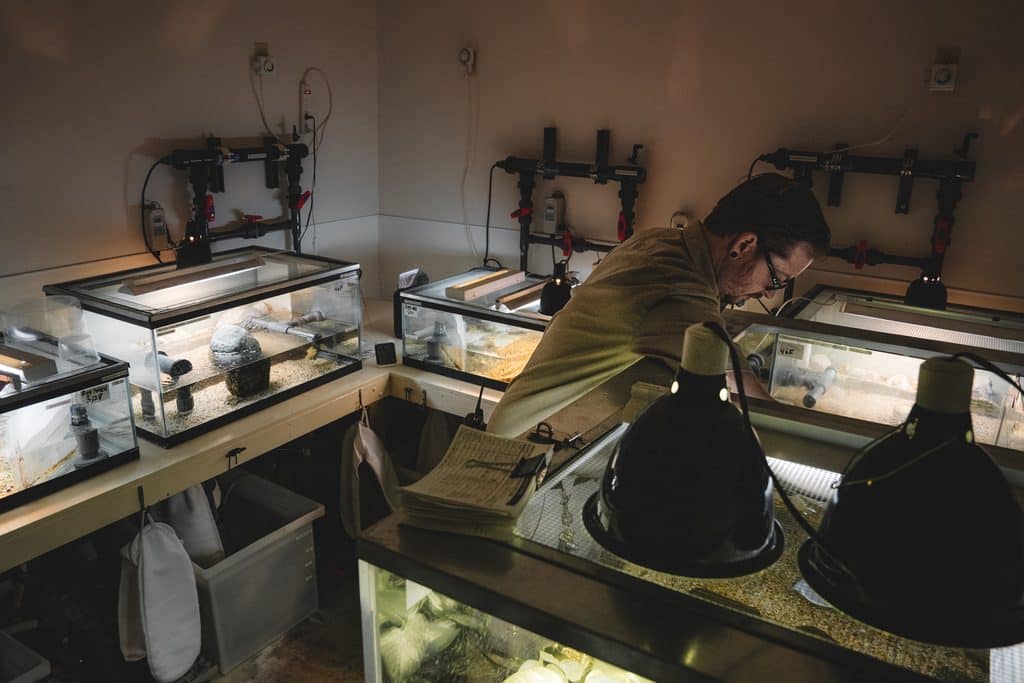
There was no roadmap for how to raise a MYLF. Teams rescued 84 tadpoles from a stream and brought them to the San Diego Zoo Institute for Conservation Research. There, biologists managed to raise several to sexual maturity. Of the 100 or so eggs those captive frogs produced, several tadpoles hatched—the program’s first success. But to recover the species, the partners needed to raise many more frogs, much more quickly.
Experts had gleaned clues from captive-breeding programs for other frog species, but they had to deal with variables those programs did not, like replicating the cold air and water mountain yellow-legged frogs require, and facilitating long periods of hibernation beneath snow. The magic combo came from efforts to breed very different animals: montane vipers, including Armenian vipers (Montivipera raddei) and European nose-horned vipers (Vipera ammodytes), a specialty of the L.A. Zoo. Like mountain yellow-legged frogs, the vipers also hibernate in winter and require finely tuned environmental conditions to signal when to rest and when to mate. “Those species require very similar husbandry and reproductive strategies in captivity,” says Recchio.
Using their knowledge of vipers, the L.A. Zoo’s experts created biosecure, temperature-controlled breeding rooms for the frogs. From there, they tweaked temperatures, water chemistry, and diet until they figured out exactly what the frogs need to thrive in captivity, including algae cultures supplemented with protein for the tadpoles.
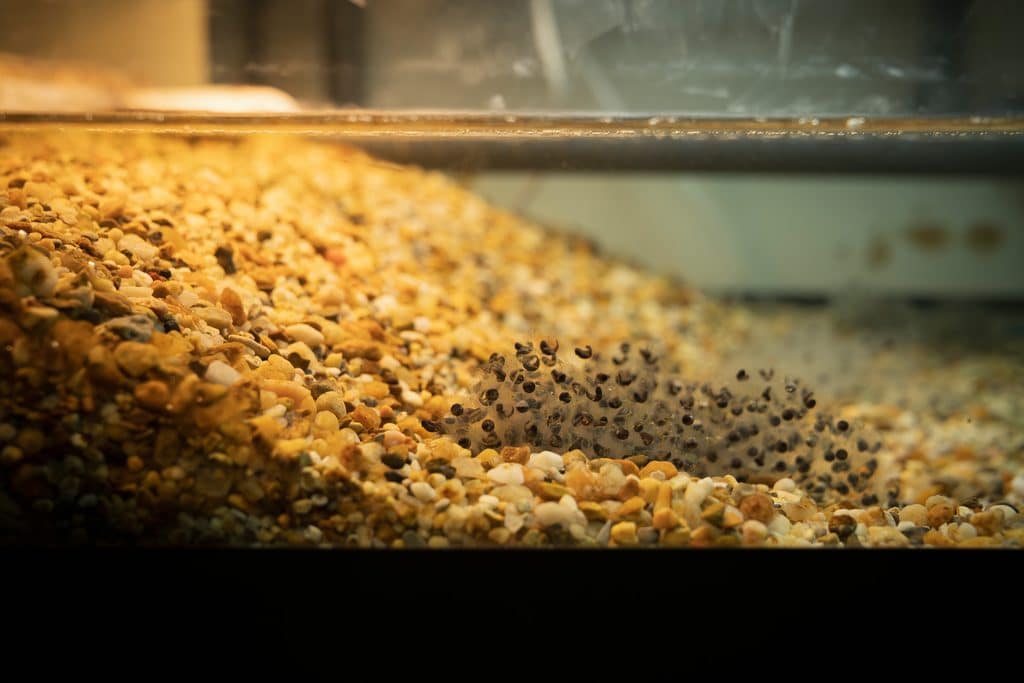
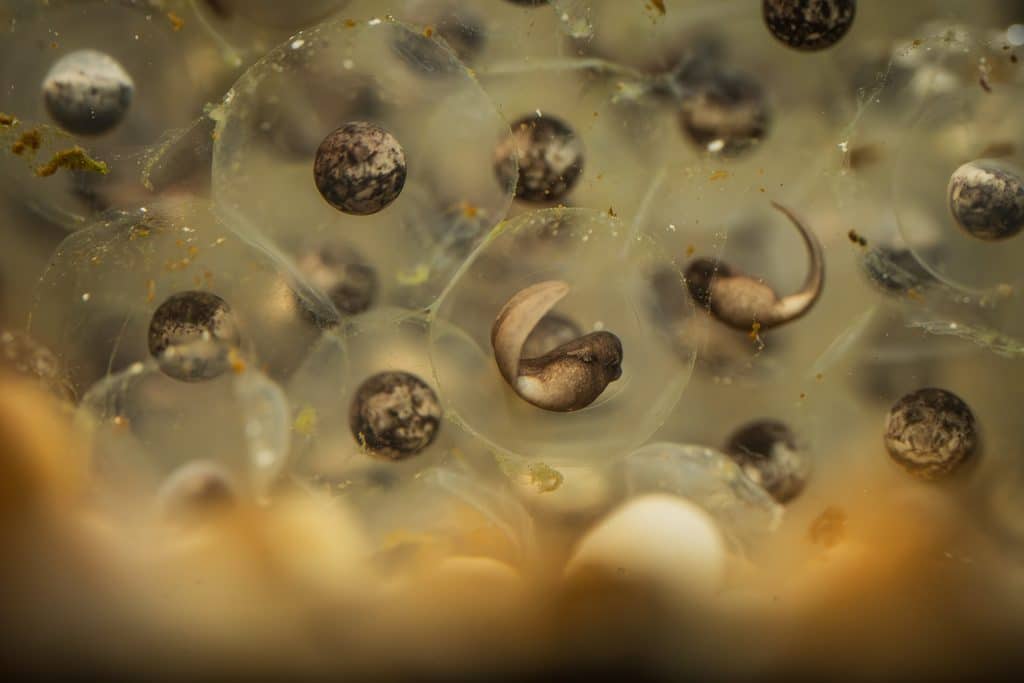
Soon, MYLFs started hatching by the thousands. Other zoos joined the effort, shouldering various phases of the captive-breeding-to-reintroduction chain. Since the first successful captive breeding results in 2010, the collaborators have released around 7,650 MYLFs into approved sites in the mountains surrounding Los Angeles, sometimes augmenting existing populations and occasionally seeding new ones. Only a tiny fraction of the released frogs make it to adulthood, however. Of those, even fewer thrive.
To complement captive breeding and reintroduction, teams monitor wild populations and study their behavioral and genetic diversity, working to restore habitat and minimize the spread of disease. In recent years, though, another threat to the frogs has emerged—a symptom of both the changing climate and the damaging land management practices of the past. It’s something that’s left an increasingly catastrophic footprint on habitats across California: fire.
Wildfire is important for ecosystems, but in today’s hotter, drier climate, after decades of fire suppression, wildfires have increased in frequency, size, and severity. All too often, they explode into megafires that burn hundreds of thousands of acres in a single season.
While California’s wild animals evolved alongside fire, this increasing size and severity has made it more challenging for them to adjust. “There are all these behavioral adaptations that wildlife have made to use this burned landscape in good ways,” says Craig Thompson, a wildlife ecologist with the Conservation Biology Institute in Corvallis, Oregon. Raptors and foxes, for instance, are drawn by sight or smell toward the smoke to hunt prey escaping the flames. Deer return to recently burned areas to eat charcoal and rid their bodies of toxins and parasites, and burnt forests can recover as open meadows that provide deer with good forage.
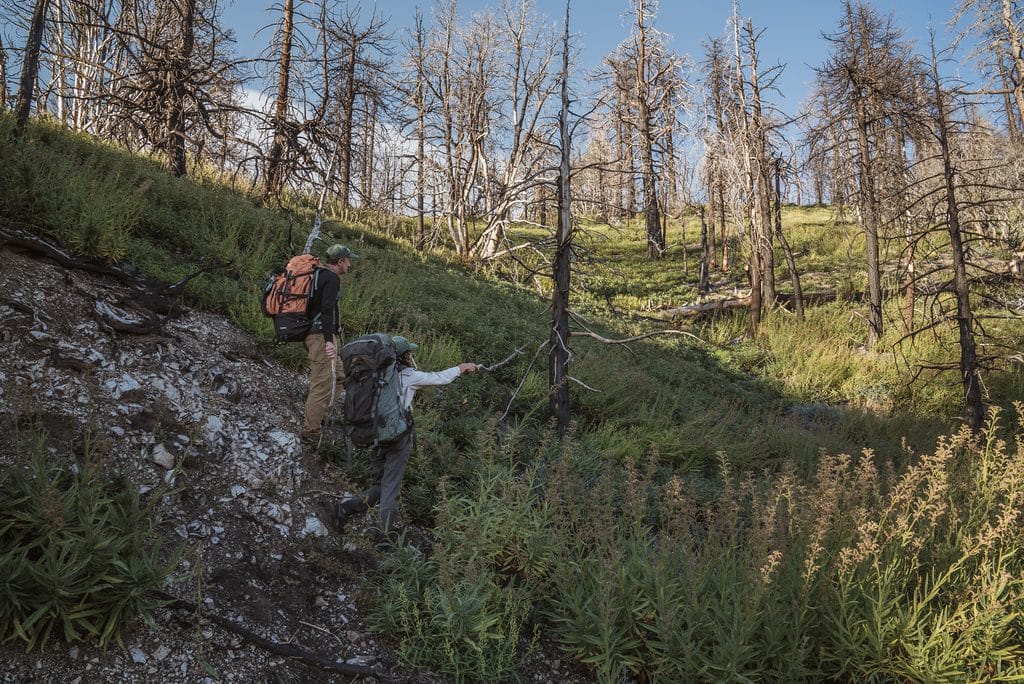
But such broad swaths of charred landscape often pose additional risks to wild creatures: When deer return to burned areas too early, they can starve because there’s no food yet, Thompson says. Severe fires can also sterilize soil so that little new growth appears, with a whole cascade of effects through the food chain. Repeated severe burns transition forests into grass and scrubland, depriving forest-adapted species, like mountain lions and bumblebees, of critical habitat. Larger and faster-moving fires may also be outpacing animals’ ability to outrun the flames—a problem exacerbated by habitat fragmentation caused by roads and housing developments, which makes escape paths more dangerous.
With so much changing, there’s a lot that scientists don’t yet know about how fires, especially megafires, affect wildlife at a population level. For the mountain yellow-legged frog, the Bobcat Fire gave scientists a chance to learn more.
The blaze broke out on September 6, 2020, when trees that the electric utility Southern California Edison had allegedly failed to trim came into contact with power lines. A heat wave had driven temperatures above 38 degrees Celsius (100 degrees Fahrenheit) for several days, and the vegetation was primed to ignite. Over the next two months, the fire burned through the Angeles National Forest and the San Gabriel range. Little Rock Creek, the site of the largest population of MYLFs left in the wild, sat directly in the fire’s path.
People who had worked on saving the frogs for decades watched in horror as the red on the map inched closer to the frogs. “‘Oh, no, it’s into this canyon now,’” Jennifer Pareti, an environmental scientist with the state wildlife department, remembers thinking. “‘Oh, no, it’s gotten over that ridgeline. Now, it’s into this canyon.’ We held our breath watching it creep toward Little Rock Creek.”
Soon, the Bobcat Fire had burned over the frog’s most important stronghold. Not knowing if they’d just witnessed the end of their life’s work, MYLF experts immediately went into rescue mode.
[break]
Photograph by Maddy Rifka
If you were a mountain yellow-legged frog, your experience of a megafire might go something like this: You’re chilling pondside when the smoke starts rolling in. Then the heat hits. Flakes of strange material float around, burning and covering your skin, making it hard to breathe. You leap from your perch down into the deepest, coolest underwater crevice that you can find, and practice your supreme powers of doing nothing.
Congratulations. You’ve made it past the flames. But if you’re a frog, it’s not the fire that kills. Now comes the real danger. You might be fine, sometimes for months after a fire. Your stream has sheltered you and washed the ash from your skin. You, the frog, are breathing easy again.
Until the rains come. A shadow passes above. Drops slap the granite wall where you cling, increasing in intensity, a torrent hammering your body. Once again, you head for the safety of the pool. But this time, the water will not save you. The fire has cleared the hillsides of plants and withered the plants’ roots, “like a moonscape,” says Backlin. The rain becomes a flood, and soil—freed from the vegetation that held it in place—sluices off the barren hillsides. Silt, chemicals—such as those used in pesticide spraying or fire retardant—and debris rage through the system, turning rivers and creeks into poisonous blenders. “If there’s tadpoles or frogs in there, they just get obliterated,” says Backlin.
Today, there is less and less MYLF habitat unaffected by fire. “So much of the range of the frog, unfortunately, has burned,” says USFWS biologist Jesse Bennett. Back in 2003, for example, fires and floods devastated City Creek, which housed the last known wild mountain yellow-legged frogs in the San Bernardino Mountains. Teams from the U.S. Forest Service and USGS managed to save 11 adult frogs from the creek and transport them to the L.A. Zoo.
After the Bobcat Fire, scientists overseeing the frog’s survival once again rallied to organize a rescue, determined not to lose a crucial MYLF population. Even as the ground still smoldered, Gallegos, Backlin, and their team set out on an emergency mission to collect the remaining frogs to keep them safe from the flooding that would inevitably follow the conflagration. Zoos stood ready to provide shelter.
Hiking into the former MYLF heartland, Backlin and Gallegos didn’t know what they’d find. Trees simmered and glowed as the team passed through blackened ravines, shimmied through crevices, and climbed down remnants of waterfalls. “It’s very unsettling when you first get to the site, and you just see the devastation,” says Gallegos.
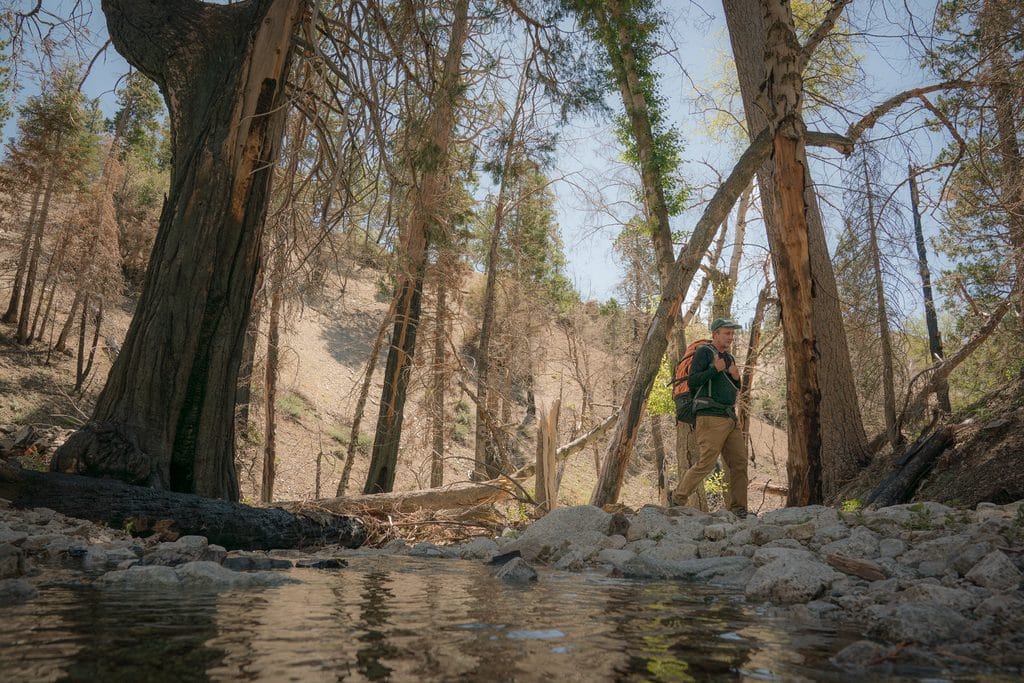
As they approached the boulder-strewn, granite corridor framing the frog’s stream, though, a miracle met them. A frog leaped from a rock. The scientists spotted another, then another. Backlin, Gallegos, and the field crew got to work. Their method involved sitting in one spot and waiting for tadpoles to trickle out from their hiding spots in the pools. They’d scoop one up and wait. Then, sure enough, another would appear. “It’s very interesting that that pattern just keeps going. It’s almost like there’s an unlimited number of tadpoles, and they just keep coming, and you slowly keep grabbing them,” says Backlin.
They had permits to collect 15 adults and 200 tadpoles in total. After more than 12 hours of searching, they’d met their tadpole quota, gathered from multiple sites along the stream to ensure genetic diversity, and had captured 14 adults. Some were destined for immediate translocation to approved habitat in unburned areas. The rest would join frogs in various zoos throughout the counties of Los Angeles and San Diego.
Photograph by Morgan Heim
At the L.A. Zoo, somewhere past the flamboyance of flamingos, sits a small brown hut that scientists call the Frog Shack. Inside, amid the hum of aquarium pumps, four tanks sit on countertops. One contains about 20 young adults. Others house anywhere between six and 10 breeding-aged MYLFs. It’s spring. The frogs have one thing on their mind—and it isn’t food.
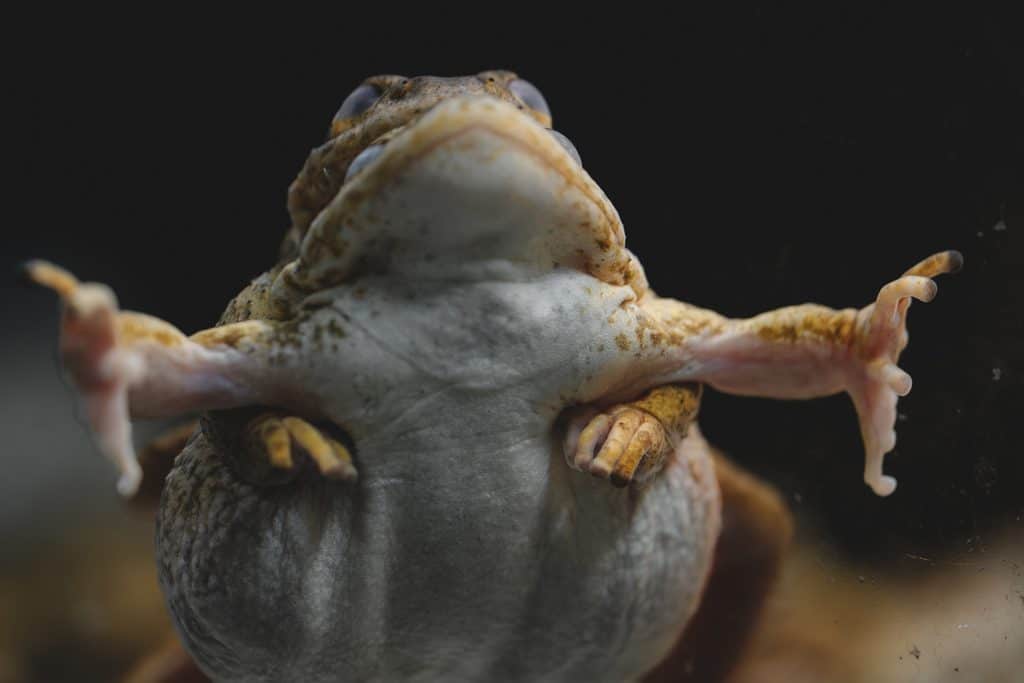
An adult male clings tenaciously to a female, snug against her back with his arms clamped under her armpits—a state called amplexus. Until she’s ready to release eggs, which could happen more than a week from now, he’s along for the ride. He must fend off other would-be suitors without letting go.
The female looks decidedly uncomfortable—bloated, as if she ate an entire pizza and drank a few too many beers. But in this evolutionary dance lies the hope for the future of the species. The male will fertilize her eggs as she releases them. The hundreds of young that hatch from that pairing will live as tadpoles in their tank until they are mature enough to join tanks containing other offspring, including frogs rescued from the Bobcat Fire. Capacity is limited, so some will stay at the L.A. Zoo while others will be transferred to partner facilities. They will sometimes spend years maturing in their halfway homes. In some cases, those mature frogs will breed in captivity; in others, they’ll be released back into the wild.
The zoos and the land and wildlife agencies work remarkably well together, but reintroduction can be surprisingly challenging. Agencies navigate complex ecological, logistical, and regulatory concerns to ensure that their plans factor in both conservation goals and public interests.
Securing new sites for MYLFs can be especially problematic, says Bennett. If, for example, former frog habitat lies in a popular recreational fishing spot, partners focused on conserving the amphibians can find themselves at odds with fishing advocates. That’s because trout prey on tadpoles. For a frog reintroduction effort to have a better chance of succeeding, scientists must sometimes first eradicate the introduced trout.
The process of reintroduction can prove slow especially in sites where historical MYLF populations have been wiped out completely. “We need fewer restrictions on where we can put them back,” says the L.A. Zoo’s Recchio. “We need more access to certain parts of the mountains.”
On top of these factors, many reintroduction sites are incredibly remote and hard for field crews to reach without expensive tools like helicopters. Add in increasing natural disasters, such as fires, droughts, and windstorms, a limited and underfunded workforce, and it becomes clear why restoration of frogs in even a single location can take decades.
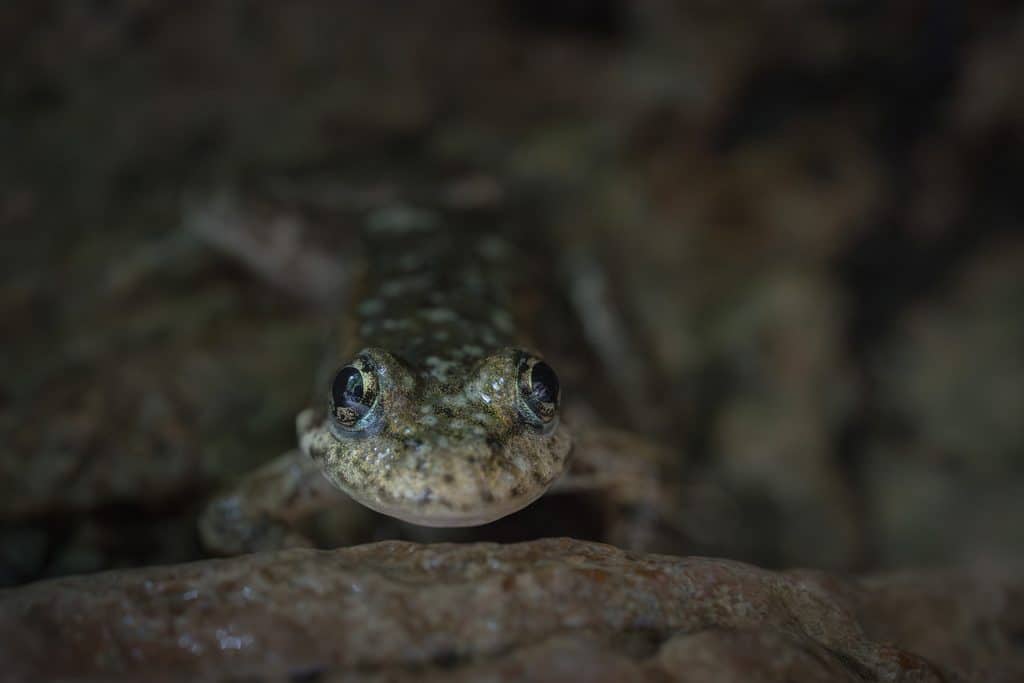
There is, however, one benefit from the increasing frequency of severe wildfire in MYLF habitat: It increases urgency to the point that agencies can overcome those logistical challenges. That proved to be the case after the Bobcat Fire. The rescue mission was quick and targeted, and was a resounding success. The population at Little Rock Creek survived. Rescued adult frogs thrived at the zoos that had become their halfway houses. Rescued tadpoles grew into their awkward “preteen” stage—sporting a tail and legs and swimming in a style likened to having two left feet—and then grew again until they were nearly big enough for release.
In 2023, three years after the rescue mission for the Bobcat Fire started, the team was ready to reintroduce a mix of rescued and captive-bred frogs to Little Rock Creek. Timing was tricky because the team wanted to release frogs when they hit what Backlin calls “the Goldilocks zone”—not too young and not too old. Too young, explains Backlin, and tadpoles are difficult to monitor in the wild. Full-grown frogs, meanwhile, like to wander off, searching for territory, making their survival equally hard to track. “They seem to just leave the creek and go in a specific direction and keep going,” says Backlin.
Young adults, however—carbon copies of adults, but less than half the size—seem happy to hang tight. In August of that year, the team set a date to release a whole batch. Just days before the crew was to head into the field, though, nature threw another curveball. Tropical Storm Hillary walloped Los Angeles and the surrounding mountains with torrential rains and wind speeds up to 140 kilometers (87 miles) per hour. “We have drought conditions for seven to 10 years. Then we get fires. We deal with fires. Now we’re going to bring tropical storms and hurricanes into the equation?” says Gallegos. “What the heck? It’s too much.”
As Angelenos dealt with downed trees and flooded streets, the MYLF conservation team made another trek to see how Little Rock Creek had fared. To their great relief, the hillsides around the habitat had mostly held firm. The creek ran clear despite new washes of cobbled debris in the surrounding draws. What’s more, mountain yellow-legged frogs leaped from rocks. The release sites still appeared to be in good shape.
Photograph by Maddy Rifka
A few days later, it’s release day, and Gallegos squeezes up a waterfall that rushes between two boulders. Crew members hug the sides of slick rocks, jamming their feet into shallow ledges searching for purchase as the water gushes into a shallow creek below. A slip, though unlikely to be fatal to a human, could prove catastrophic for the frogs inside the packs.
The canyon narrows and becomes thick with trees as the sweaty, heat-worn hikers pass into the cool shade. After a short sidehill around a slope, Gallegos, Backlin, and the others arrive at what can only be described as MYLF paradise. You wouldn’t know a fire had burned through here three years ago. The trees were spared. Shaded, clear pools sparkle in beams of summer light. The team unloads the packs and places the containers into the water, where they bob and float to allow the frogs to acclimate. One frog clings to the side of its small plastic container like a lost astronaut.
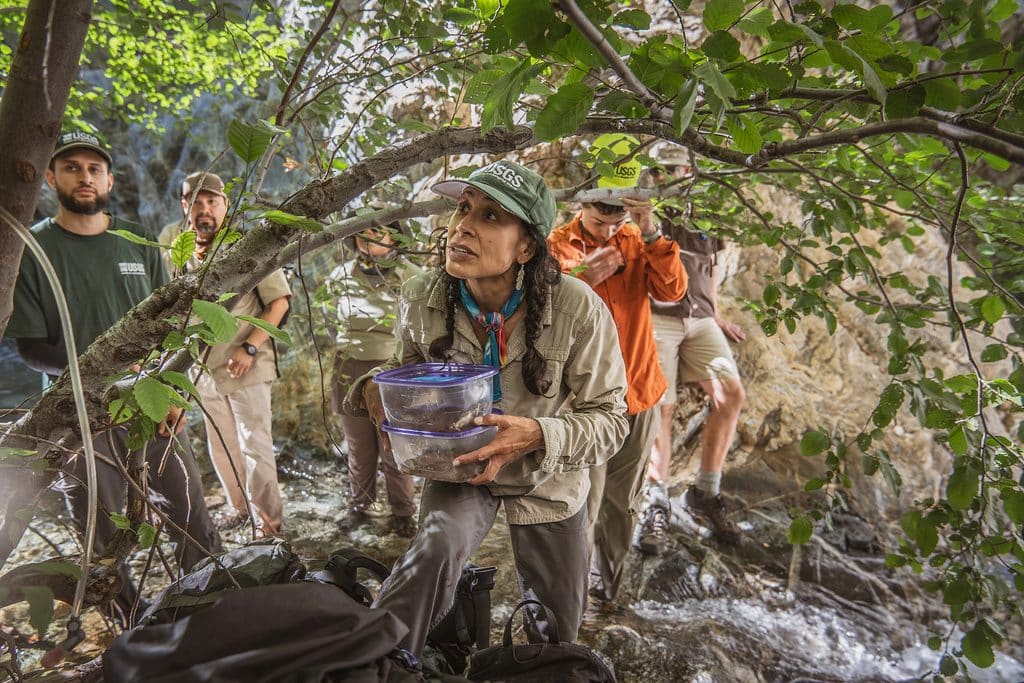
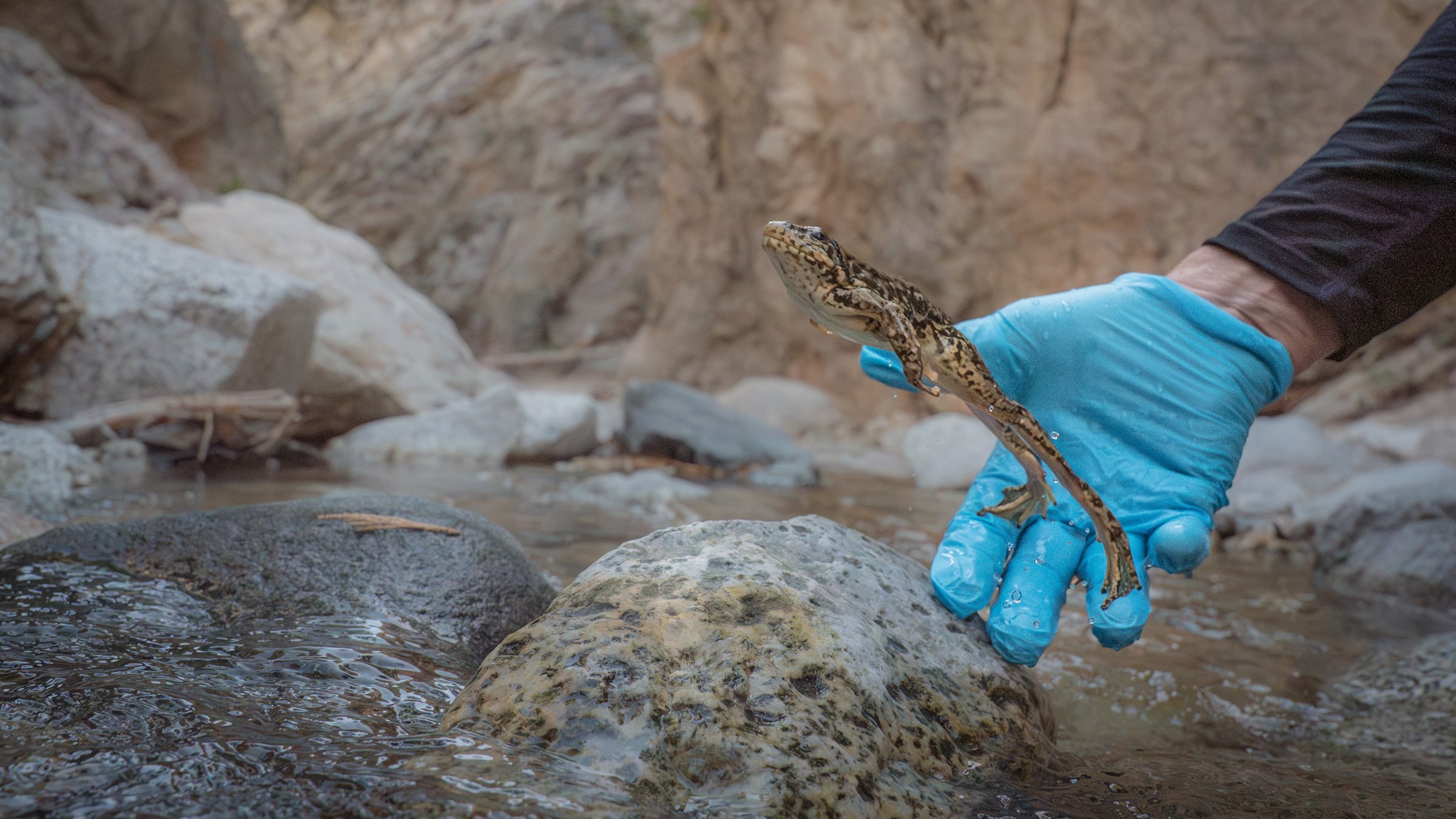
Gallegos crouches at the edge of a pool just beneath a tree, dips a container under the water’s surface, and peels back the blue lid. Two young frogs shoot out, while one insists on swimming against the back of the tub. Another young frog floats up to the front of my underwater camera housing and pushes itself along the glass before crawling onto my shoulder.
By the end of the day, the team has set 122 frogs free. Backlin opens one last container under the falls. The water sweeps the last few into the pool below, twirling for a moment in a loose-limbed dance before kicking their legs and scooting off to a perch … not very far away. They have their do-nothing reputations to uphold, after all. The next day, the team releases another 51 in another stream a few miles to the east.
As the frogs enjoy their new freedom in the mountains, some have stayed back at the L.A. Zoo, where Recchio has opened a new MYLF exhibit. “We need to get the word out on these dumb little frogs,” he explains with an affectionate grin.
The display is the first of its kind in the world—a vital link where regular people with little chance of encountering a MYLF in the wild can learn about their plight, and about the work that is keeping them from leaping into oblivion. Nearly 1.8 million people visit the zoo every year, most of whom walk through the herpetology house. Parents and children crowd around the MYLF enclosure as Recchio cleans the glass and checks the lamps inside the tank. The display combines a view of frogs in their montane habitat with the inner workings of the lab.
Inside, half a dozen MYLFs explore their surroundings, now living a life of cushy retirement after having passed the torch to younger cohorts in the Frog Shack. Most do what they do best: sitting and blending in with the display’s granite features. A few practice calisthenics in their miniature alpine creek, sometimes stepping on the face of a neighbor, or confidently miscalculating a jump to a rock.
It’s fitting that the release and the display’s opening have happened so close together in time—both quietly momentous occasions symbolizing hope for the future. One represents an ecological achievement. The other is existential: a chance for the frog’s human neighbors to learn that they are there, to find awe in their persistence, and perhaps even to come to love them. We save what we love, after all.
That outsized and unreasonable affection for a clumsy, near-colorless frog empowers Gallegos and Backlin to brave wildfires and post-storm floodwaters; to learn how to raise the highest-maintenance, least charismatic, most laid-back creature you might ever encounter; to persevere despite physical, mental, and technical challenges. It’s going to take more of that commitment—that love—to help these frogs survive their many trials by fire. There’s a long way to go before scientists can say that the species will survive. But as the display glass fills with fingerprints and wondering faces, one can’t help but think that mountain yellow-legged frogs just might stand a chance.
Photograph by Morgan Heim
Hi, I’m Dave, the executive director of bioGraphic. (And that’s my dog, Finn.) Thanks for taking the time to read this story.
Stories like this simply don’t get produced without financial support from readers like you. bioGraphic is not backed by a private company or owned by a billionaire. It’s an independent, nonprofit magazine. And one-quarter of our annual budget comes directly from reader donations.
We need your support more than ever, as governments slash funding for conservation and scientific research, placing even more ecosystems and wildlife at risk around the world. At bioGraphic, we’re steadfastly shining a light on the threats to our planet’s incredible biodiversity. And we’re showcasing the hard work of people bravely taking action to protect at-risk species.
bioGraphic publishes environmental reporting that you can’t find anywhere else: deeply researched, trustworthy stories that are also beautiful and captivating to read. We offer an antidote to reader apathy and doom-and-gloom news by revealing the wonders of the natural world and focusing on real solutions to big problems. When you finish a bioGraphic story, we want to leave you feeling informed, delighted, and inspired.
We don’t run ads or hide our stories behind a paywall. The readers who generously support bioGraphic allow our work to remain free for everyone.
Will you help us keep telling these crucial stories?

Author

Related Articles
Ethiopia’s Grand Tree-Planting Plan
Efforts to restore lost forests often fail, but Ethiopians are betting big: planting billions of saplings to revive habitat, regenerate soil, and stabilize the land.
The Trouble with Tamarisk
Twenty-five years ago, land managers unleashed a beetle to control an invasive tree sucking rivers dry. But water levels haven’t risen—and the real villains are still causing trouble.
Death by a Thousand Dams
Tens of thousands of small barriers hamper fish recovery in the northeastern United States. But while the demolition of big dams out west gets the most attention, a similar revolution is revitalizing northeastern streams and rivers—one tiny dam at a time.