
Photograph by Alex Hyde
Story by Liz Lindqwister
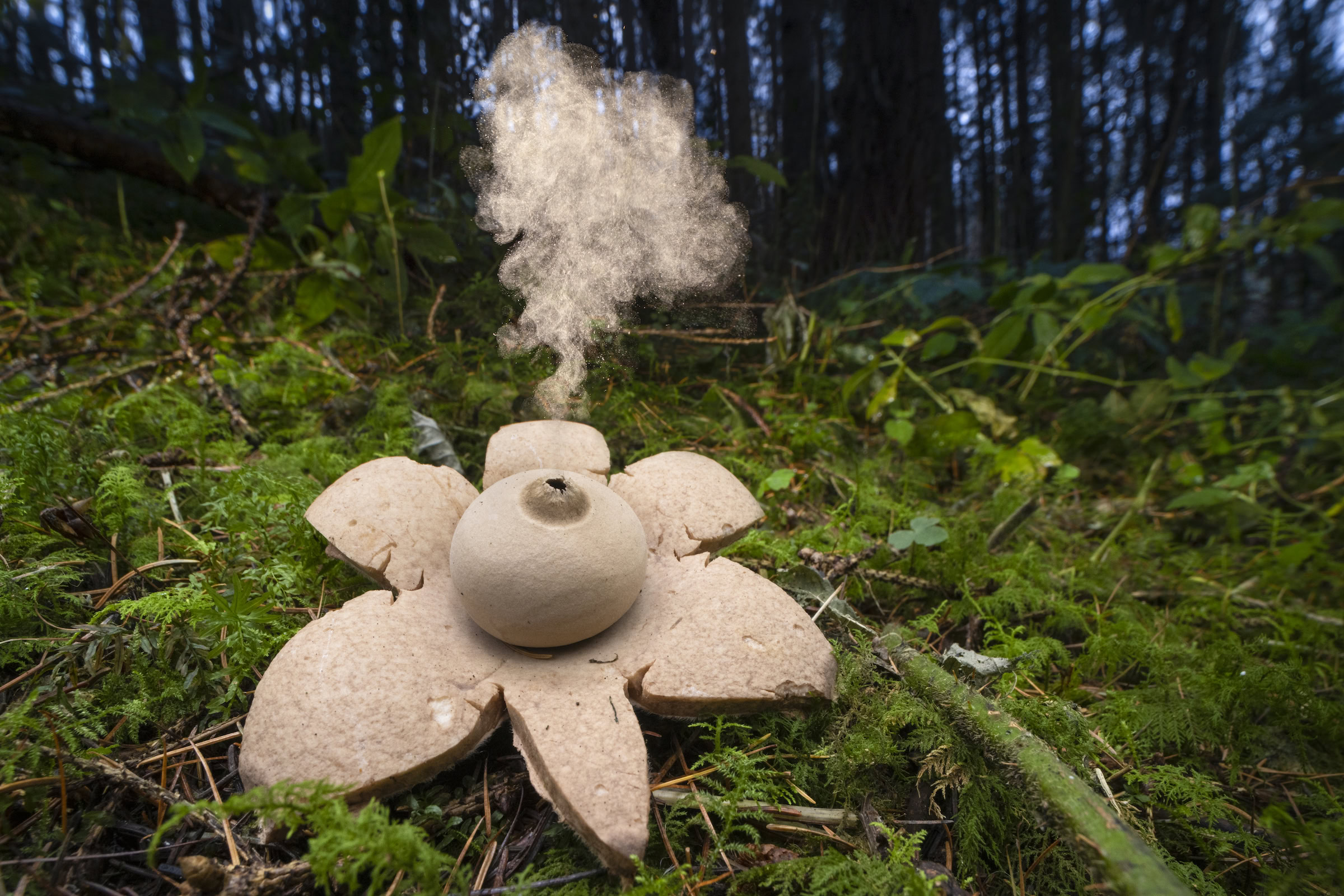
Nestled amidst leaf litter and decaying stumps on forest floors around the world, the collared earthstar (Geastrum triplex) can be hard to spot—that is, until the mushroom’s bulbous core wheezes a fleeting puff of spores. As a member of a group of fungi called Gasteromycetes, or “stomach fungi,” the collared earthstar begins its life cycle as a hardened bulb of just a few centimeters, anchored underground by a network of tiny fungal threads, called mycelia. In the late summer and early fall, earthstars reach maturity and “bloom” into their characteristic, flower-like shape as the thicker outer tissue (the exoperidium) splits into an array of some four to eight points, much like a rind falling off an orange. Once fully mature, the average earthstar resembles a drab clementine perched atop a star-shaped saucer.
When triggered by a falling raindrop or, in this case, a quick poke from photographer Alex Hyde, earthstars burst and expel billions of spores from their hollow internal core. This six-armed earthstar, which Hyde photographed in England’s Peak District National Park, was about the size of an apple and situated among other earthstars on a damp, shaded patch of woodland floor. Hyde says the earthstar’s fruiting body can persist for months at a time, which makes it easier to map their locations and plan for photo shoots like this one when the fungi reappear in the spring.
Perhaps owing to their ability to disperse billions of spores with a single puff, earthstar fungi of the Geastraceae family are practically ubiquitous throughout the world, from the damp forests of the United Kingdom to Hawaii’s coastal coconut groves. Their use in traditional medicine is similarly widespread, included among the myriad fungi used by Chinese medicalists to treat such ailments as lung and throat irritation.
And like other puffballs—fungi with a spore-releasing, ball-shaped body—earthstar fruits and their spores have been utilized for medical and cultural purposes among many Indigenous tribes in the Americas. Blackfeet Nation tradition holds that the constellations of ka-ka-toos that litter the forest floors of their ancestral grounds in the Upper Great Lakes region represent fallen stars that tumbled to earth due to supernatural forces. Tribal members have used the hollowed, dried out shells of earthstars and other puffballs to make baby rattles, to provide inspiration for tipi designs, and to ward off unwelcome spirits.
Western scientists have also expressed their reverence for the diminutive earthstar. British mycologist C.B. Plowright wrote, for example, that spotting one would “gladden the heart of the most lethargic fungologist.” Yet as extraordinary as the earthstar is on the surface, the role the rest of the organism plays underground is essential to the health of the trees and other plants towering above. By interweaving its underground web of mycelia with the roots of nearby plants, the earthstar exchanges mineral nutrients, water, and food in what some scientists refer to as an “underground handshake,” underscoring this curious fungus’s symbiotic role in the ecosystems it calls home.

Peak District National Park, United Kingdom
Authors


Related Articles
The Wonder of a Pale Whale
A curious calf with an atypical birthday suit is a good sign for southern right whales.
Saying “Ah!” at the Shrimp Spa
On coral reefs, an army of tiny cleaners eat their clients’ parasites, food particles, and dead skin, boosting biodiversity in the process.
Friends or Foes?
A flatworm and a sea squirt mingle in the tropical waters of West Papua, offering a glimpse into the complexity of interspecies relationships.