
Photographs by Ralph Pace
On a cool spring morning, a group of scientists and volunteers gathers beneath a canopy on the shore of San Diego Bay in California. Several people are staging a mobile research lab, complete with a basket of syringes and vials, coiled tape measures, giant calipers, and the type of hanging scale used to weigh seafood or farm animals. Beyond, the crooked finger of the bay points toward Mexico, running 24 kilometers (15 miles) from downtown San Diego south to the small community of Imperial Beach, California, which is about 5 kilometers (3 miles) from the border.
To call this land- and seascape utilitarian is an understatement. San Diego’s international airport, a cruise ship terminal, and a major naval base are set on the northern edges of the bay, along with two museums, a convention center, a marina, and a park. The scientists and volunteers are in the south, in Chula Vista, where the shoreline is best described as post postindustrial.
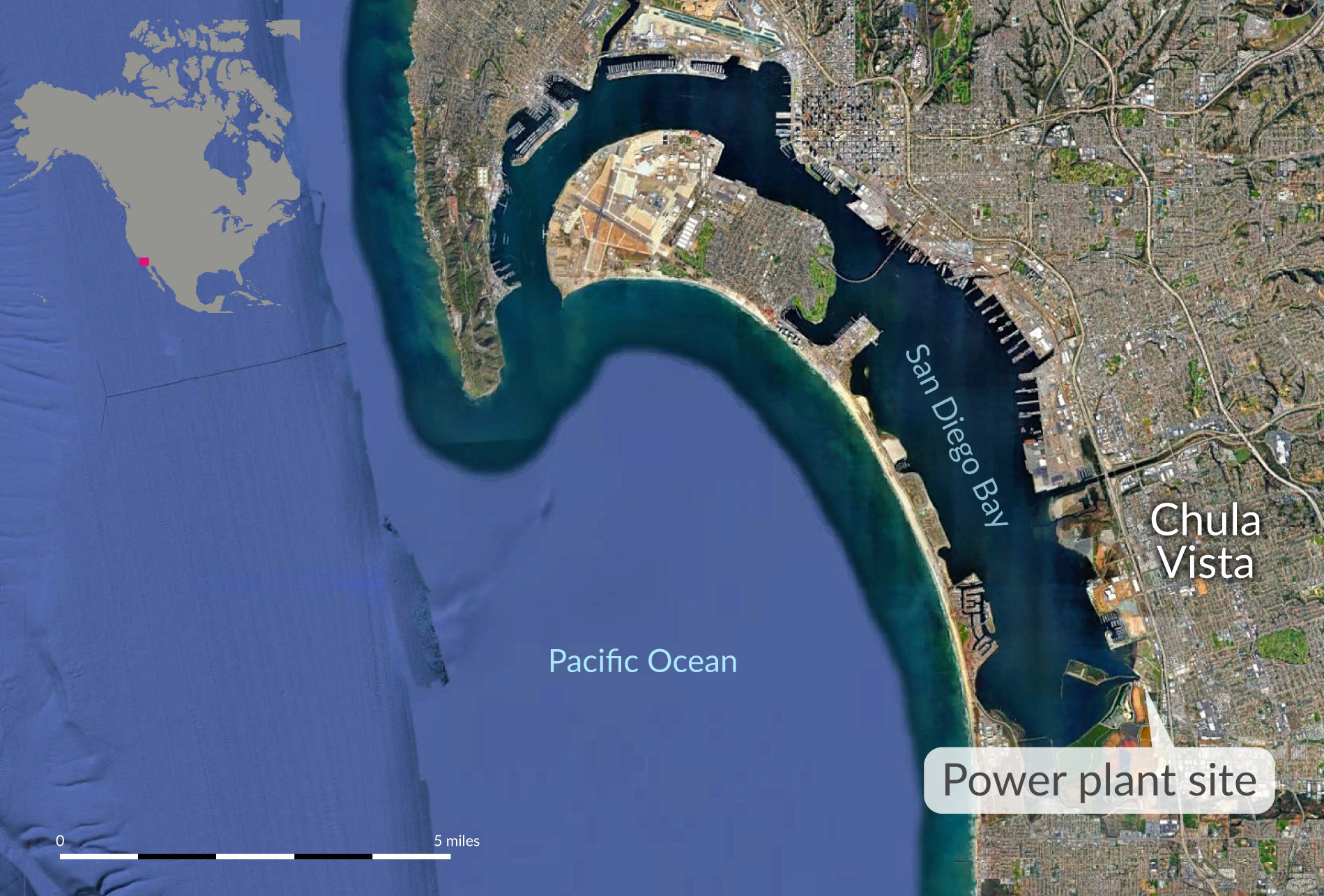
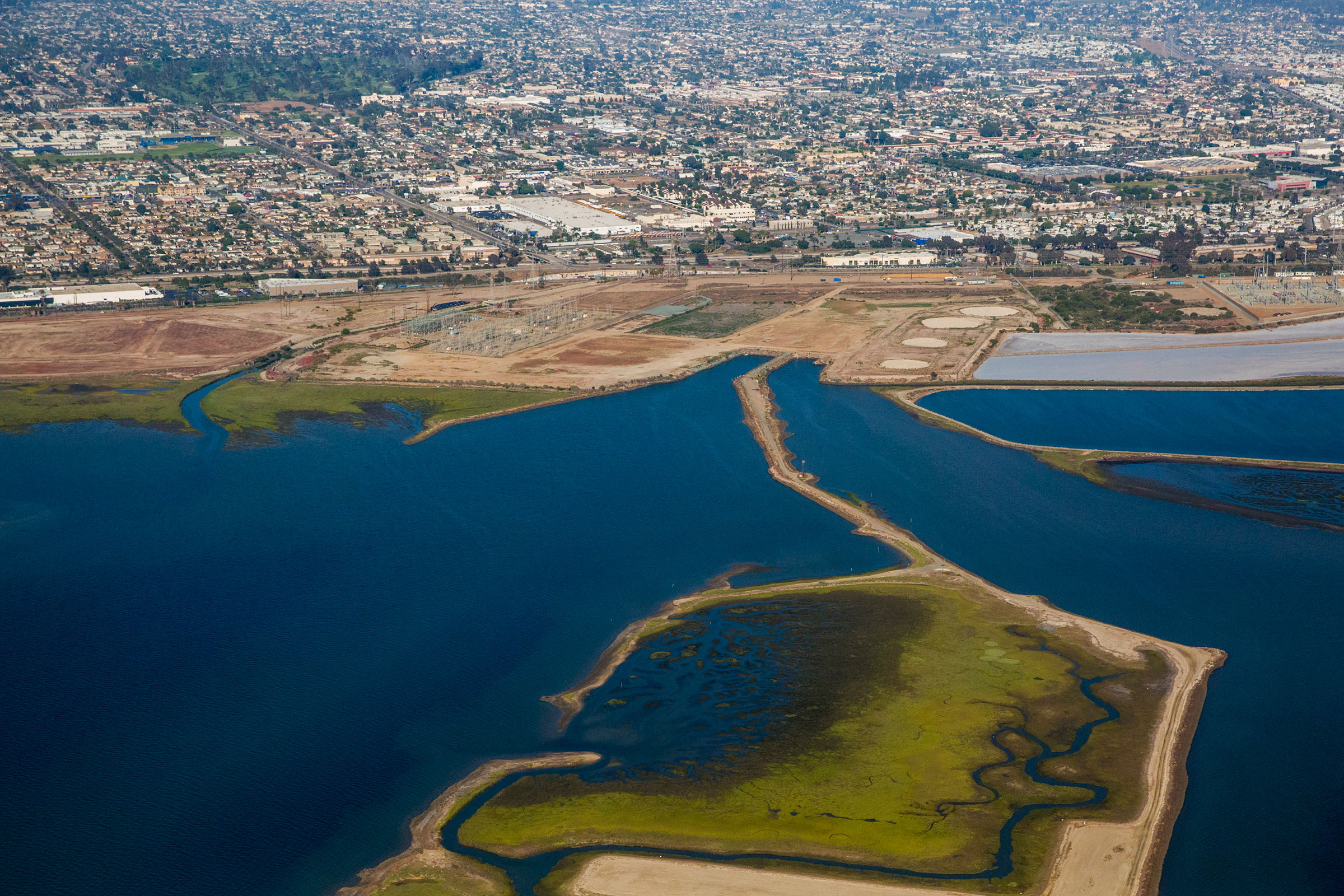
Though much of the area feels derelict, a USD $1.3 billion resort opened in May 2025 near a beach once dominated by a power plant, which was demolished over a decade ago. Old jetties, decomposing asphalt, and barbed wire fencing from the power plant clutter the shoreline near the hotel, where rooms start at around $550 a night. A cinderblock wall spray painted with a Frida Kahlo mural barely muffles the traffic screaming down Highway 5. And yet it is here where two of the scientists gathered on the beach today first discovered evidence of an endangered species success story.
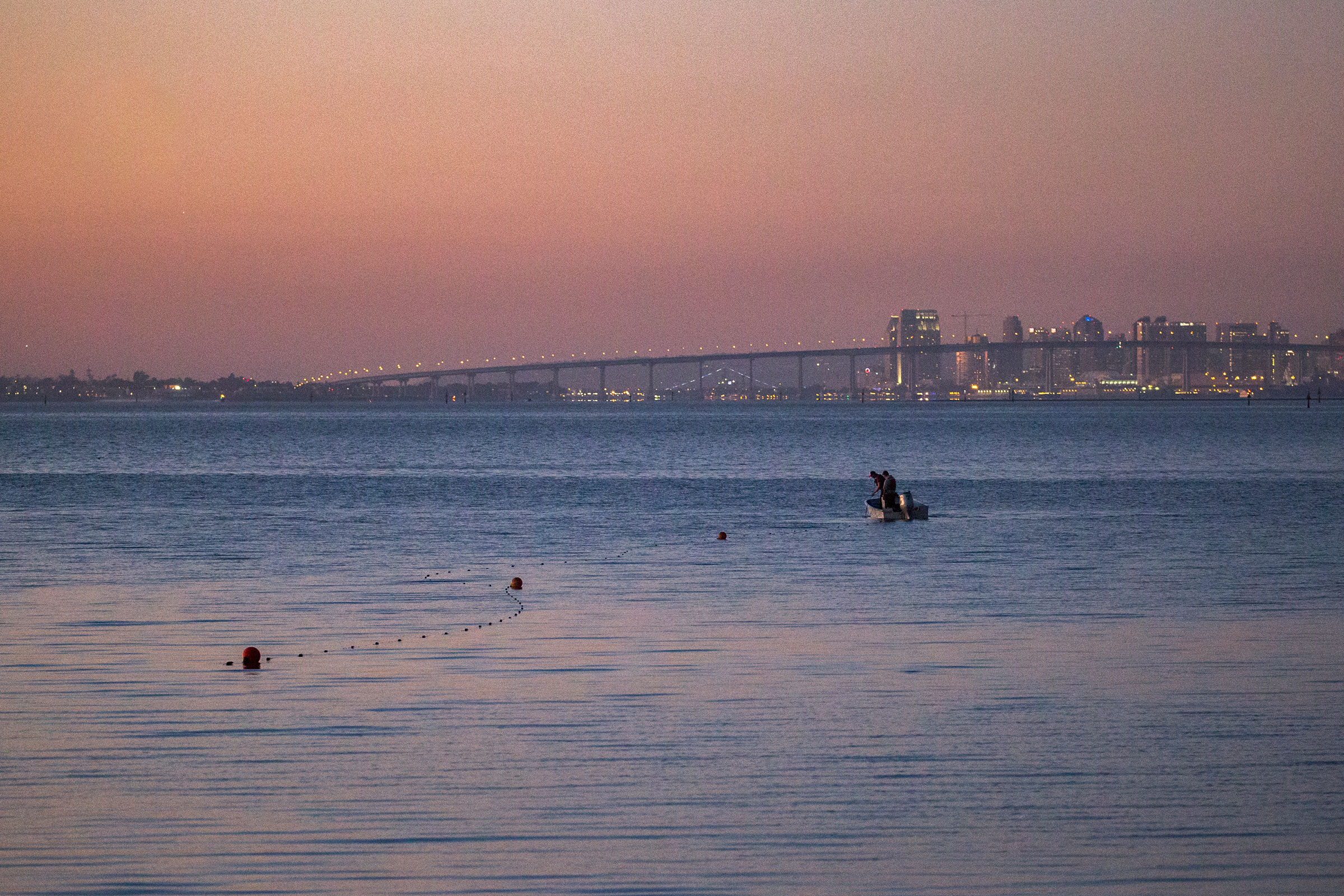
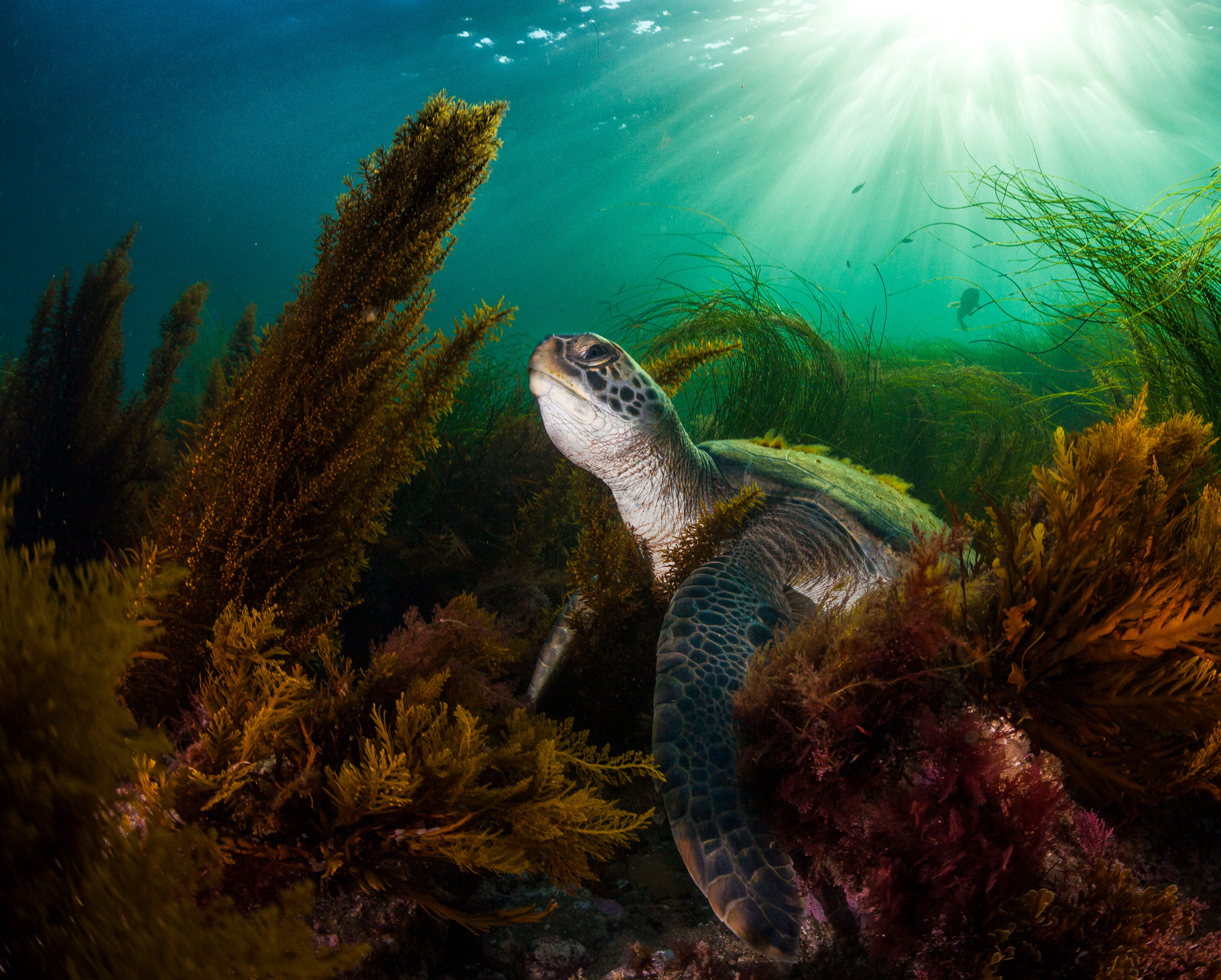
One of those scientists, Jeffrey Seminoff, head of the Marine Turtle Ecology & Assessment Program at the U.S. National Oceanic and Atmospheric Administration (NOAA), stands under the canopy giving volunteers instructions. Today’s work is part of an ongoing survey held for several days each spring. A grinning Seminoff eventually turns his gaze toward the murky water, knowing that somewhere in its modest depths, munching eelgrass, is the resilient reptile we’ve all come to see: the eastern Pacific green sea turtle.
After his discussion with volunteers, Seminoff—dressed in cargo shorts, a sleeveless gray hoodie, and rubber work boots—hustles to the water. He launches a skiff and buzzes into the bay to set up a labyrinth of fishing nets. If a turtle gets tangled in the nets, he’ll tag it with a time and depth recorder to get a better sense of where turtles forage and when they tend to float on the surface; information that could eventually be passed along to the public to help prevent boat strikes. Seminoff invited me to join him as he tags turtles during this year’s survey because a few weeks earlier I’d happened across a sea turtle in the busy harbor of Marina del Rey in Los Angeles, California, where the boats and the views are pretty but the water is an unnatural inky green, littered with trash and funky clots of algae. When I rang Seminoff to tell him I’d spotted a sea turtle in this seemingly unlikely habitat roughly 210 kilometers (130 miles) north of San Diego, he wasn’t surprised.
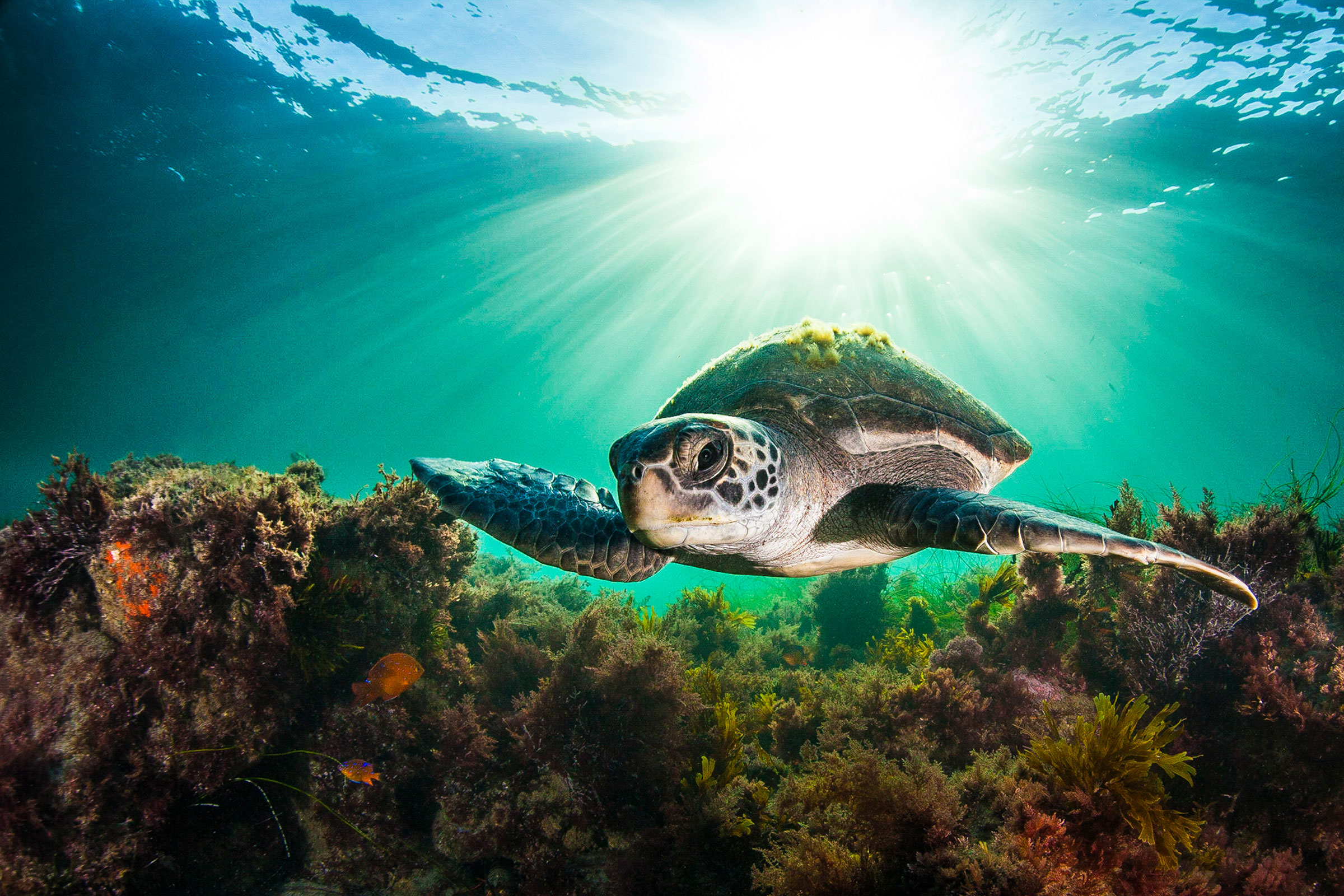
Although eastern Pacific green turtles, one of 11 distinct populations of the green sea turtle (Chelonia mydas), are mostly associated with Hawai‘i, the Galápagos Islands, and Mexico, their range increasingly includes the California coast. In fact, eastern Pacific green turtles who typically nest and hatch on tropical beaches have been spotted as far north as Monterey Bay in chilly, foggy waters nearly 620 kilometers (385 miles) from here.
Boat captains and power plant workers first noticed them in San Diego Bay in the early 1970s—a dangerous time to be a sea turtle. Chelonia mydas range across the world’s tropical and subtropical seas; throughout the 1970s and ’80s, they were hunted across much of the tropics for their meat. Locals also ransacked their eggs, another delicacy. Meanwhile, shrimp trawlers and gillnet boats decimated migrating turtles as bycatch. Protections that came into effect in 1978 in the United States and in 1990 in Mexico helped green turtle numbers in the region bounce back, and now, in an era of shifting climate and unprecedented biodiversity loss, this once-endangered population has moved into new—and unexpected—territory. NOAA officially began monitoring the turtles in California in 1997, and Seminoff became the eyes of the program a few years later.
He’s watched on satellite data as icons representing tagged turtles squiggle through some of Los Angeles’s crowded marinas. They gather in an industrial river inland from the cranes and container ships of Los Angeles Harbor, and in other toxic, polluted, and busy waterways. “These are completely urban turtles,” Seminoff says. He believes that San Diego Bay was the first stop in what has since become a significant expansion of the turtles’ historical range.
Seminoff has ideas about why this population of green turtles have become a rare conservation success story. “They’re very curious creatures,” he says. “Always on the move, looking around. They share a stick-to-itiveness.” You might say they’ve got chutzpah.
Sea turtles have been around for over 100 million years, pre-dating dinosaurs. Green sea turtles, one of seven species of sea turtle, tend to be long-lived, reaching at least 75 years old, if they can survive a rather perilous opening act.
Hatchlings emerge from their eggs and are immediately exposed to an armada of predators—gulls and frigates, jaguars, panthers, alligators, coyotes, crocodiles, and crabs, depending on the locale. Some version of the same scene occurs on the nesting beaches of Florida, the Virgin Islands, Mexico, Guam, the Mariana Islands, the Galápagos Islands, and the Hawaiian Islands.
The lucky ones reach the ocean and hitch a ride on whatever flotsam they can find, such as a sargassum raft where they can forage algae, jellies, small crabs, and snails, living a solitary existence until they are a bit bigger than a dinner plate. Legendary naturalist Archie Carr, grandfather of sea turtle science and long-time University of Florida researcher, dubbed this period of a turtle’s life “the lost years,” because once hatchlings disappeared into the surf, researchers had no idea what their lives were like in the open sea. This period usually lasts four to six years. “Then there’s just an inherent instinct to get to a coastal habitat because that’s where food’s more abundant,” Seminoff says. Once they find good foraging ground closer to shore, the area becomes their home base.
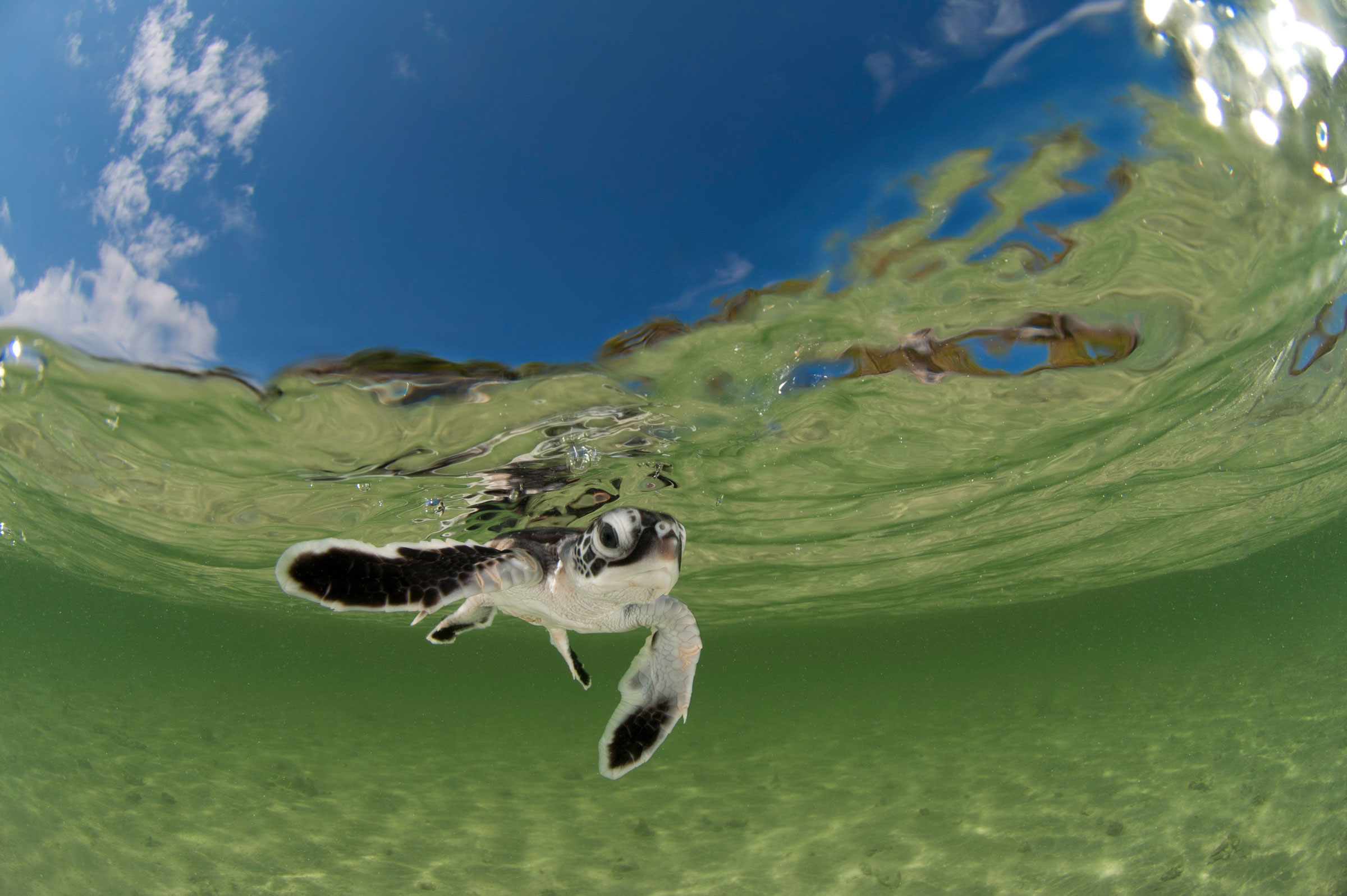
Unlike other marine turtles, adult green sea turtles are largely herbivores, but the eastern Pacific population is omnivorous, inhaling plenty of moon and other jellies. In the 1970s, some of the turtles discovered murky San Diego Bay, where they found a warm current and abundant eelgrass. As their brethren in the clear blue waters off Mexico and Hawai‘i were floundering, here they were secretly flourishing, at least until 1976 when a fisherman tipped off budding marine biologist Margery Stinson.
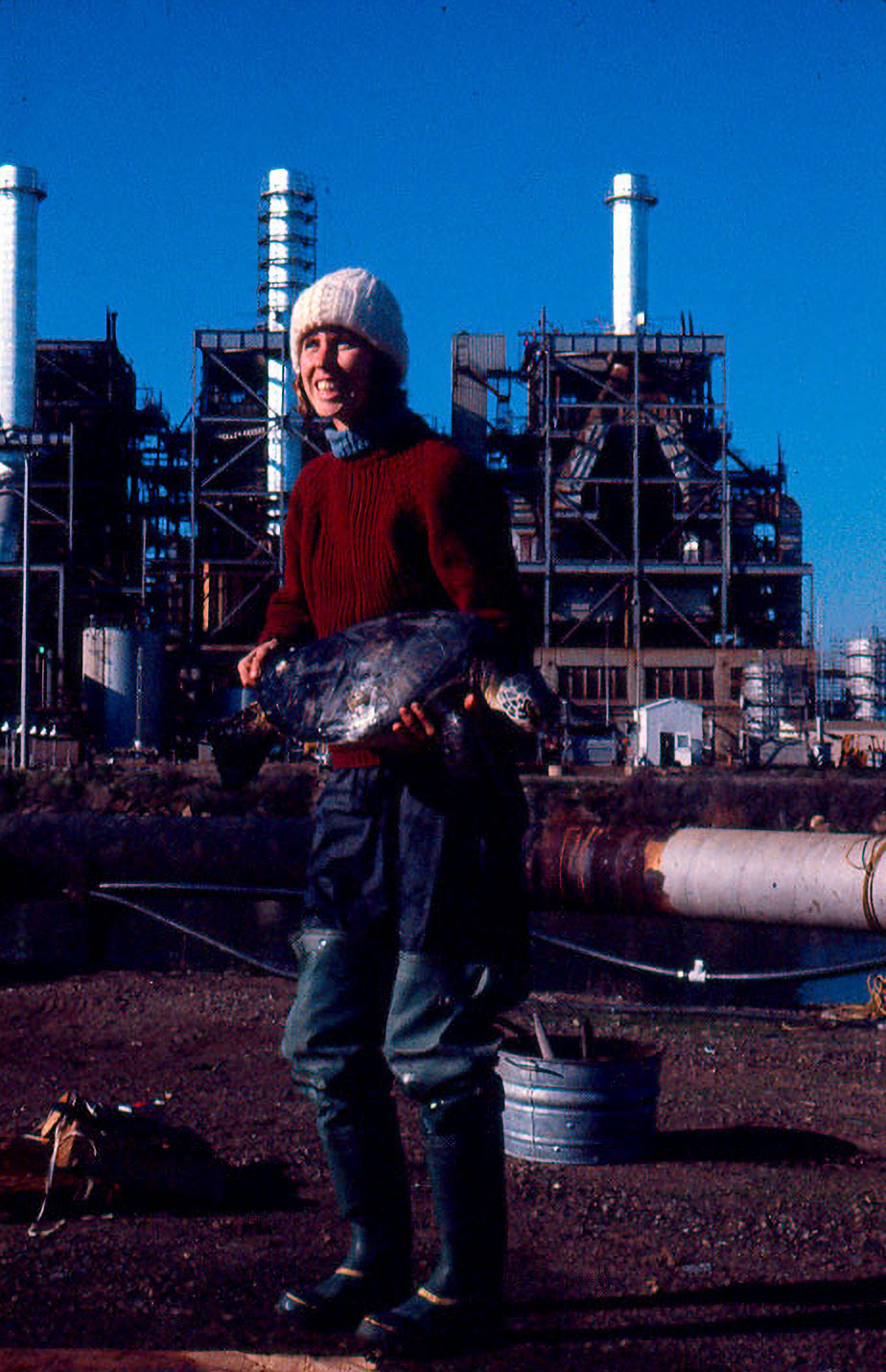
Stinson—who Seminoff calls “the grandmother of sea turtles of California”—found it hard to believe. San Diego was well north of the turtles’ known range. Plus, the South Bay Power Plant, a prolific polluter fueled by natural gas, was still in operation, and boat traffic clogged the bay. Yet when Stinson visited the shore near the power plant’s smokestacks and peered through binoculars, it didn’t take her long to spot them. Green sea turtles are the largest of the hard-shelled turtles, measuring over 1-meter (3.3-feet) long and weighing up to 181 kilograms (400 pounds).
“As wind whipped across the water,” she wrote in her 1984 master’s thesis, “binoculars could not be focused fast enough to catch more than a glimpse of these giants surfacing for air.” Stinson snapped photos, identified the species as Chelonia mydas, and went on to conduct the first formal study of the San Diego Bay population.
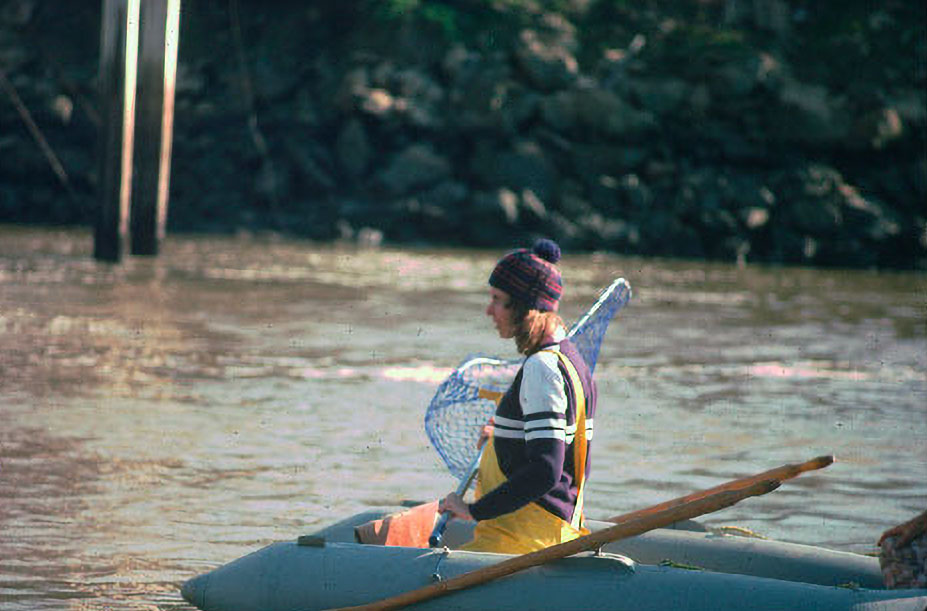
In 1979, she set up tuna nets at the mouth of the power plant’s effluent channel, where seawater—used to cool the plant—was released, creating a 3-kilometer (2-mile) plume of warm water. Members of the U.S. Navy helped her bring six turtles ashore, including a female turtle that Stinson named Wrinkle Butt because her carapace, or shell, came up short at the back end. The turtles were transported to what is now known as the Hubbs-SeaWorld Research Institute, a marine science center that was then an offshoot of the SeaWorld amusement park in San Diego. Staff biologists attached tracking devices to the turtle shells in the hopes of recording surrounding water temperatures and the turtles’ daily routines. These were the days of radio telemetry, and since radio waves falter underwater, each tag’s range was less than 5 kilometers (3 miles). Once Stinson released the turtles back into the ocean, she had to tail them in a skiff to record the data.
Stinson spent seven years studying the turtles. She found that the population of 30 or so tended to congregate in the effluent channel, but there was no evidence of nesting. “Surfacing with each rising turtle,” she wrote, “were questions concerning their existence in these northern waters.” Why had they come? Where did they go when they weren’t in the bay? Firm answers were scant, but she concluded that they left the bay in summertime.
After attending one of Stinson’s lectures in 1985, a young marine biologist named Peter Dutton was inspired to pick up the thread. Dutton and his colleague and future wife Donna McDonald, another scientist, started spending evenings in the industrial glow of the power plant, setting nets to capture turtles. He took skin samples from his captives and attached acoustic tracking tags to their shells. What he learned from those tags astonished him.
The eastern Pacific green turtle population in Mexico was critically endangered at the time and those in Hawai‘i were also struggling. But somehow these oddball turtles observed feeding in San Diego seemed to be thriving.
Now, Dutton, who launched NOAA’s sea turtle monitoring program in 1997, waits among the scientists and volunteers gathered on the shores of San Diego Bay, hoping to collect DNA samples from any turtles Seminoff and the team bring ashore. As Seminoff sets nets out on the water, Dutton reflects on the details that poured from those acoustic tags in the mid-1990s.
“We noticed the turtles were here in the summer,” says Dutton. “It’s just that when the rest of the bay warms up, they tend to spread out.” Where Stinson estimated a population of 30, Dutton believed the San Diego Bay turtle population to be closer to 100 individuals. He recaptured some turtles that Stinson had already tagged, including Wrinkle Butt. “And once we started seeing [their] growth rates, we realized San Diego Bay was a haven.”
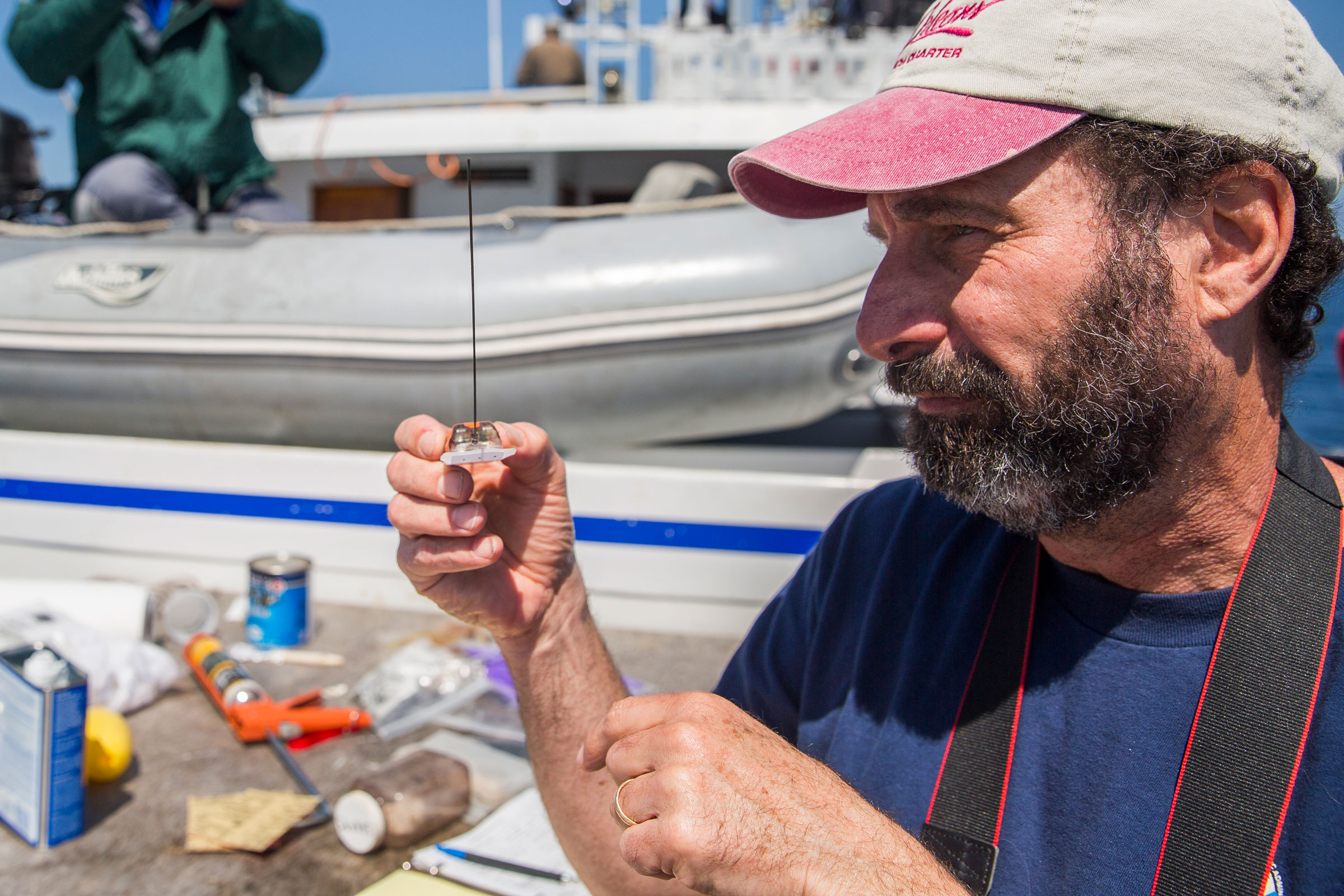
Today, Dutton leads the Marine Turtle Genetics Program at NOAA, and though he studies all seven species of sea turtles, the eastern Pacific population of green sea turtles remains a focal point. As we wait for unsuspecting turtles to swim into Seminoff’s nets, Dutton takes me on a short, nostalgic site tour. He points out where the power plant used to be and where he and McDonald would settle in with red wine and chocolate to watch for turtles. He identifies where the turtles sought that warm jet of effluent, and he remembers how he just couldn’t shake the mystery of their presence here. No one knew where the turtles were coming from, where they were nesting, or why a largely tropical species favored such cold, murky, and polluted water. At the time, genomics was hitting its stride, and Dutton wondered if genetics could help solve the riddle that had taken over his life.
Dutton decided to further his education on green turtles at Colola Beach in Michoacán, Mexico, where Javier Alvarado, a visionary scientist who led the marine biology department at the Michoacan University of San Nicolás of Hidalgo (UMSNH), conducted research. Alvarado was one of the first to mass tag nesting females in Mexico, and it was alongside him that Dutton learned how to collect their blood to get DNA samples. But Dutton still needed a geneticist to analyze the DNA; when nobody stepped up to help, he enrolled at Texas A&M University to map the green sea turtle genome himself.
In 1992, after Dutton had departed Colola Beach for Texas, Seminoff arrived in Mexico as a PhD candidate. He soon learned that even though a predecessor of Alvarado’s named Kim Clifton had convinced local fishing cooperatives to limit the turtle harvest—and the Mexican government had banned harvesting turtles and their eggs two years before his arrival—the eastern Pacific green turtle nesting population had continued to dwindle.
“That year, 212 females nested, which was down from 25,000 females in the mid-1960s,” Seminoff says. Alvarado and his team had focused on educating people about sea turtle conservation in the communities surrounding the nesting beaches where they worked. But their tagged turtles were turning up farther north in the Gulf of California, where fishermen continued to harvest turtles despite the law as it was a local delicacy and there was scant enforcement. Seminoff followed the tags and zeroed in on fishing pueblos in northwestern Mexico, where the turtles who laid their eggs on Colola Beach went to forage. Along with a colleague, Wallace J. Nichols, he launched a nonprofit, Grupo Tortuguero de las Californias, to educate the public about the population’s collapse and to convince local people to comply with Mexico’s new ban.
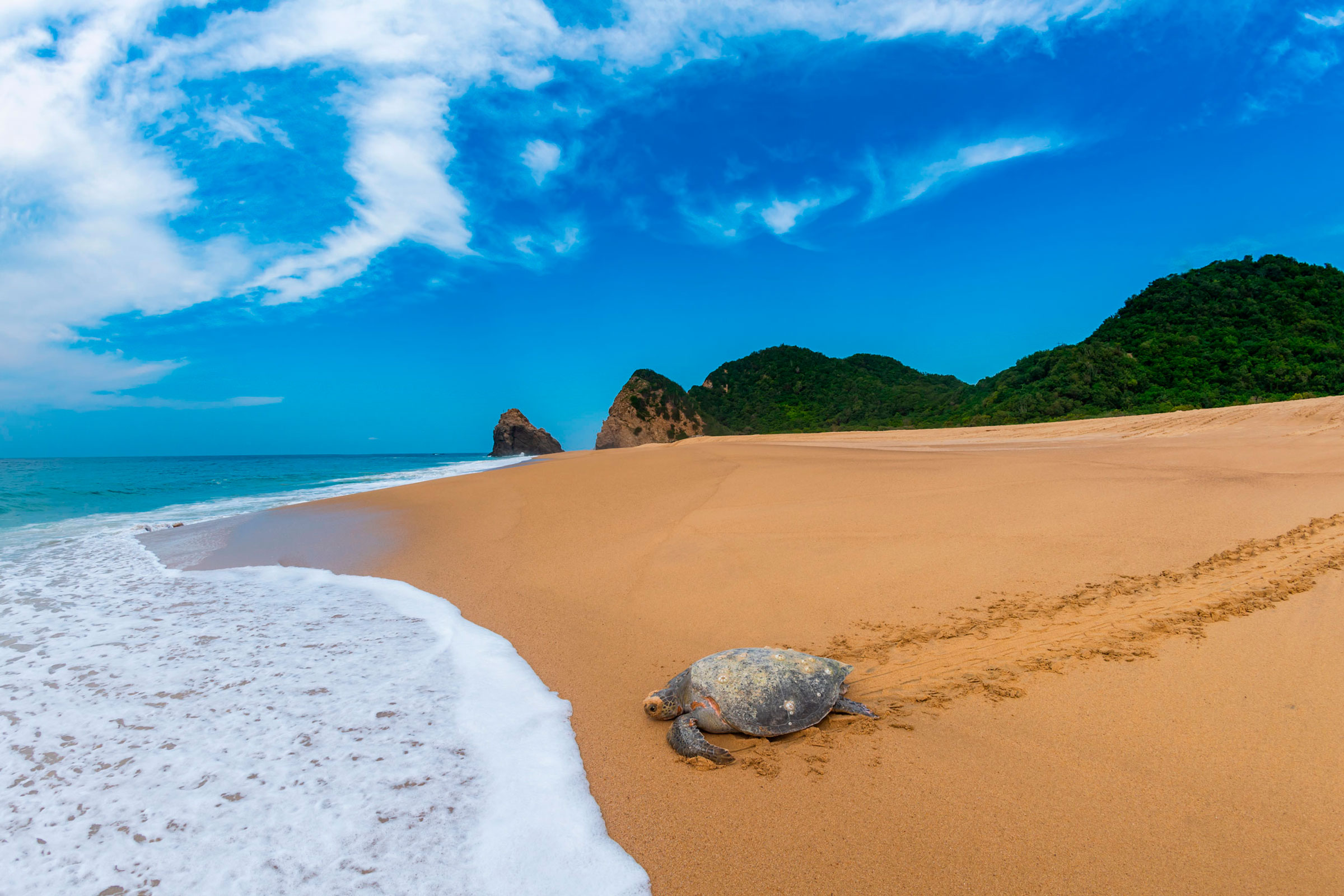
“This was the most important thing for recovery of the population,” says Carlos Delgado Trejo, a marine biologist at UMSNH, who worked under Alvarado, “because in Baja California, people ate the nesting females [from] Michoacán.” In 2002, the nesting female population on Colola Beach and elsewhere in Michoacán increased for the first time in decades.
That same year, NOAA split the turtle program in two. While Dutton branched off to create the Marine Turtle Genetics Program, Seminoff took on the monitoring work as part of the Marine Turtle Ecology & Assessment Program. At this point, Seminoff suspected the San Diego turtles must have come from Mexico, but none of the creatures he pulled from the water near the South Bay Power Plant sported tags affixed by Alvarado’s team. Had the tags fallen off? Were these turtles from somewhere else entirely? Until he figured out where they were coming from, Seminoff wouldn’t dare hypothesize why they wound up here. But technology improved, and in 2004, Seminoff attached antennae to about 10 green turtles he captured in the bay so he could track them via satellite.
“Lo and behold, some of those animals started to migrate to Mexico, to the nesting beaches,” he says. The work of protecting nesting sites in Mexico, then, seemed to be aiding the California population.
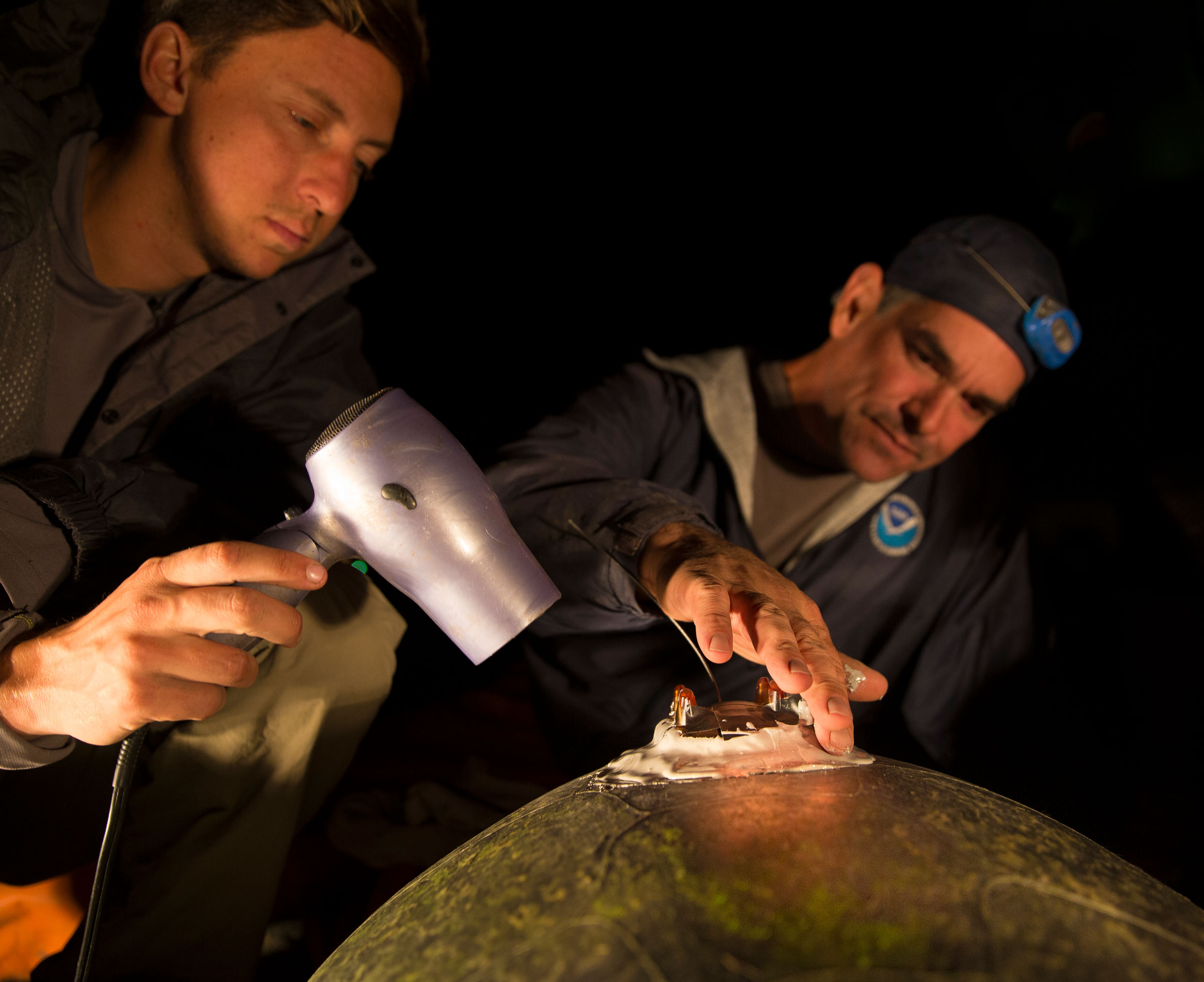
Dutton, meanwhile, was busy traveling to remote beaches in Mexico, Hawai‘i, and the Galápagos to collect blood, home in on nesting locations, and build a genetic baseline for the eastern Pacific green turtle for the launch of the genetics program. He and Seminoff added to their genetic and satellite dataset for nearly 15 years. In 2018, nearly 40 years after Stinson cast her first net in San Diego Bay, Seminoff and Dutton published their findings, which showed that 99 percent of the eastern Pacific green turtles tagged in San Diego Bay, were born either on the Michoacán coast or on the remote Revillagigedo Islands offshore. That’s a swim of up to 2,500 kilometers (1,600 miles) for the Colola Beach population, and around 1,600 kilometers (1,000 miles) for those from the Revillagigedos. It’s a long distance for eastern Pacific green turtles, but not atypical for sea turtles in general.
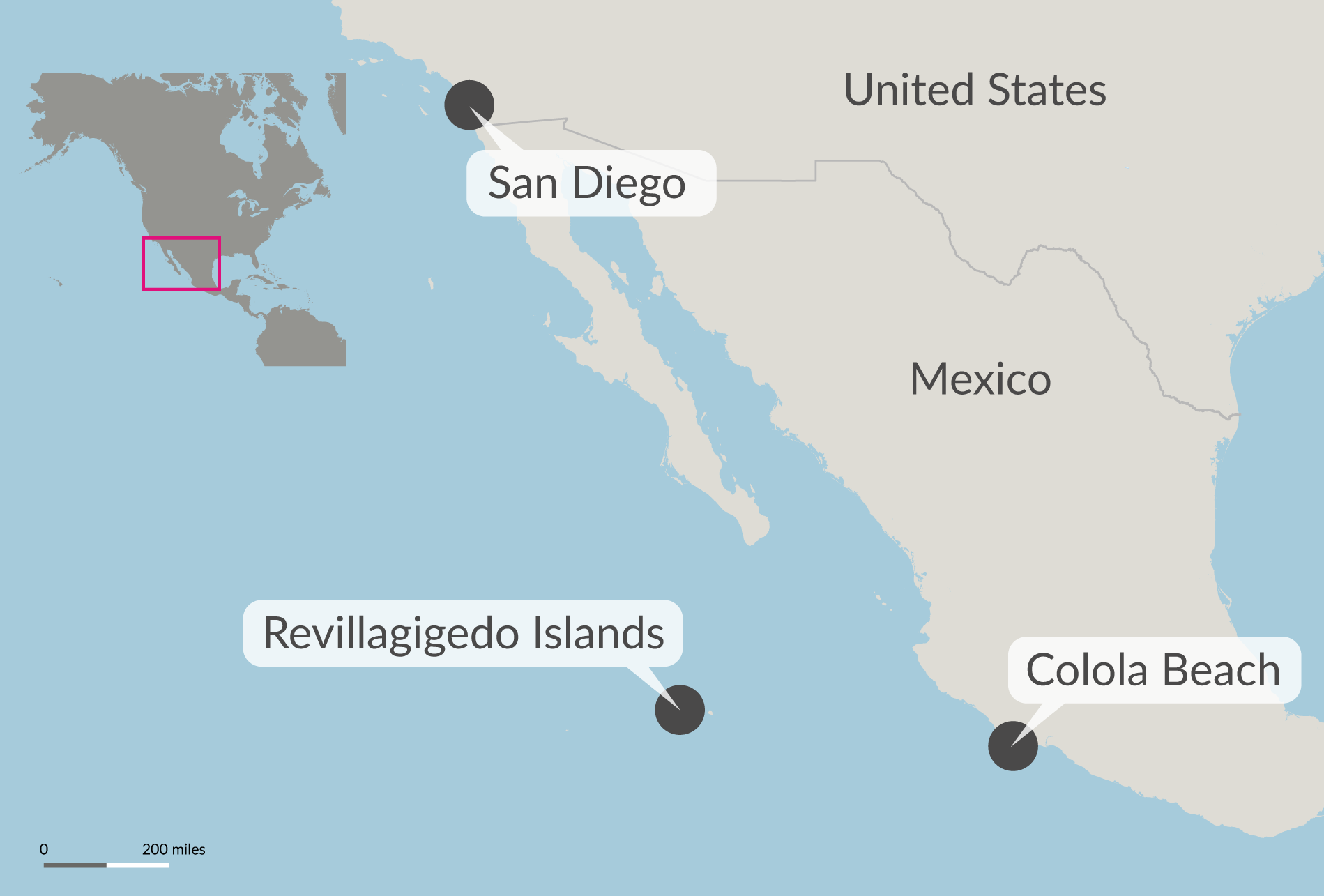
Seminoff and Dutton showed that adult females make that round-trip trek to and from the nesting beaches every two to four years, without stopping to forage. They believe males migrate annually to mate offshore from the nesting beach with any incoming females. NOAA uses this information to keep fishing boats out of the migration path to mitigate bycatch. Only females make landfall. Each one buries 30 kilograms (80 pounds) of eggs in the sand spread out in four to six nests.
Over the years, Seminoff has added the use of camera and video tags to his work. Although turtles are not considered especially social, he has charming footage of individuals rubbing noses in the seagrass. Seminoff also began tagging turtles in the San Gabriel River near Los Angeles after word filtered in from a jogger who noticed a sea turtle in the tidal flow of the 45-kilometer (28-mile) urban channel that runs southwest from the city’s downtown, past oil wells, and the smokestacks of a behemoth power plant. “Walk along one of the culverts, they’re all right there,” says Seminoff. “A boil of sea turtles.”
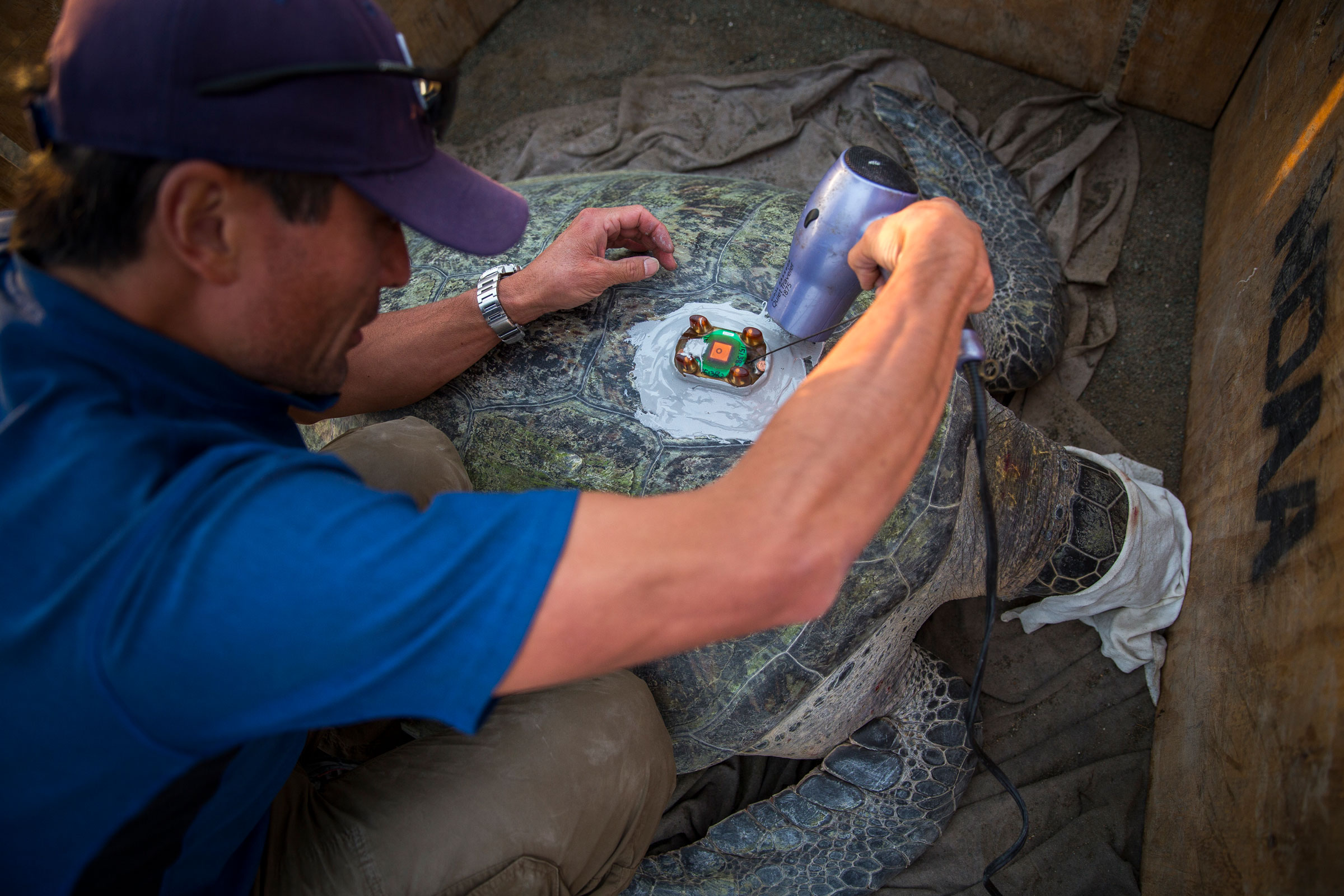
On the beach at Chula Vista, the air warms up by early afternoon, but a brisk breeze is blowing when I join Seminoff in his skiff and we motor into the chop. Within the hour, he hauls a nearly 70-kilogram (150-pound) turtle on board himself, which explains why he has the muscular hands of a fisherman. When we return to shore, we lug the turtle up to the shade of the canopy using a medical transport sling and place it into a wooden frame, which Seminoff calls a turtle box, to ensure it doesn’t shuffle back to sea. Two other turtles are being assessed, and Seminoff recognizes them. One is still wearing a satellite telemetry device. Seminoff kneels and glazes it with a fresh coat of epoxy to make sure it sticks. Others on the team collect skin and blood and tag the new specimen. Seminoff squeezes a parasite out from under its skin with the care and skill of someone with years of experience.
Seminoff still enjoys such hands-on work, but the research that most excites him these days delves into California’s history. Since the 1970s, when California’s green turtles first surfaced, scientists have suspected that the animals represent an expansion of the species’ known range. New evidence shows that these suspicions are almost definitely true.
Michelle Early Capistrán, a postdoctoral fellow at Stanford University’s Hopkins Marine Station in Monterey, California, recently completed a meta-analysis of commercial ship landings based on local newspaper reports from 1850 to 1930. She and her team have also been picking through hundreds of archaeological studies to explore population trends of green sea turtles dating back the past 10,000 years. Of particular interest is whether turtle remains were common in post-contact Indigenous sites in Southern California.
“There were fewer than 10 [archaeology] papers that talk about turtles, and two talk about the exact same site,” says Early Capistrán. “Compare that to hundreds of papers that mention abalone, sandfish, sea lions, or other marine mammals.”
If green turtles were once present in the environment in large numbers, they would likely show up in both the public record of the day and in the archaeological record of Indigenous communities. In other words, prior to the 1970s, sea turtles were likely exceptionally rare if they were around at all.
Why eastern Pacific green turtles migrated north to forage remains unsettled. The pioneering turtles of the 1970s may have been opportunists, their chutzpah guiding them toward new habitat and, coincidentally, away from human hunting grounds. Lately though, one of the driving forces behind range expansion is likely population growth in Michoacán. Colola Beach—where Seminoff noted just 212 nesting females in 1992—saw 27,000 nesters come ashore in 2024, the highest number on record. It’s logical that as their numbers have increased, Mexico’s turtles have had to seek new foraging grounds, but there’s probably more to it.
“The question is if it’s an effect of climate change or population growth. I think it’s both,” says Early Capistrán. “The fact that they’re branching out could be because of warming water temperatures driving collapse in their primary food sources, like seagrass. Seagrass collapse has been a big issue in Baja.”
There is no shortage of eelgrass in San Diego Bay and sea lettuce in Los Angeles’s San Gabriel River, and there’s a variety of algae in Southern California’s marshes and harbors. Clearly turtles have figured that out, and the new rangeland comes with relatively few predators, but how can they withstand the manufactured chemicals in the water?
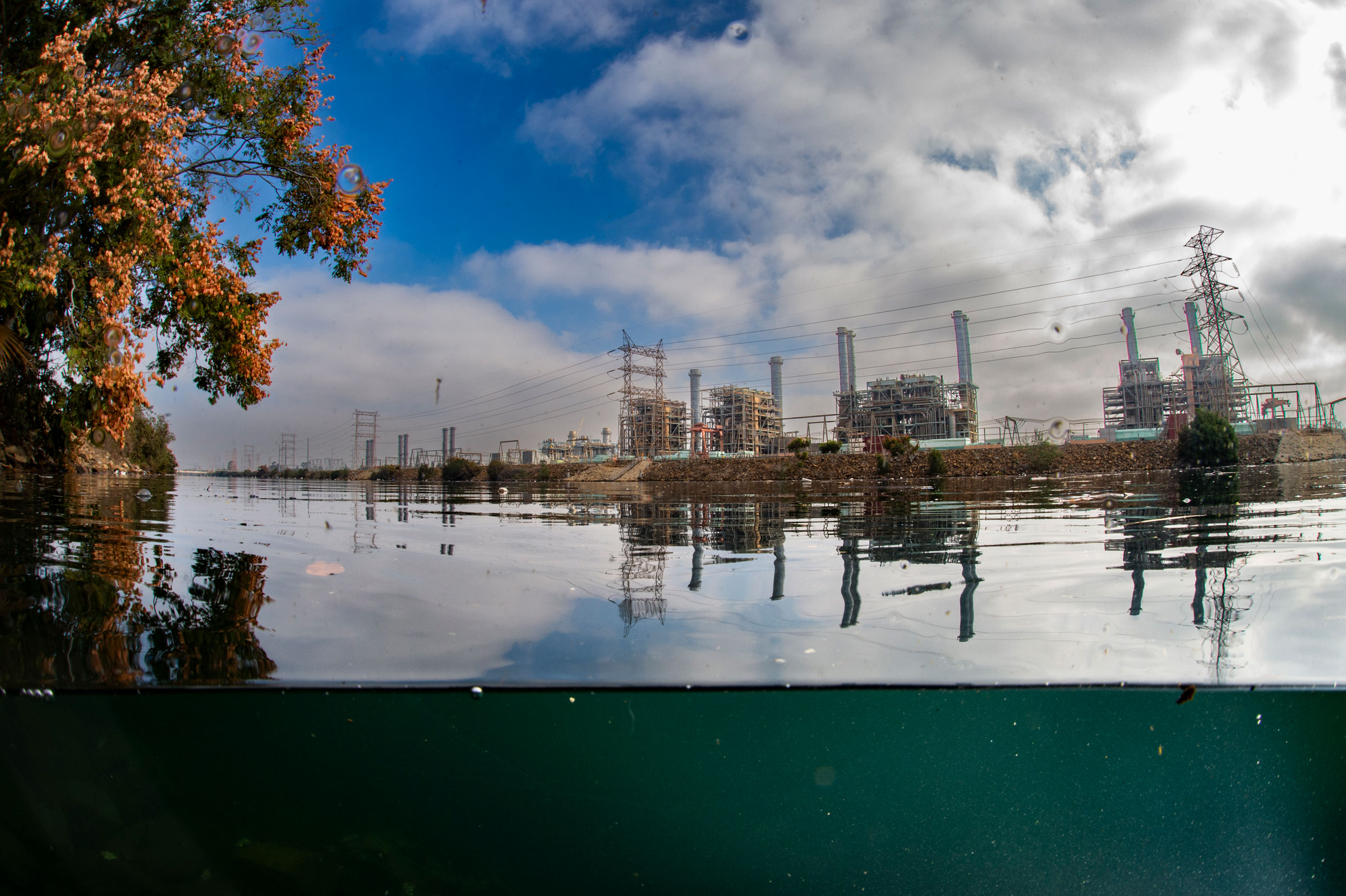
Lisa Komoroske, an ecologist at the University of Massachusetts Amherst, coauthored several recent toxicological studies on sea turtles in San Diego Bay and the San Gabriel River. Although bloodwork from turtles in the San Diego Bay area showed traces of heavy metals, chemicals like PCBS that were banned decades ago, and PBDEs, which can be found in flame retardants, Komoroske did not find any evidence that the compounds are having negative effects on the animals.
When humans are exposed to PCBs and PDBEs over time, the risks range from rashes to thyroid and liver damage to cancer. Maybe, since turtles eat lower in the food web, the toxicants aren’t accumulating to dangerous levels.
Or perhaps a species that was nearly stamped out by an insatiable human appetite is now adapting to the Anthropocene. “People like to think of them as being super vulnerable,” says Early Capistrán, “and it’s like, dude, they outlived the dinosaurs. They beat T. rex. They’re gonna be around when we’re long gone.”
Hi, I’m Dave, the executive director of bioGraphic. (And that’s my dog, Finn.) Thanks for taking the time to read this story.
Stories like this simply don’t get produced without financial support from readers like you. bioGraphic is an independent non-profit—we’re not backed by a private company or owned by a billionaire. One-quarter of our budget comes directly from reader donations.
bioGraphic publishes environmental reporting that you can’t find anywhere else: deeply researched, trustworthy stories that are also beautiful and captivating to read. Right now, we need your help to raise $30,000 by October 2. Every dollar will go directly to more crucial reporting projects.
Around the world, governments are slashing funding for conservation and scientific research, placing even more ecosystems and wildlife at risk. At bioGraphic, we’re steadfastly shining a light on the threats to our planet’s incredible biodiversity. And we’re showcasing the hard work of people bravely taking action to protect at-risk species.
bioGraphic offers an antidote to apathy and doom-and-gloom news by revealing the wonders of the natural world and focusing on real solutions to big problems. When you finish a bioGraphic story, we want to leave you feeling informed, delighted, and inspired.
We don’t run ads or hide our stories behind a paywall. The readers who generously support bioGraphic allow our work to remain free for everyone.
We reached our goal, but there’s time left. Will you help us smash our original goal and reach a new goal of $30,000 by October 2?

Related Articles
The Trouble with Tamarisk
Twenty-five years ago, land managers unleashed a beetle to control an invasive tree sucking rivers dry. But water levels haven’t risen—and the real villains are still causing trouble.
Death by a Thousand Dams
Tens of thousands of small barriers hamper fish recovery in the northeastern United States. But while the demolition of big dams out west gets the most attention, a similar revolution is revitalizing northeastern streams and rivers—one tiny dam at a time.
The Unwilding of Patagonia’s Pollinators
In a region synonymous with wilderness, native bumblebees are being replaced by industrial worker bees—and ecosystems are paying the price.
