
Story and photographs by Dustin Patar
Translation by Olga Papash and Geo Filippov
The silence permeating the early February air is the kind only made possible by a thin layer of snow, which fell on the oak forest of central Ukraine the night before. Nestled in a clearing is an oblong pen, with ears of corn and an assortment of root vegetables littered across ground pocked with hoof prints. It’s a trap.
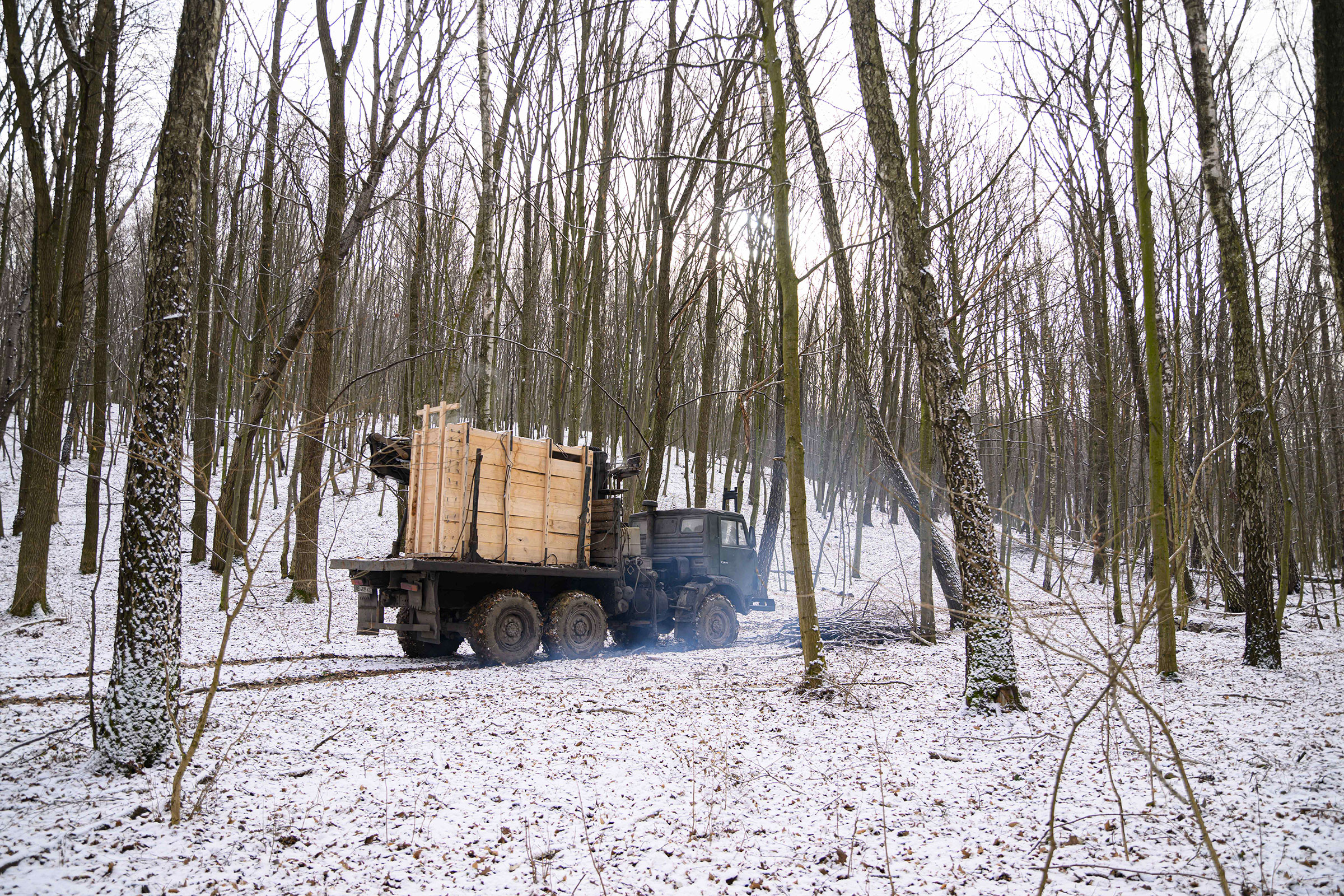
Suddenly, a faint grumble interrupts the tranquil scene. As the noise grows louder, accompanied by the sound of snapping branches, a nearby group of fatigue-clad men spring into action. Moments later, the dark, lumbering beast enters the clearing: a six-wheeled, olive-drab Kamaz truck. At more than 3 meters (10 feet) tall, it stands in stark contrast to the skinny, leafless trees of this forest preserve near the city of Khmilnytske.
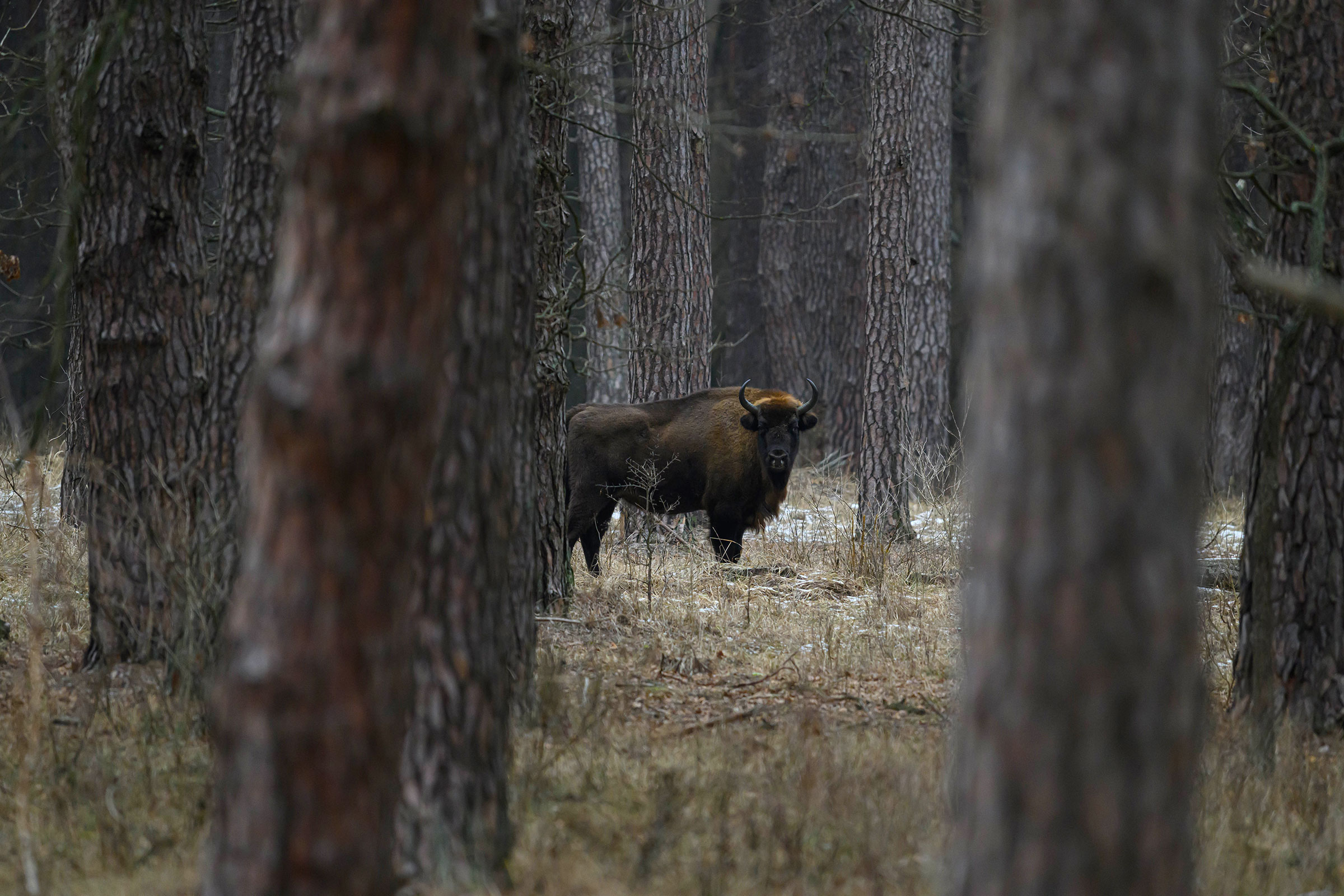
The truck, which belongs to a state-owned forestry unit and is normally used for logging, stops beside a wooden crate at one end of the pen. The box is mostly featureless except for two small openings at the top of both sides, from which steam billows. Several forestry workers peer through the slots at a male European bison (Bison bonasus) who wandered into the trap a few days earlier.
After the men load the crate and the bison onto the Kamaz, the truck skulks back in the direction it came, beginning a day-long trip to Zalissia National Nature Park, roughly 300 kilometers (200 miles) away, near the city of Kyiv. The journey is far from over, but even making it this far is a small but symbolic victory for Ukrainian conservationists, who face not only Russian attacks on their sovereignty but also on their decades-long effort to ensure that Europe’s largest land mammal—once nearly extinct due to human conflict—still has a home in Ukraine.
Three years earlier, both Ukraine’s bison and its people were quietly going about their lives when everything changed. On February 24, 2022, the haunting shriek of air raid sirens blasted as Russia invaded from the north, east, and south. Within the first 24 hours, Russian forces had pushed to the Dnipro River on the outskirts of Kyiv. The staff of Zalissia park, roughly 32 kilometers (20 miles) northeast of the Ukrainian capital, rushed to plan for what they saw as an inevitable occupation by Russian forces.
At the start of the war, the fenced-in 14,800-hectare (36,572-acre) park, slightly larger than San Francisco, was home to an abundance of wildlife, including an estimated 2,000 deer, moose, bison, and other ungulates. A smattering of buildings provided homes for staff.
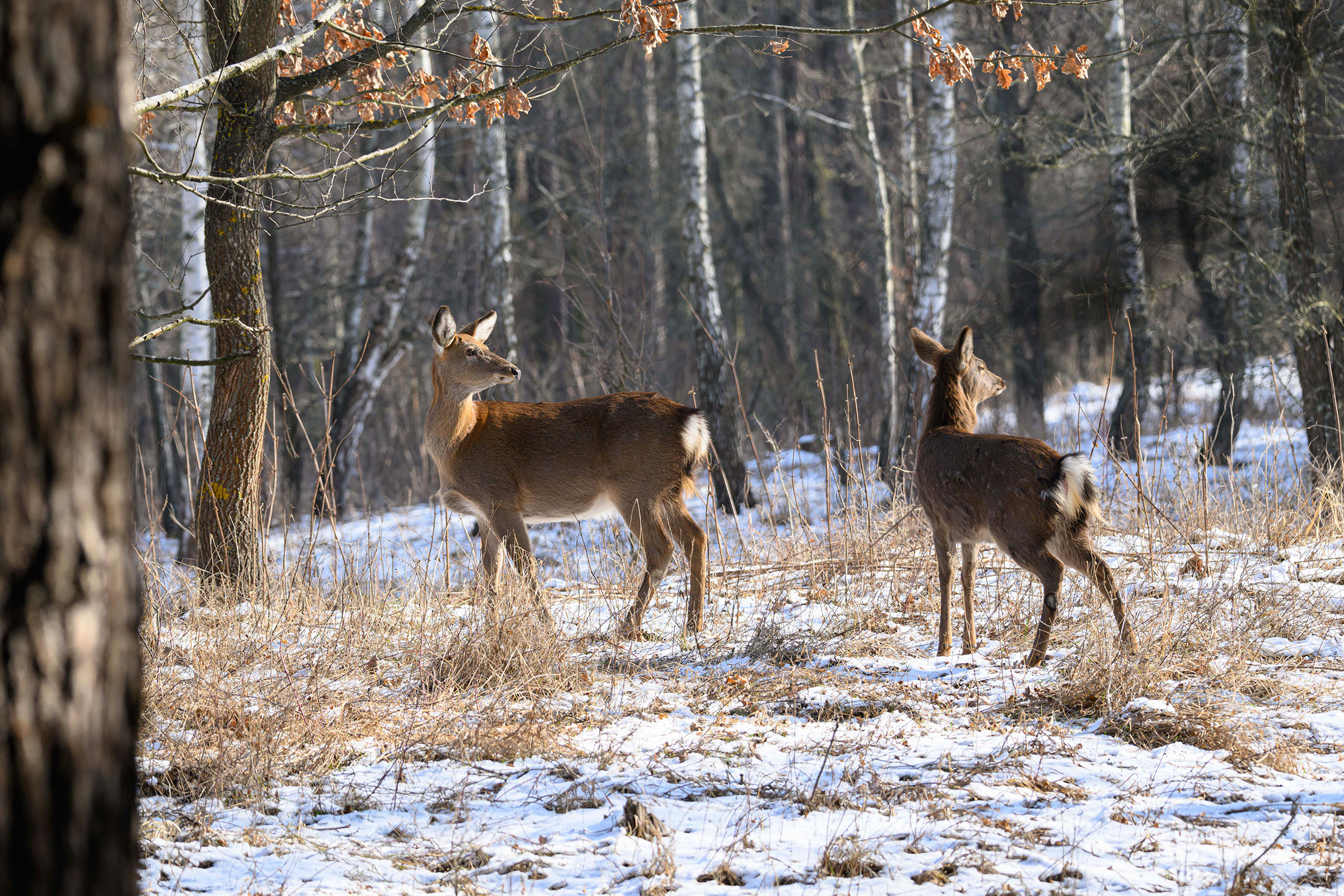
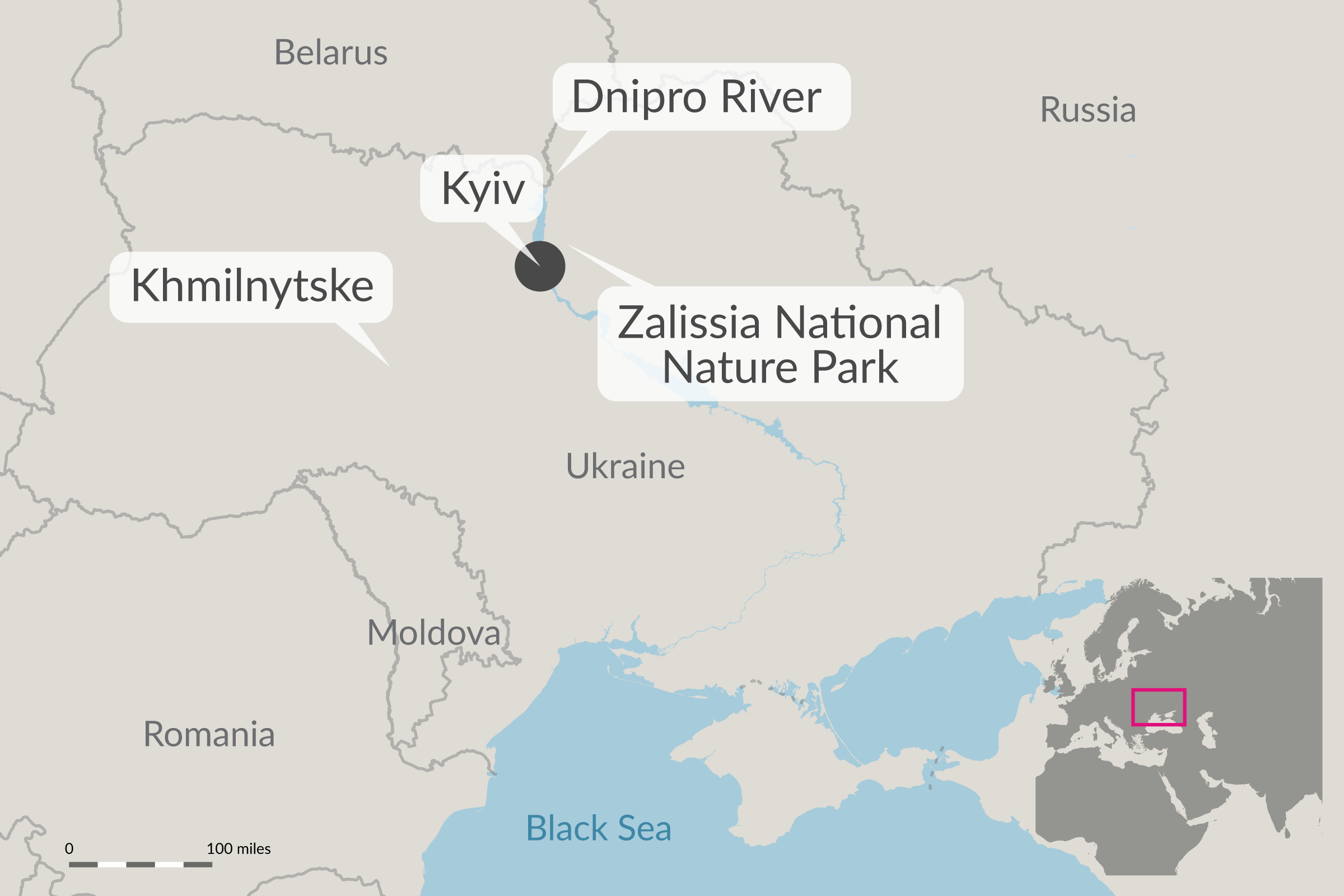
By the time a subsequent wave of Russians assembled outside of Zalissia’s southern border about two weeks after the initial invasion, all but 50 of the park’s 266 employees had evacuated. Among those who stayed was park director Taras Kohut. “The people who stayed here, they feel like it’s their home,” he says. “They have their houses here, their kids grew up here, and they feel this park and the animals are a big family.” With signage removed from the M01 highway outside the park and entrances sealed off with concrete blocks, park staff—armed with guns and other munitions from the territorial defense forces—retreated to Zalissia’s interior forest, preparing to defend themselves and this place that mattered so deeply to them. From there, they went on patrols and assisted the Red Cross by opening one of the park’s roads to evacuees fleeing from nearby settlements to Kyiv, away from the approaching Russian forces.
The M01 just outside the park became a battleground. Ukrainian forces ambushed a column of Russian tanks on the highway—an effort that was captured on video and quickly gained international media attention as an example of both the heavy fighting and of the fervor of the Ukrainian counteroffensive. Within a few weeks of their arrival, the Russians had been expelled from the area, pushed back across Ukraine’s northeast border. By then, Kohut and his staff had helped more than 20,000 people evacuate through the park, earning the team a letter of commendation from the national Ministry of Defense.
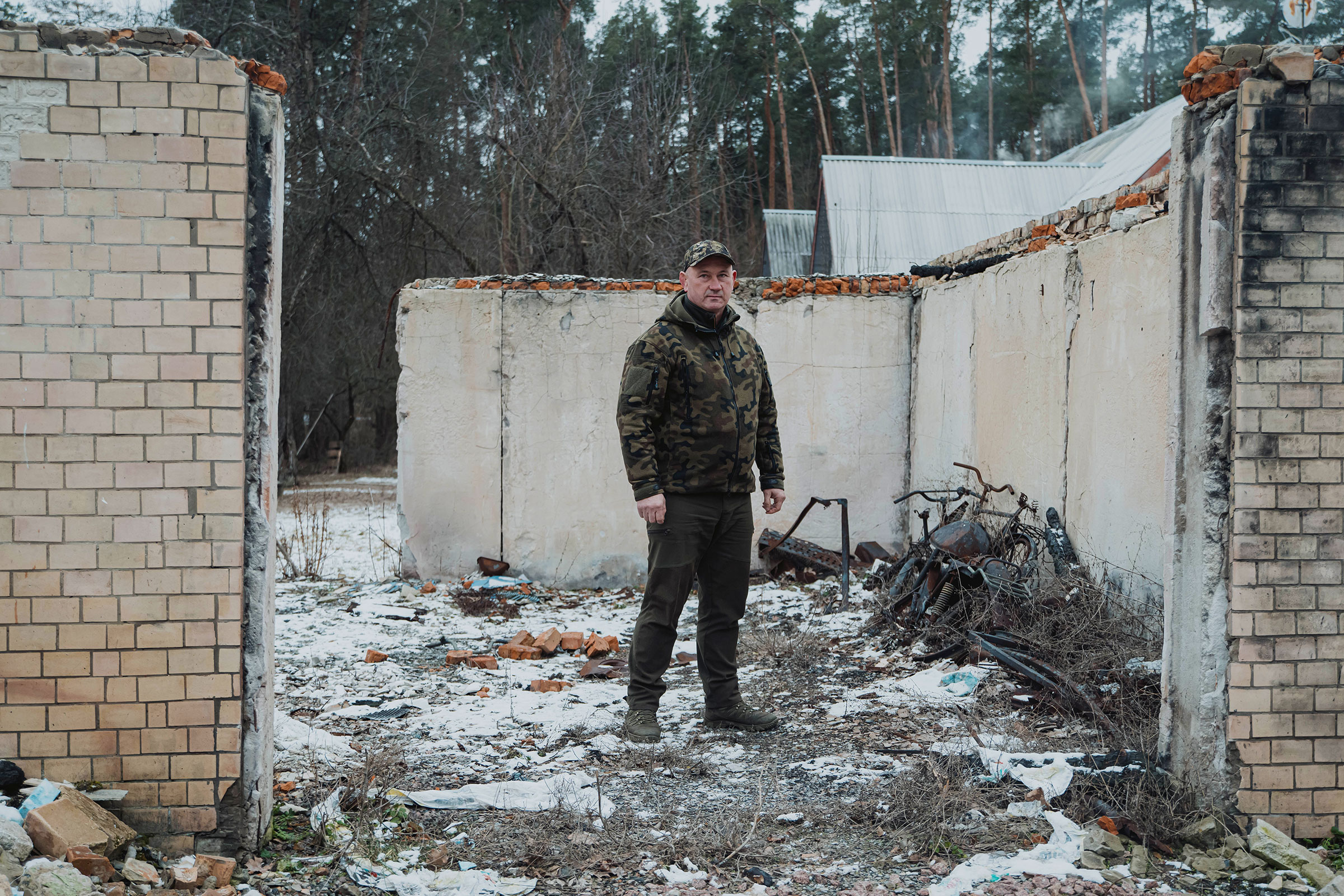

As the dust settled, the extent of the damage to Zalissia became apparent. Several buildings close to the M01 lay in ruins, portions of the park’s perimeter fence were gone, and swaths of forest had been destroyed. And although the fighting in that part of the country had subsided, danger persisted. In their wake, Russian forces left behind land mines, unexploded ordnance, and booby traps.
Further damage to the park also continued. In the days, weeks, months, and now years since Russia’s invasion of Ukraine began, Zalissia has been hit by countless drones and ballistic missiles that, for one reason or another, failed to reach their likely target of Kyiv. These ever-present reminders of war have made assessing damage to the park’s fauna challenging. Victoriia Polska, head of Zalissia’s science department, recalls the grief she felt when, in 2022, she was permitted to enter an area that had just been cleared of mines and came across the remains of a bison.
“[We] really had hoped … that we would find them alive,” she says. In total, park staff found the remains of three bison, but it wouldn’t be until early 2023 that a wildlife survey of the park revealed that one-third of its bison were gone. Only 14 animals were left. Worse, not a single male was left in the herd. Sometime after that discovery, Polska and park staff decided to release Muscat, a young, captive-born male who had been brought to the preserve from the Kyiv Zoo in 2019 due to a lack of space and had since been kept in captivity. After an initial mating season yielded no results, Polska and her colleagues believed Muscat was sterile. This meant that if no male bison were brought to the park, the herd was doomed to vanish, just as the entire population of European bison nearly had in the past.
When Ostap Reshetylo of WWF-Ukraine got the call that a male bison had entered the trap in Khmilnytske’s forest, he had just a few moments to feel elated before scrambling to organize logistics. A day later, he arrived in the snow-dusted oak forest and found himself face to face with the captured animal, whom he estimated to be 9 years old. “I had seen some videos previously when I was informed that bison is trapped,” recalls Reshetylo. “But of course, it is much, much better to see with your own eyes.” It was the moment he had been working toward for two years, since WWF and Zalissia staff had begun collaborating with the goal of relocating two male bison to Zalissia to save the herd.
Now, the Kamaz emerges from the half-frozen mud of the Khmilnytske oak forest and onto pavement. The next step is to transfer the crated bison to a smaller, road-friendly transport van that will take it the rest of the way to Zalissia. The scene that played out earlier in the day repeats, this time in a new clearing surrounded by forestry-related buildings. Kohut and Reshetylo stand by, watching as the crate sways, dangling from a hydraulic arm attached to the back of the Kamaz. Once it’s secured, the two men scramble into the van and drive away, followed by several others, including Polska and Ihor Dykyy, who works alongside Reshetylo at WWF.
The stretch of road from Khmilnytske to Zalissia takes the bison past a mix of forests and farmland with a medley of settlements scattered between. Despite being halfway across the country from active combat, signs of the war are everywhere, from military trucks on the highway to uniformed soldiers walking down the street. At one point, an air raid siren wails in one of the villages, warning of some imminent threat. Yet daily life continues.
Sights and sounds like these have become the norm since the full-scale invasion began. Ukrainians have adapted out of necessity. “If you think about it every time, you just go insane,” says Polska, noting that in the past year the anxiety she initially felt when she heard an air raid siren has stopped. “You just need to accept that life has this kind of uncertainty.”
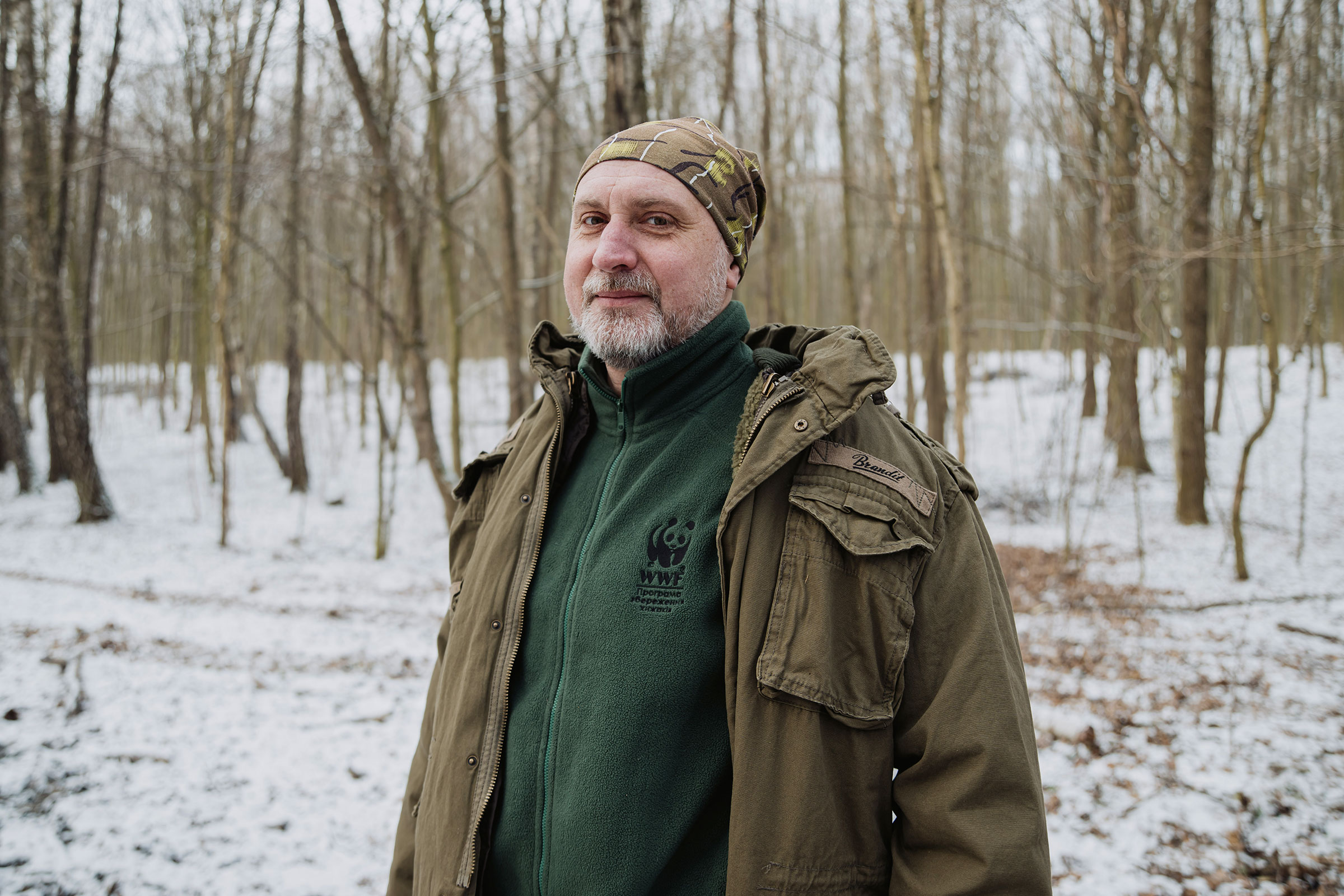
Others have adapted in different ways. Shortly after the war began, Dykyy, who was a professor of zoology at a university in Lviv in addition to working with WWF, enlisted in the territorial defense forces. “I’m a man who has to protect his family,” he says. Eventually, the academic, who had never held a gun before and spent his career focused on wildlife conservation, found himself on the front lines. There, the realities of combat set in. “At war, civilian logic doesn’t work,” he says, “It’s either you kill, or you are killed.”
According to Ukrainian president Volodymyr Zelensky, an estimated 55,000 Ukrainian soldiers have been killed in action as of early 2026. Memorials commemorating their sacrifice are slowly engulfing public squares in every town and city and institution, including Zalissia. An additional 15,000 or so Ukrainian civilians have been killed in the war, seven of whom died in an attack roughly two city blocks from Reshetylo’s home in Lviv. “Here in Ukraine, we understand that all our plans can be destroyed any minute,” he says.
In addition to the human loss, impacts on the wild world have been profound. In 2024, Ukraine’s environment minister claimed that the Russian military had committed 6,500 crimes against the environment since the invasion, such as damage to forests, contamination of ecosystems by mines and other unexploded ordnance, water pollution, and air pollution. Some 30 percent of protected areas had been impacted by the war as of 2023, and several remain under Russian occupation. Polska notes that not all the dangers posed by the occupying forces are about what happens; sometimes what doesn’t happen is just as dangerous. “Even if these territories are not destroyed, like literally by shelling and fire, they still need special care, special attention, which cannot be provided under Russian occupation,” she says.
Faced with such staggering losses, it can be hard to understand the drive to save one small herd of bison, especially considering that the country has six other herds. For Reshetylo and his colleagues, the project is a show of hope—in Ukraine, in its wildlife, and in its people—in the midst of so much destruction.
“Being conservationists, biologists, ecologists, we can’t just sit and look and wait [for] when [the war] will stop finally,” says Reshetylo. “We are trying to do at least something. … We have to look to the future and have this positive way of thinking.” While in the mud of the frontlines, Dykyy even spent whatever downtime he could manage trying to document the ecological effects of the war, imagining that one day he could return to the classroom and share them with students.
Russia’s invasion isn’t the first time that broader geopolitical forces have affected the fate of European bison in Ukraine and beyond.
Sometime around the mid-Holocene, roughly 6,000 years ago, European bison, also known as wisent, were found throughout the European continent, from as far west as the Champagne region of what is now France to as far east as the Volga River in modern-day Russia. Although they had an extensive range, archaeological and paleontological evidence—or rather the lack thereof—suggests that European bison were never as abundant as their North American cousins, which may have once numbered as many as 60 million animals.
Although the two bison are similar, European bison predominantly live in forested areas, where they graze on shrubs and trees above the forest floor. They are slimmer, less hairy, and have longer legs than those from the North American plains. Buffalo, as they’re often known in the United States, have larger heads positioned closer to the grass they eat. Perhaps the most obvious visual difference is that a buffalo’s horns tend to point up, whereas their European cousins have horns that point more forward.
Early Europeans treated bison as though they were a limitless resource. One account suggests that, in 1431, at least 60 bison died each week to be served at royal banquets in Lutsk, Ukraine. Similar stories of slaughter, including one by Russian tsar Ivan the Terrible, can be found throughout early Ukrainian literature. The ever-increasing human footprint and gradual overexploitation, later spurred on by the development of firearms, eventually proved too much. By the early 1800s, European bison had vanished from the wilds of Ukraine. Although Ukrainians made several attempts to reintroduce the animals a century later, they didn’t succeed: Not a single wild bison in Europe survived World War I and the subsequent Russian Revolution. Whether the animals predominantly died as a direct result of the conflicts or at the hands of hunger-stricken citizens desperate to survive is unclear, but the species lived on only in zoos and private reserves.
In 1965, a Soviet Union-wide conservation program made another attempt at reintroducing bison to Ukraine. This one was more successful. By the mid-1990s, the country was again home to more than 660 bison, representing a third of the world’s population. But the collapse of the Soviet Union in 1991 quickly changed that.
“After the proclamation of independence of modern Ukraine, the difficult times came once again,” recalls Vitalii Smagol, a large-mammal zoologist at the Schmalhausen Institute of Zoology in Kyiv and Ukraine’s foremost expert on European bison. A prolonged economic crisis provoked poaching, habitat degradation, and corruption that led to mismanagement, despite the bison being listed in the Red Book of Ukraine. “We can’t say for sure, but we think that at that time, almost every year, Ukraine was losing up to 50 bison.”
When Smagol started to work with bison in 2009, the first thing he did was count the population. One herd, officially listed as 200 animals, had dwindled to 14; another had declined from 300 to 30. “It turned out that it’s not like two or three times [less], it’s more than 10 times less than they had on the official count [from the year prior],” says Smagol. His research indicated that just over 200 bison were left in Ukraine, and that four of the country’s 11 herds had been lost. Although turmoil in the country continued throughout the following decade, so too did bison conservation efforts. By 2021, Ukraine’s bison population had climbed back to 402 animals, the fifth-largest in Europe.
Yet war and its effects aren’t the only factor limiting their future.
Several vehicles sit in a dim clearing inside Zalissia National Nature Park, surrounded by the black silhouettes of towering pines. Although light is limited, it’s clear that the bed of the cargo van is empty, as is the nearby wooden crate. The people who came here from Khmilnytske stand in a quiet huddle, illuminated by the headlights of one of the parked cars. The light darting between their shadows reveals a large tarp, draped over a mound with four hooves sticking out. The male bison is dead.
As emotions flare, Dykyy draws on his military experience to offer support to those around him. “After being at war and having combat experience, you realize panicking is useless,” he says. “What happened has happened.”
The next morning, the group gathers around the bison again, joined by a veterinarian who will perform a necropsy. Once the bison’s chest cavity is open, everything becomes clear. The animal’s red and pink heart has ruptured and looks more like a strange beached jellyfish than a rigid muscular organ.
Although the bison died of a stress-induced heart attack brought on by its move to Zalissia, what really killed it was genetics. All 9,000 bison now in existence across Europe can be traced back to the same 12 captive individuals that scientists bred in 1924 in an attempt to save the species after it had entirely disappeared from the wild. Zoologists like Polska and Smagol refer to this as the first genetic bottleneck. The second bottleneck occurred just over 20 years later, after World War II, when 67 animals were used to jump-start the species once again.
According to a 2020 International Union for Conservation of Nature report, the limited genetic pool of European bison potentially constitutes “the most serious threat to the species’ future.” One side effect of the bison’s poor genetic makeup is a heart prone to stress-induced failure. While the bison of Zalissia who died during the Russian occupation could have been shot or killed by mines, it’s also entirely possible they simply died of heart attacks. The potential for bad hearts also makes it extremely risky to tranquillize the animals before transporting them. Moving animals without sedation, which is what the WWF and Zalissia team did—with the help of experts—presents some risk, too, but it was a chance the conservationists felt they had to take.
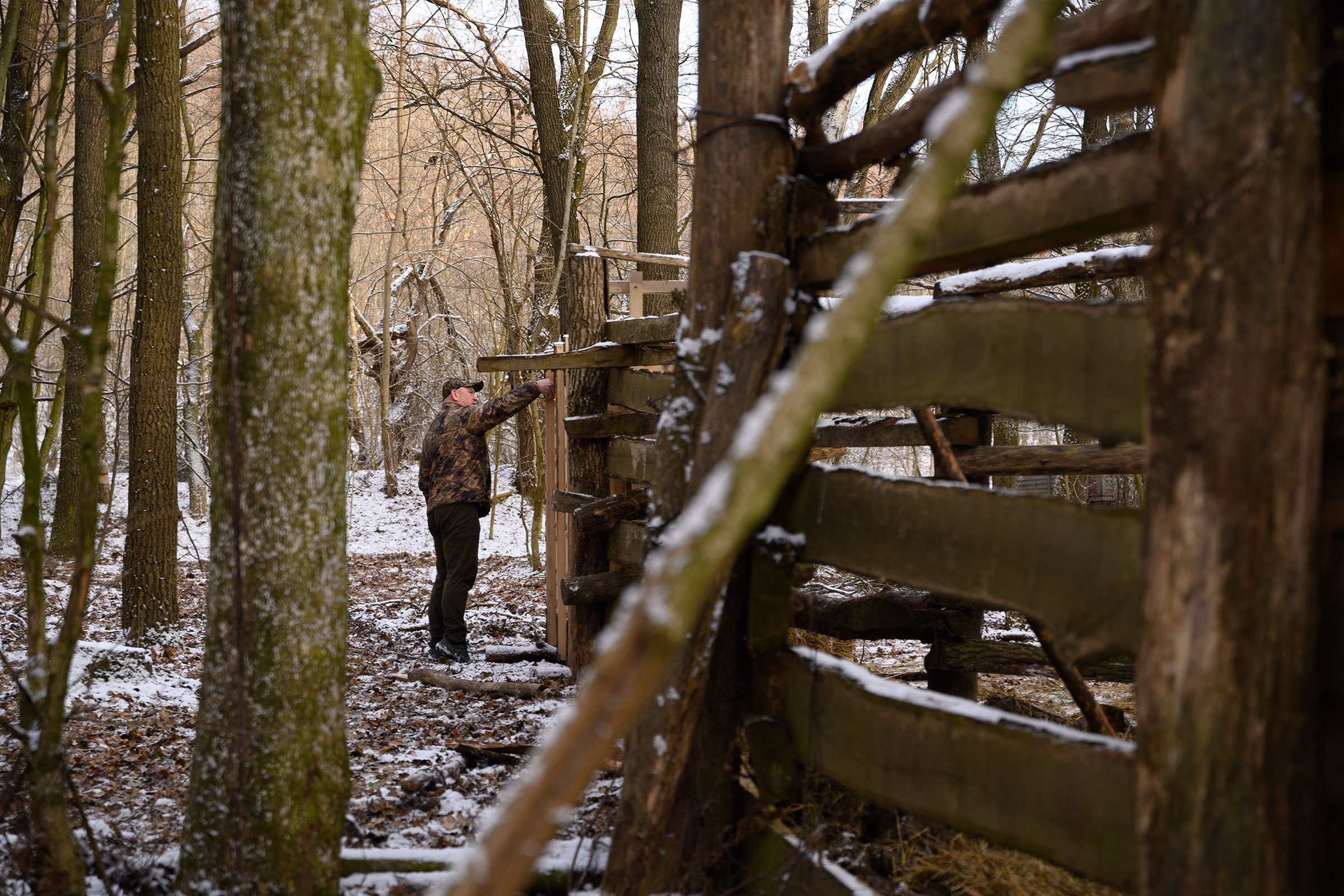
Weeks after the necropsy, efforts to trap a second bison resume, but the team is thwarted by warm temperatures: Bison will only wander into traps if stricken with wintertime food scarcity. The window to move a second bison soon closes, and given all of the behind-the-scenes complexities, the earliest another relocation could take place is 2027—though there are currently no plans for that.
One of the chief concerns among those trying to save Zalissia’s herd at the outset was that female bison of breeding age have two modes: pregnancy and calf feeding. Smagol says that if they break this cycle of pregnancy and lactation long enough, it may mean they can no longer reproduce, which he feared was the case in Zalissia.
In the months following the failed relocation effort, though, the team receives a surprise: three bison calves born to the Zalissia herd, two males and one female. The father is Muscat, the bison born in the Kyiv Zoo who Polska assumed was sterile after an initial unsuccessful breeding season. With nothing to lose, she had allowed him to roam free for a second summer. As it turned out, he was not so sterile after all.
Unfortunately, on November 14, 2025, Muscat also dies of acute heart failure, this time caused by severe stress triggered by a powerful explosion, part of a major Russian attack on the greater Kyiv area that also claims the lives of six Ukrainians and injures 34 others. Muscat’s legacy lives on in the park, but Polska fears that the Zalissia herd is still on the verge of extinction due to the animals’ overall poor genetic condition and the fact that some of the females have likely aged beyond their prime reproductive years.
Even with the tragedies and triumphs of the past several years, Polska remains unfazed. As is necessary in such a dynamic situation, she has long-term backup plans. In late 2024, Zalissia entered into an agreement with the Czech Republic, which will gift two male bison to Zalissia with the understanding that the park will cover transportation costs. An outbreak of a disease called bluetongue among Czech bison has halted those efforts for now, and the war has stripped the park of all but essential funding, but Polska is confident the work of saving Zalissia’s bison will continue. “We need to preserve what we got from the previous generation and pass it to the next ones,” she says. It’s a sentiment that everyone working on the bison relocation project agrees with, and it’s also undoubtedly the reason European bison as a species still persists today, after nearly being lost to extinction just over 100 years ago.
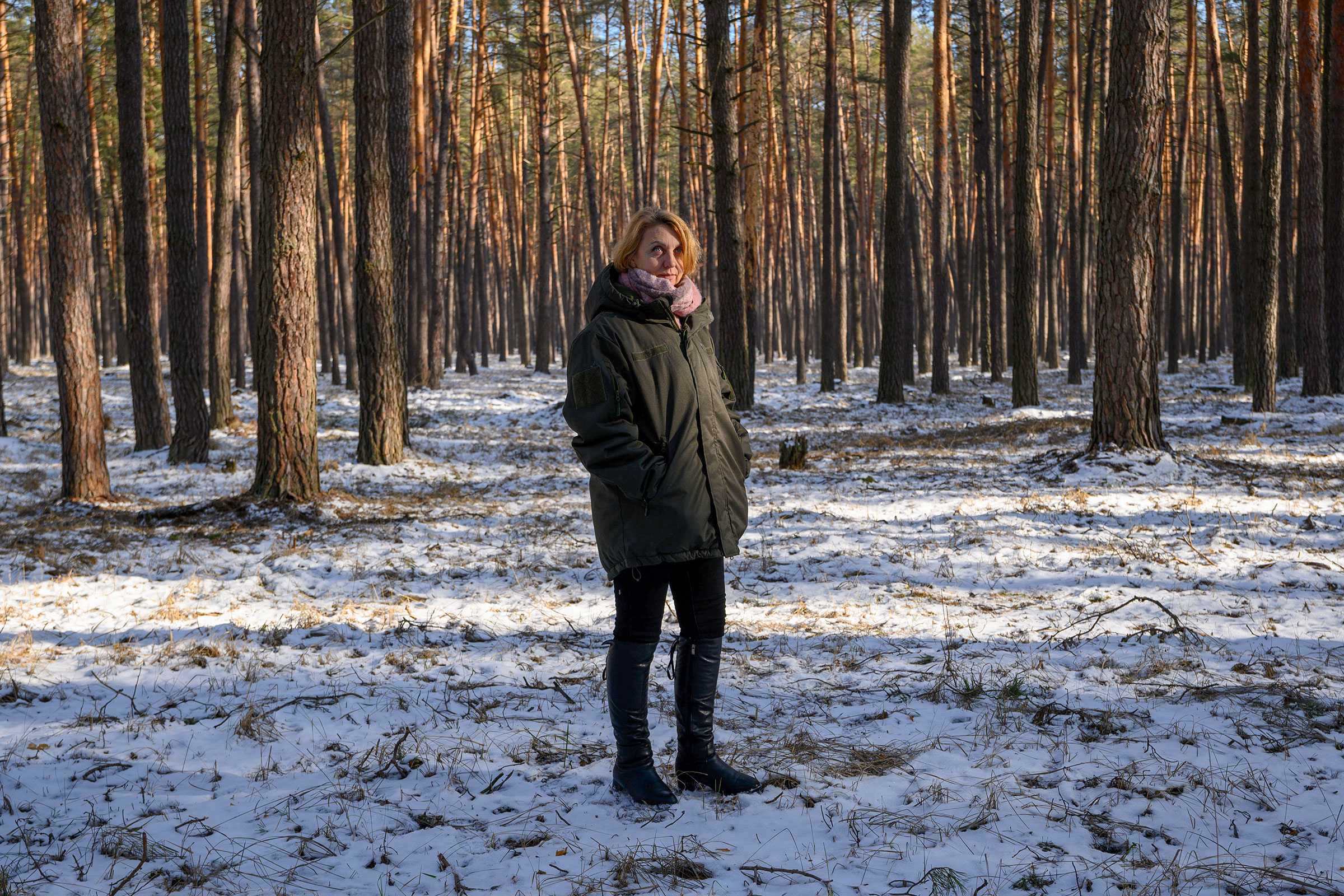
Although Zalissia has long been a protected area, it was only officially designated a national park weeks before the Russian invasion. With the change came a management plan that included the establishment of a research center and breeding program that will enable the park to help repopulate Ukrainian wildlife populations, including bison, within and beyond the park. Although the need for such a program has only increased since the start of the invasion, it, too, will have to wait until funding hopefully returns when the war ends.
Until then, Polska, Smagol, Reshetylo, and the rest of Ukraine will continue working toward that future. Dykyy has now returned to his university and is teaching a new course on how combat influences wildlife habitats, based on his front-line observations. Although the situation in Ukraine continues to be tenuous, the zoologist-turned-soldier finds resolve by recalling an anecdote he once heard about survivors of concentration camps: “The first who died were the pessimists because they saw the darkness, then the optimists because they thought it would end soon, and it didn’t. Those who survived were the ones who were focused on small daily actions.” It’s a lesson as applicable to conservation as it is to survival and combat.
Hi, I’m Dave, the executive director of bioGraphic. (And that’s my dog, Finn.) Thanks for taking the time to read this story.
Stories like this simply don’t get produced without financial support from readers like you. bioGraphic is not backed by a private company or owned by a billionaire. It’s an independent, nonprofit magazine. And one-quarter of our annual budget comes directly from reader donations.
We need your support more than ever, as governments slash funding for conservation and scientific research, placing even more ecosystems and wildlife at risk around the world. At bioGraphic, we’re steadfastly shining a light on the threats to our planet’s incredible biodiversity. And we’re showcasing the hard work of people bravely taking action to protect at-risk species.
bioGraphic publishes environmental reporting that you can’t find anywhere else: deeply researched, trustworthy stories that are also beautiful and captivating to read. We offer an antidote to reader apathy and doom-and-gloom news by revealing the wonders of the natural world and focusing on real solutions to big problems. When you finish a bioGraphic story, we want to leave you feeling informed, delighted, and inspired.
We don’t run ads or hide our stories behind a paywall. The readers who generously support bioGraphic allow our work to remain free for everyone.
Will you help us keep telling these crucial stories?

Author
Related Articles
Trial by Fire
In the burn-scarred mountains of Southern California, a team of biologists fights to help an imperiled frog.
Ethiopia’s Grand Tree-Planting Plan
Efforts to restore lost forests often fail, but Ethiopians are betting big: planting billions of saplings to revive habitat, regenerate soil, and stabilize the land.
The Trouble with Tamarisk
Twenty-five years ago, land managers unleashed a beetle to control an invasive tree sucking rivers dry. But water levels haven’t risen—and the real villains are still causing trouble.