
Photograph by Henley Spiers
Story by Skylar Knight
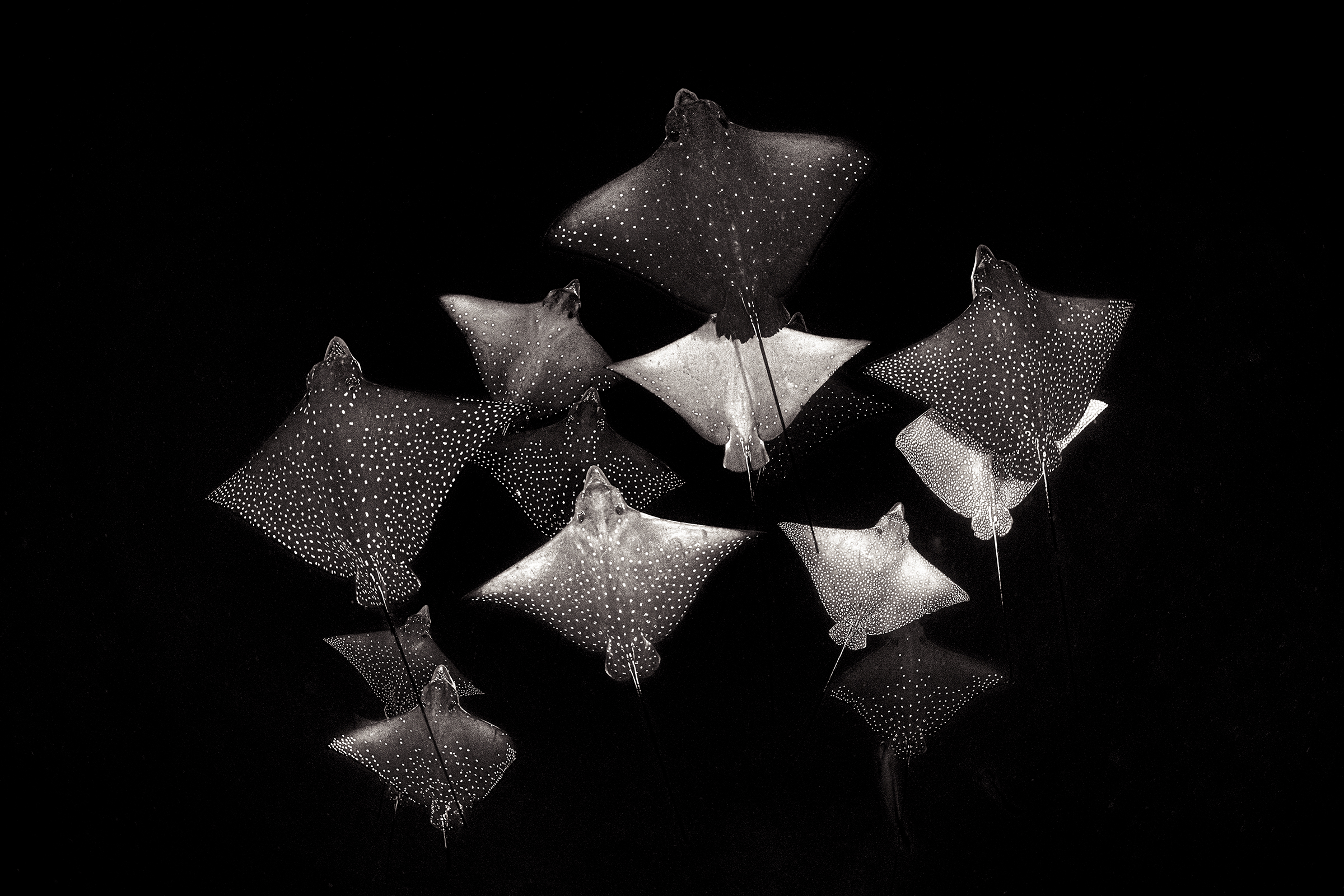
When underwater photographer Henley Spiers chanced upon this school of spotted eagle rays (Aetobatus narinari) during a dive in the Maldives, he immediately keyed in on the individuals with the most arresting patterns of spots. He thought they’d make powerful solo portraits, but it turns out those spots are also unique identifiers. According to a recent study, individual eagle rays have distinct enough patterns of markings on the backs of their wing-like fins that researchers can tell them apart. That could open up new opportunities for understanding the majestic species, which boasts a 3-meter (9.84-feet) wingspan and flies, as its name suggests, with the grace of an eagle on an updraft.
Though they have few natural predators, spotted eagle rays, like other large fish, are often unintentionally caught in commercial fishing nets, a phenomenon called bycatch. Worldwide, nearly 10 percent of all fish landed are bycatch. And although there is a dearth of species-specific data, the subclass of fish that includes sharks, rays, and skates may be particularly susceptible. (Fortunately for the group of rays, also known as a “fever,” seen here, the Maldives has had a decade-long ban on shark fishing which has likely reduced bycatch rates.)
The information gap on spotted eagle ray bycatch represents just one of many mysteries about the species. There is even some debate about whether spotted eagle rays located in the Pacific, such as those Spiers photographed, are an entirely different species from those found in the Atlantic.
Scientists hope to solve some of these mysteries, and protect rays better, with the help of long-term monitoring. To date, researchers have mostly used electronic tags implanted at the base of their fins to identify and track rays. But tags are not only invasive and potentially harmful, they can also fall off or become unresponsive. Now that scientists know how to track a ray by its spots, they may be able to use drones—and even satellites—with hi-resolution imaging capabilities in tandem with pattern-matching software to support these efforts. Then, a ray’s unique “wing” patterns may function a bit like a human fingerprint, revealing the movement of individuals around the world.
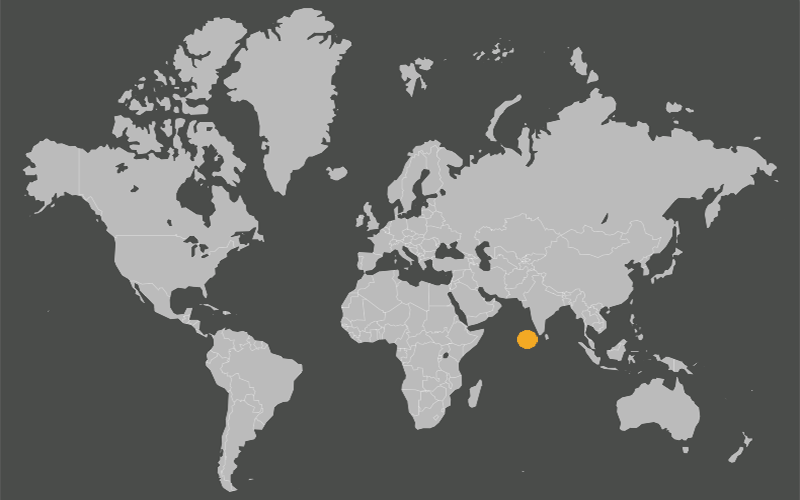
South Malé Atoll, Maldives
Hi, I’m Dave, the executive director of bioGraphic. (And that’s my dog, Finn.) Thanks for taking the time to read this story.
Stories like this simply don’t get produced without financial support from readers like you. bioGraphic is not backed by a private company or owned by a billionaire. It’s an independent, nonprofit magazine. And one-quarter of our annual budget comes directly from reader donations.
We need your support more than ever, as governments slash funding for conservation and scientific research, placing even more ecosystems and wildlife at risk around the world. At bioGraphic, we’re steadfastly shining a light on the threats to our planet’s incredible biodiversity. And we’re showcasing the hard work of people bravely taking action to protect at-risk species.
bioGraphic publishes environmental reporting that you can’t find anywhere else: deeply researched, trustworthy stories that are also beautiful and captivating to read. We offer an antidote to reader apathy and doom-and-gloom news by revealing the wonders of the natural world and focusing on real solutions to big problems. When you finish a bioGraphic story, we want to leave you feeling informed, delighted, and inspired.
We don’t run ads or hide our stories behind a paywall. The readers who generously support bioGraphic allow our work to remain free for everyone.
Will you help us keep telling these crucial stories?

Authors


Related Articles
Milt Meal
Marine creatures will do almost anything for a meal—including feasting on the sperm and eggs of spawning invertebrates.
The Art of the Catch
To bulk up for winter hibernation, Alaska’s brown bears employ a range of techniques for snaring salmon.
The Wonder of a Pale Whale
A curious calf with an atypical birthday suit is a good sign for southern right whales.