
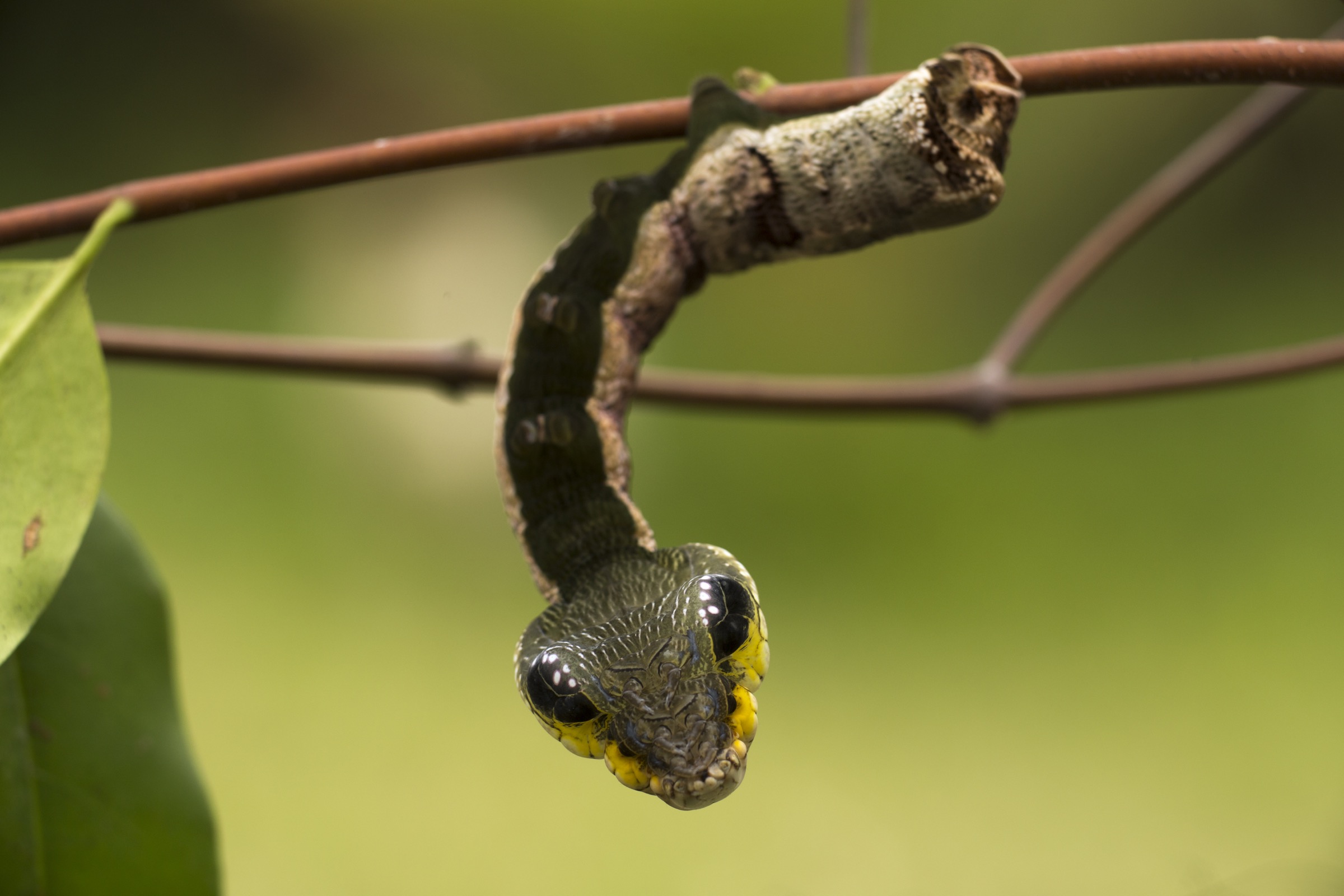
Photograph by Mark Bowler
Story by Madison Pobis
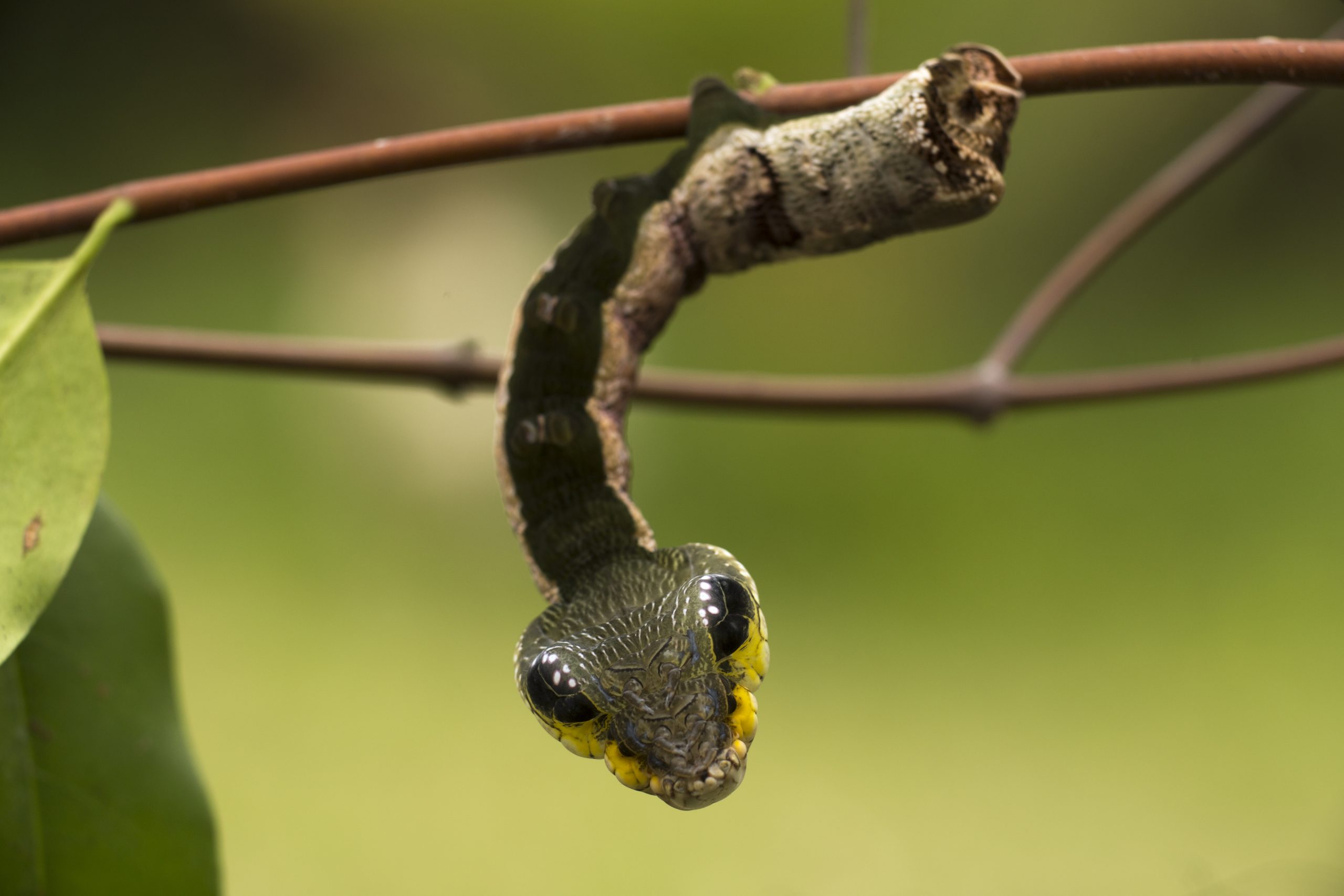
As a sphinx moth caterpillar (Hemeroplanes triptolemus) grows and molts, storing energy from the leaves it consumes, a kaleidoscopic blend of brown and white patches keep it camouflaged amidst the foliage it calls home. The larger the caterpillar grows, however, the harder it becomes to hide. Fortunately for this particular species, its final stage of development offers a new strategy for protection—one intimidating enough to deter even the most ambitious rainforest predator.
At the slightest hint of danger—be it a stooping bird or pouncing lizard—the sphinx moth caterpillar begins its masquerade. Dangling from a twig, it reveals an underside patterned in faux snakeskin and eyespots that appear to glisten. By sucking in air through tiny holes in its surface, the caterpillar inflates its head to create the illusion of a triangular skull swollen with venom glands. If the shape of a deadly snake isn’t enough to startle away a hungry predator, the caterpillar will lunge as if to strike. And despite the larva’s comical lack of any actual weaponry, the strategy appears to be effective. In experiments using artificial caterpillars made out of pastry dough, researchers have found that eyespots and a snake-shaped head can greatly improve a caterpillar’s odds of survival among avian predators, even in regions where tree-dwelling snakes are rare.
Other caterpillars in the sphinx moth family have evolved similar tactics for surviving the stages of development when they are most vulnerable to predators. Nessus sphinx moths (Amphion floridensis), for example, emit an alarming shriek by forcing air through modified mouth parts whenever they’re disturbed, and many larvae will vomit toxic foregut contents onto pesky parasites. These evolutionary strategies have helped to ensure that caterpillars will survive and eventually emerge as fluffy moths ready to mate, pass their adaptations along to the next generation, and of course pollinate flowers, helping to secure not only their own species’ survival but that of countless plants as well.
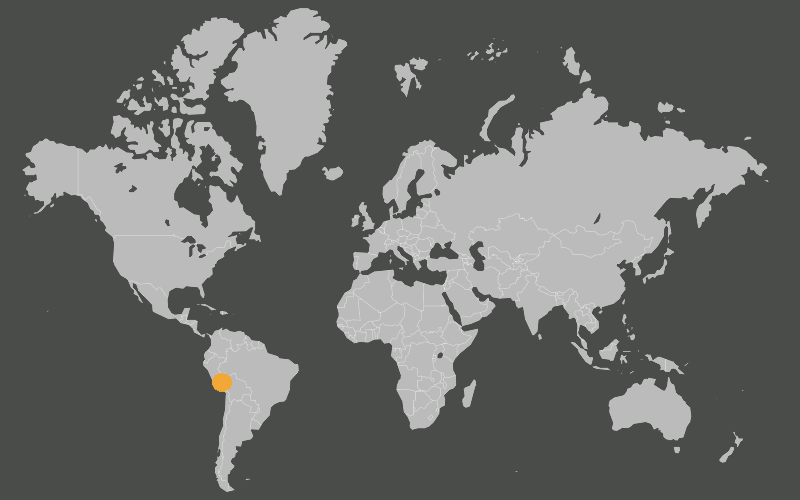
Amarakaeri Communal Reserve, Peru
Hi, I’m Dave, the executive director of bioGraphic. (And that’s my dog, Finn.) Thanks for taking the time to read this story.
Stories like this simply don’t get produced without financial support from readers like you. bioGraphic is an independent non-profit—we’re not backed by a private company or owned by a billionaire. One-quarter of our budget comes directly from reader donations.
bioGraphic publishes environmental reporting that you can’t find anywhere else: deeply researched, trustworthy stories that are also beautiful and captivating to read. Right now, we need your help to raise $30,000 by October 2. Every dollar will go directly to more crucial reporting projects.
Around the world, governments are slashing funding for conservation and scientific research, placing even more ecosystems and wildlife at risk. At bioGraphic, we’re steadfastly shining a light on the threats to our planet’s incredible biodiversity. And we’re showcasing the hard work of people bravely taking action to protect at-risk species.
bioGraphic offers an antidote to apathy and doom-and-gloom news by revealing the wonders of the natural world and focusing on real solutions to big problems. When you finish a bioGraphic story, we want to leave you feeling informed, delighted, and inspired.
We don’t run ads or hide our stories behind a paywall. The readers who generously support bioGraphic allow our work to remain free for everyone.
We reached our goal, but there’s time left. Will you help us smash our original goal and reach a new goal of $30,000 by October 2?

Related Articles
The Art of the Catch
To bulk up for winter hibernation, Alaska’s brown bears employ a range of techniques for snaring salmon.
The Wonder of a Pale Whale
A curious calf with an atypical birthday suit is a good sign for southern right whales.
Saying “Ah!” at the Shrimp Spa
On coral reefs, an army of tiny cleaners eat their clients’ parasites, food particles, and dead skin, boosting biodiversity in the process.
