
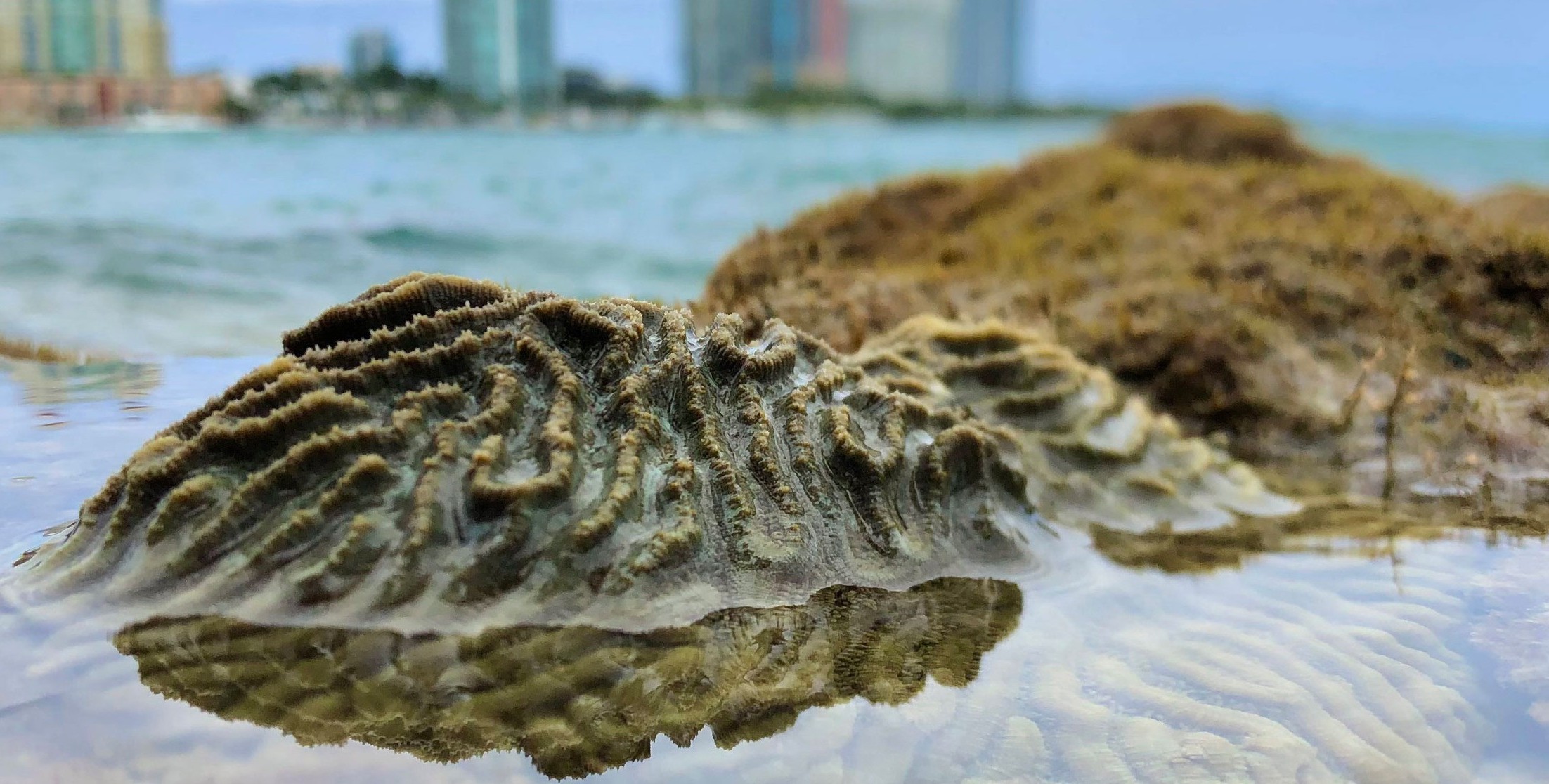
In the shadow of multimillion-dollar mansions and towering high-rises, beneath the daily roar of cruise and container ships, there is a colony of corals that’s not supposed to exist.
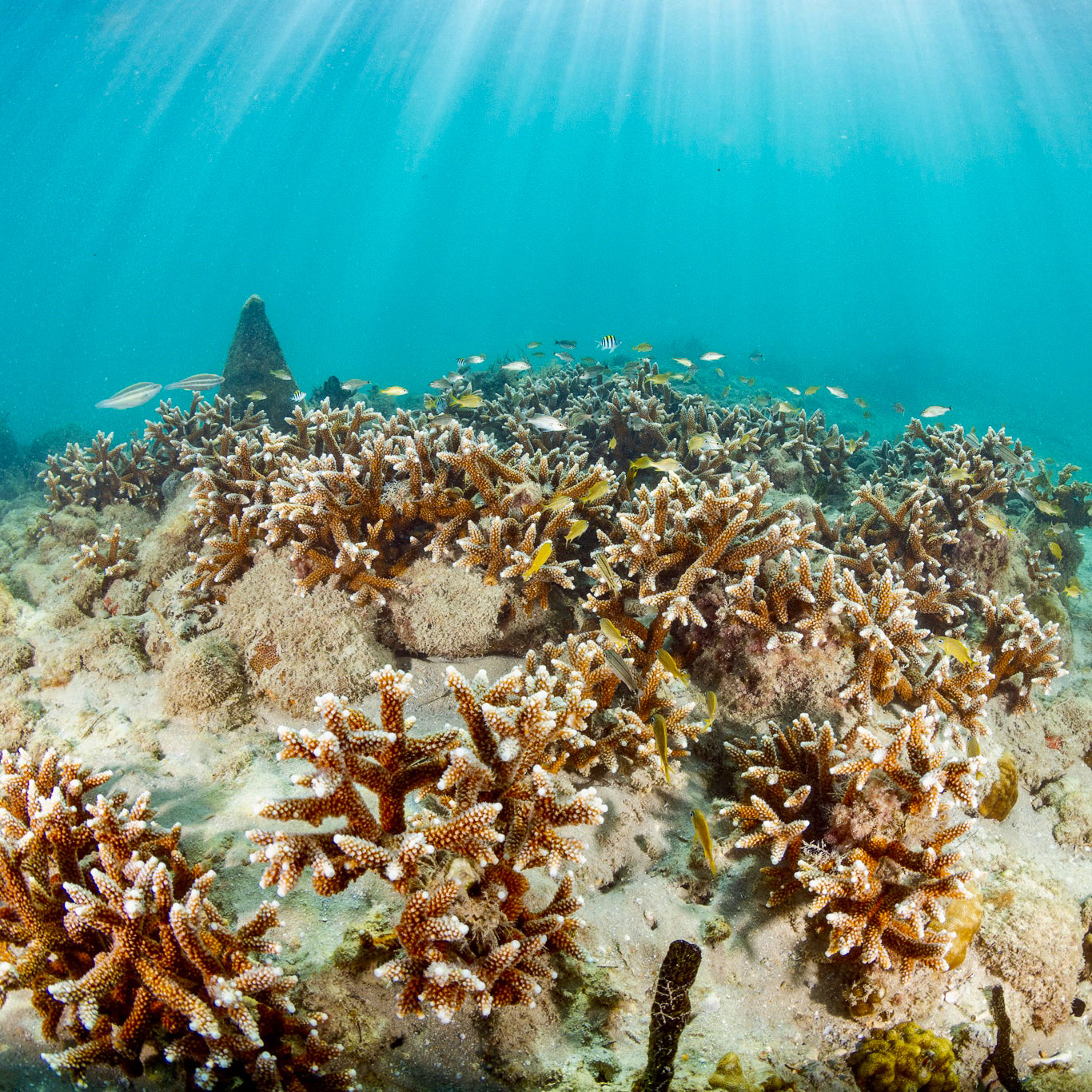
The corals, found in PortMiami, part of Florida’s largest city, grow on discarded shopping carts and on concrete and stone breakwaters. They reach sizes that astonish scientists and attract fish, manatees, and turtles to this busy port, and include two species—elkhorn and staghorn corals—that have been declared functionally extinct elsewhere in Florida. And these corals have stolidly weathered waves of disease, cloudy waters from dredging and pollution, and extreme highs and lows in temperatures. In a time when corals have a reputation for fragility, PortMiami’s tell a different story.
“There’s just something about Miami. I always think of it as the perfect storm,” says Michael Studivan, a scientist at the Cooperative Institute for Marine and Atmospheric Studies at the University of Miami (UM), which is part of a coral program run by the National Oceanic and Atmospheric Administration (NOAA). “There are so many stressors. Yet it seems to be working.”
The unlikely result, Studivan says, is a community of corals that may be primed to handle the stressors that will almost certainly arise in the decades to come, as the waters here—and elsewhere in the world’s oceans—become hotter, more acidic, and less hospitable.
Photograph by habianggaraputra/Shutterstock
If, a century ago, you had dunked your head into the water bordering what is today downtown Miami, there’s almost no chance you would have seen corals there. Corals need salty water and hard surfaces to grow on, and before it was reshaped by human hands, the corner of Biscayne Bay now known as PortMiami was sandy and shallow, sheltered from the Atlantic by a barrier beach, and bubbling with freshwater springs from the surrounding Everglades.
But around the turn of the 20th century, the city of Miami and surrounding suburbs began to expand. Development destroyed more than half of the Everglades’ wetlands and diverted much of its fresh water through canals, leaving less to flow into Biscayne Bay. After a hurricane in 1928, the federal government built a dike around Lake Okeechobee to the north, cutting the Everglades off from another primary source of fresh water. At the same time, workers dredged the growing port, making it deeper for ships and creating more land for the buildings rising at the shoreline. Dredged sand was heaped into piles and secured with stone riprap, creating hard-sided artificial islands that studded the newly formed port. The last piece of the transformation came with the creation of Government Cut, a shipping channel that split Miami’s barrier beach and opened the once-sheltered bay to the open sea.
The sum of all of these changes was a body of water that was dramatically saltier and better-connected to the Atlantic, with more hard surfaces for enterprising corals to capitalize on.
Nobody knows exactly when corals began to show up around Miami, but experts think that they’re a consequence of all this human interference. Although any mariner navigating around southeast Florida knows that a long spine of coral reefs parallels the shoreline just a handful of kilometers offshore, it took time for anyone to notice corals within city limits. A 1943 survey only mentions the offshore reefs, not any corals within Miami itself. Nor do corals appear in a 1950 study of conditions in and around the port, which even tested what organisms colonized an underwater raft that was left on the seafloor for a year.
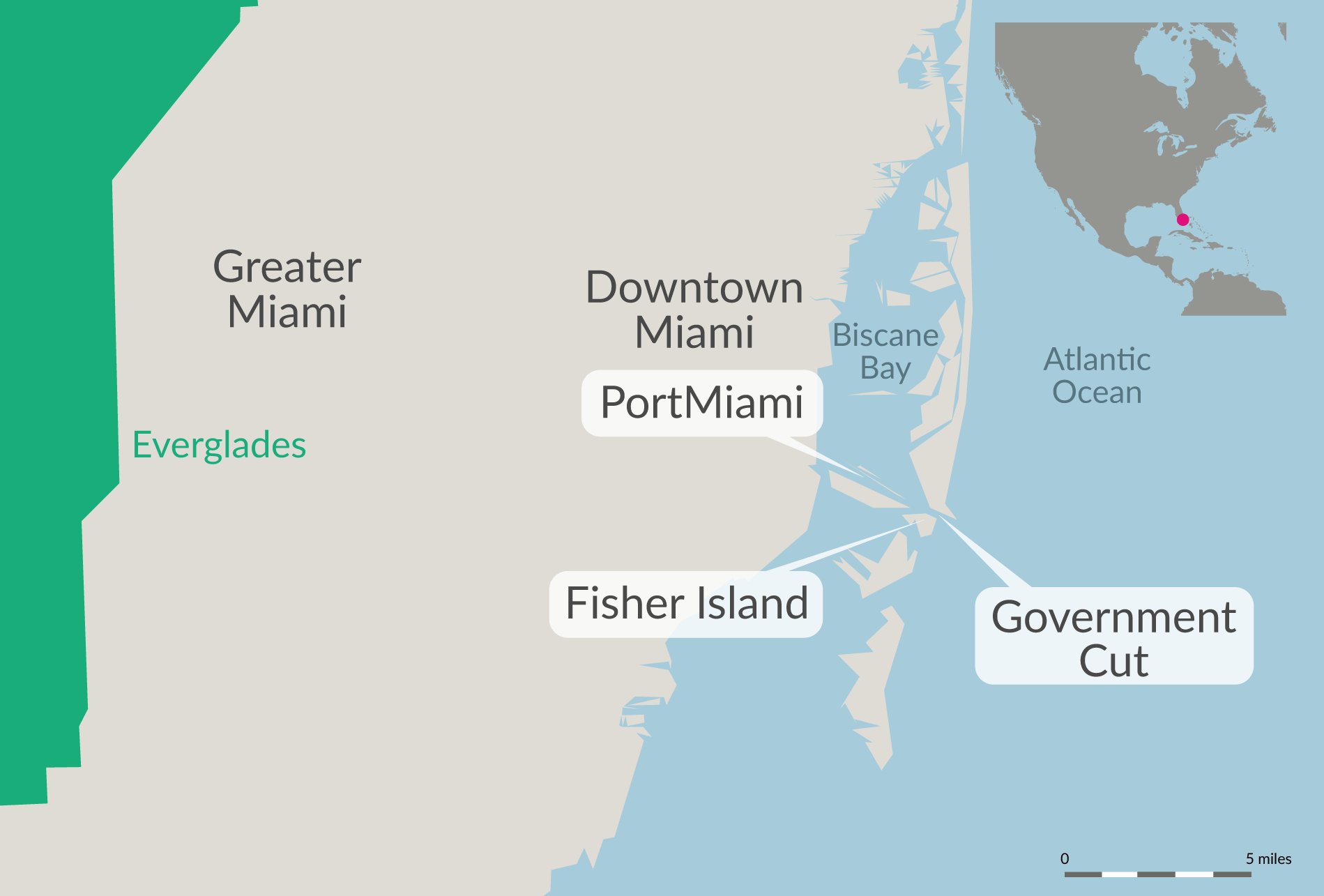
When corals did arrive, they likely came as spawn, flushed in from offshore reefs through Government Cut and other channels. Colin Foord, a marine biologist who studied corals at UM in the early 2000s, first came across these pioneers in 2009: He was snorkeling in the busy waters around Fisher Island, just feet away from the bustling shipping channel of Government Cut, when he spotted coral growing on the island’s seawall. It was a strange luminous green and had pointed, nubbly branches like a staghorn, yet seemed to grow outward like the fingers of a relaxed hand, more like an elkhorn. Foord suspected he might have found a rare hybrid of these two corals, both globally classified as critically endangered after pollution, disease, and warming waters had battered populations across the Caribbean and this part of the Atlantic.
“It changed my whole perspective on where these endangered corals could even live,” Foord says.
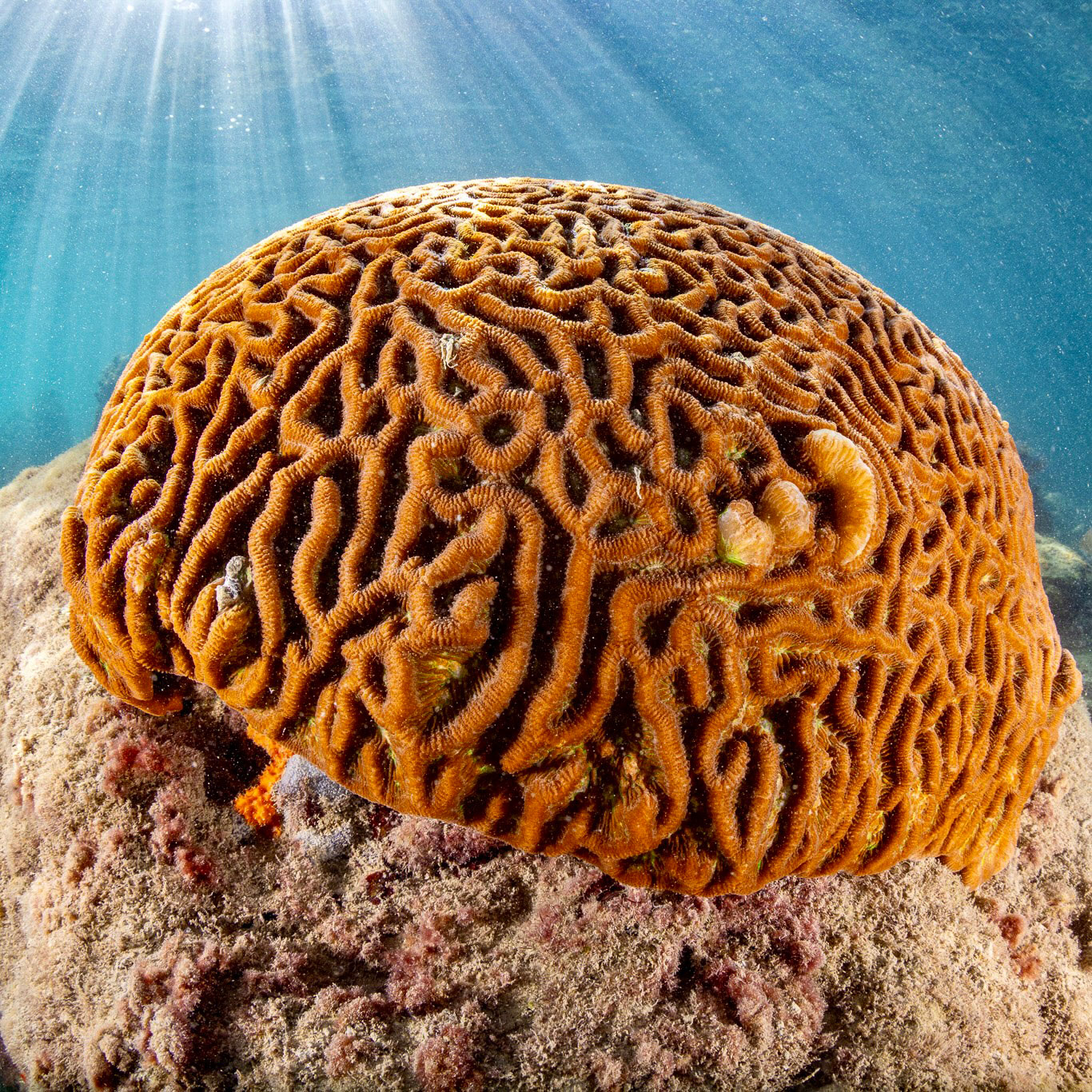
Foord is the cofounder of Coral Morphologic, a nonprofit that uses art, photography, and music to highlight the beauty of corals and raise money for restoration. Intrigued by this discovery in his own backyard, Foord began exploring further and soon found a population of large brain corals growing along the causeway that crosses the port. These communities couldn’t be called reefs, which build up over eons as corals grow and die on top of one another; Foord and others estimated that based on where they were growing, most of Miami’s corals were just a few decades old. Yet they were large, healthy, and often bustling with marine life.
A few months later, Foord noticed something even more astonishing. In January 2010, a record 10-day cold snap killed thousands of fish and corals across much of Florida’s shallow coastal waters. Despite growing only about 30 centimeters (1 foot) below the surface, the Fisher Island corals weathered the cold seemingly unperturbed.
The years that followed threw test after test at Miami’s corals, and under Foord’s watchful gaze, the corals endured each storm. Other researchers soon joined. In 2018, NOAA’s Florida-based Coral Reef Conservation Program partnered with Coral Morphologic to more formally monitor the port’s coral community. In early 2020, they co-established the Coral Urban Reef Experimental Site (CURES), just across the shipping channel from Fisher Island, to grow new offshoots of Miami’s urban corals and stress test samples from offshore reefs.
Since monitoring started, researchers have documented Miami corals’ tolerance to acidic waters; bursts of fresh water from rain and runoff; and extreme temperature swings, including an unprecedented heat wave in 2023 that caused many of Florida’s corals to bleach. Bleaching occurs when stressed corals eject the photosynthetic algae that live in their tissues, thus losing access to the sugars the algae produce from sunlight. Without these sugars, corals often die. The 2023 bleaching event killed scores of offshore corals—as well as all the staghorns and elkhorns from offshore reefs that had been transplanted to the CURES site—leading officials to declare staghorn and elkhorn functionally extinct in Florida.
Yet native Miami corals at CURES, including staghorn and elkhorn, didn’t bleach at all, even as water temperatures soared to 32 degrees Celsius (90 degrees Fahrenheit). And though many brain corals in the port did bleach, biologists watched up to 80 percent of them recover.
Still another test came from stony coral tissue loss disease, a pathogen that has killed an estimated 35 percent of affected corals since 2014. It’s been labeled the most lethal hard-coral disease ever recorded, yet surveys found that species of brain corals that were wiped out by the disease offshore remained abundant throughout the port.
“These communities seemed to shrug it off entirely,” says Studivan, the UM and NOAA scientist. Now, he’s part of a group of scientists trying to figure out why.
Photograph by David Pike/Nature Picture Library
Working out of the NOAA-UM Experimental Reef Laboratory (ERL), Studivan and his colleagues are zooming into the molecular level to uncover how human-caused changes may be giving PortMiami’s corals the tools they need to survive.
The first clue comes from what these creatures are eating. Corals are animals, with sting-loaded tentacles that can—if needed—catch microscopic organisms. This type of feeding is usually a supplement to photosynthesis, as it’s more energetically taxing. Yet the chemical signatures in Miami corals’ tissues suggest they’re hunting phytoplankton as often as they’re absorbing sugar from their algal partners.
This may be because of nutrient-rich runoff from the city, which leaves the port constantly full of plankton—Studivan calls it an “all-you-can-eat buffet.” Unlike photosynthesized sugars, plankton are also available even when city runoff or sediment kicked up by boats blocks out the sun.
The corals seem to put the extra energy they get from their plankton-heavy diet toward a stronger defense system. When the researchers subjected both Miami’s corals and corals from offshore reefs to high heat and acidity in the lab, they saw that the port corals were quicker to activate their immune systems or moderate their metabolism to adjust.
“[Miami’s] corals are always prepared to handle the worst,” Studivan says. “They are always ready to eat, and they are always ready to fight off disease.”
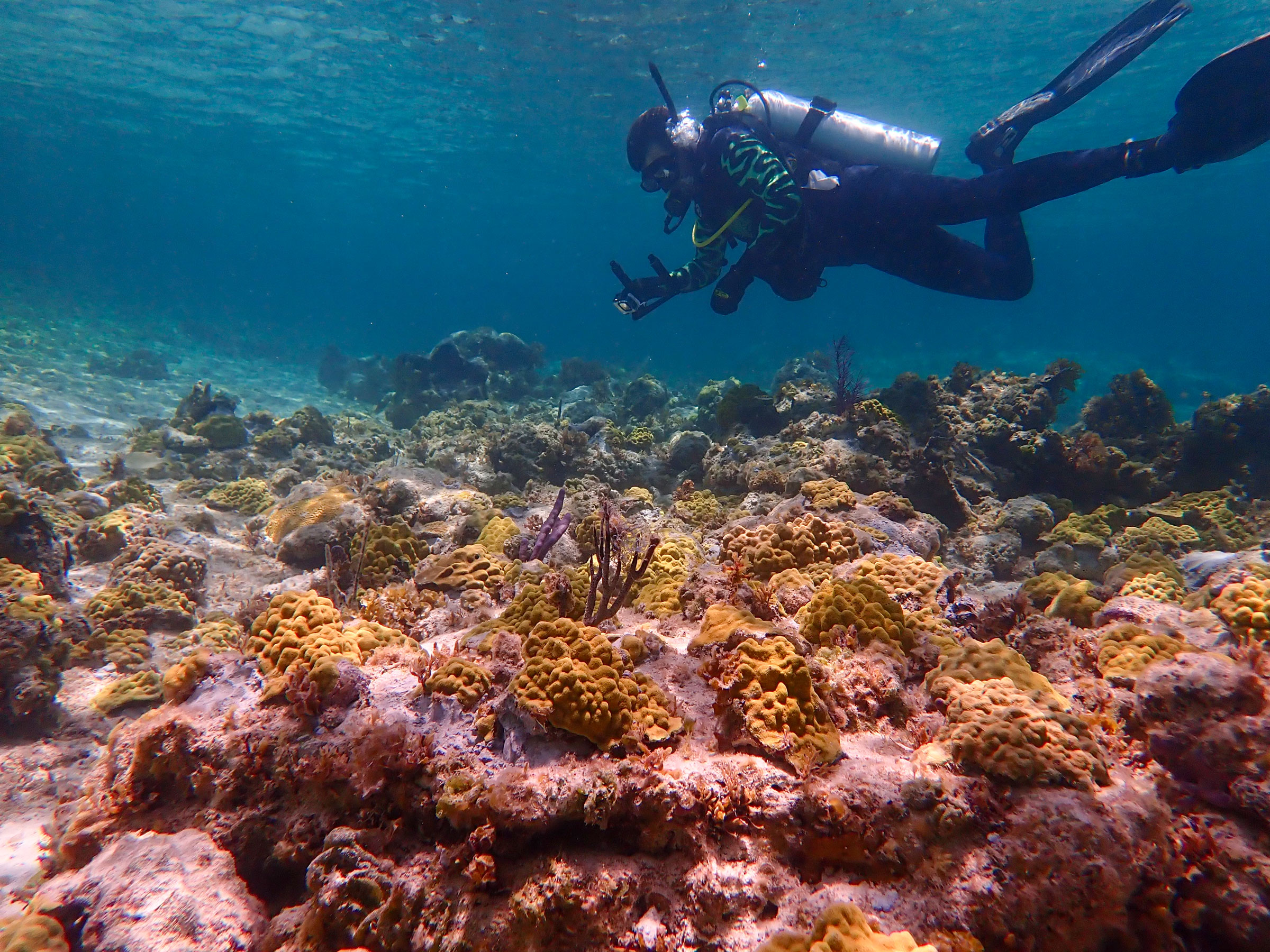
The final helping hand may come from the algae cohabitating with some corals, including Foord’s mysterious hybrid—which turned out not to be a hybrid at all, but a true staghorn. Foord now thinks its odd, spread-out shape might be due to living in a shallow, high wave-energy environment. (Researchers are still uncertain about the fluorescent green color, but it may be a form of sunscreen that better equips it to live in the shallows.) Even more curious, this staghorn hosts algae from the species Durusdinium trenchii, native to the western Pacific and Indian Oceans. D. trenchii may have been introduced to the region from ships or the aquarium trade; researchers elsewhere have observed that corals hosting Durusdinium species seem to be more tolerant of warmer waters.
Miami is one of only two places Durusdinium has been found in the highly-vulnerable staghorn, which itself lives only in the Bahamas, Florida, and the Caribbean. Foord and his colleagues have dubbed this unlikely duo the Ventura strain and are studying how well it can survive in the cooler waters offshore. The aim is to figure out if Ventura, and other PortMiami corals, might be transplanted to help rebuild natural reefs—perhaps bolstering suffering populations with their resilient genes—and whether corals from offshore sites can be habituated to the stressful conditions in the port. Though research is still ongoing, early results from ERL suggest that the offspring of port corals crossbred with reef corals inherit some of that Miami resilience.
While the Miami teams’ research is aimed at restoring local reefs, this kind of work may also provide a new direction for restoration efforts worldwide. There are urban coral communities around Singapore, Hong Kong, Jakarta in Indonesia, and Naha, the capital of Okinawa, Japan, as well as near smaller cities across Southeast Asia. So far, these communities are not nearly as well studied as Miami’s, but some share its resilient traits, like an increased tolerance to heat waves found in Singapore corals.
Researchers are quick to point out that urban corals shouldn’t be seen as a replacement for healthy coral reefs: Urban coral communities tend to be less complex and less diverse than reefs. But Foord doesn’t think that means we should discount their value, for science or for storytelling. Over nearly a decade of running Coral Morphologic, he has found that stories of optimism about the future of coral reefs are more effective at getting the public to care: “When the graph is going up, people want to be a part of that story. When the graph is going down, everybody wants to get off that ship.”
One of Foord’s tools in his mission to help humans connect with corals has been the Coral City Camera, which streams a continuous view of a coral community in the shadow of Miami’s pilot boat docks. (Its next-door neighbors are CURES, the container port, and Miami’s cruise ship terminals.) When COVID-19 left many people isolated at home, the Coral City Camera gave them a window into the natural world and became an internet darling.
The camera has been streaming 24/7 since May 2023—more than 1,000 continuous days—and has documented more marine life than anybody expected. Massive spotted eagle rays and graceful green turtles cruise by the camera, as do hunting barracuda and sharp-eyed lemon sharks. Manatees sometimes stop to nose at its lens with their whiskers, or squid to dance before its watchful eye. And day after day, fish of every color frolic and fight and flash their teeth—all attracted to the miniature ecosystem that the corals create.
The resulting video feed and the global community that’s rallied around it is what Foord calls “easily the happiest, most optimistic place on the internet.”
“When people watch, they become personally invested in this community of marine life, and they feel like they want to protect it,” he says. “Corals are the original city builders of the planet: They build homes that marine life utilize. Turns out that corals on the internet can build a community of people.”
Photograph by Coral Morphographic
Hi, I’m Dave, the executive director of bioGraphic. (And that’s my dog, Finn.) Thanks for taking the time to read this story.
Stories like this simply don’t get produced without financial support from readers like you. bioGraphic is not backed by a private company or owned by a billionaire. It’s an independent, nonprofit magazine. And one-quarter of our annual budget comes directly from reader donations.
We need your support more than ever, as governments slash funding for conservation and scientific research, placing even more ecosystems and wildlife at risk around the world. At bioGraphic, we’re steadfastly shining a light on the threats to our planet’s incredible biodiversity. And we’re showcasing the hard work of people bravely taking action to protect at-risk species.
bioGraphic publishes environmental reporting that you can’t find anywhere else: deeply researched, trustworthy stories that are also beautiful and captivating to read. We offer an antidote to reader apathy and doom-and-gloom news by revealing the wonders of the natural world and focusing on real solutions to big problems. When you finish a bioGraphic story, we want to leave you feeling informed, delighted, and inspired.
We don’t run ads or hide our stories behind a paywall. The readers who generously support bioGraphic allow our work to remain free for everyone.
Will you help us keep telling these crucial stories?

Author
Related Articles
Trial by Fire
In the burn-scarred mountains of Southern California, a team of biologists fights to help an imperiled frog.
Ethiopia’s Grand Tree-Planting Plan
Efforts to restore lost forests often fail, but Ethiopians are betting big: planting billions of saplings to revive habitat, regenerate soil, and stabilize the land.
The Trouble with Tamarisk
Twenty-five years ago, land managers unleashed a beetle to control an invasive tree sucking rivers dry. But water levels haven’t risen—and the real villains are still causing trouble.