
The Snowshoe Effect
The Svalbard rock ptarmigan, Earth’s northernmost land bird, is finely tuned for winter survival.
Photograph by Pål Hermansen
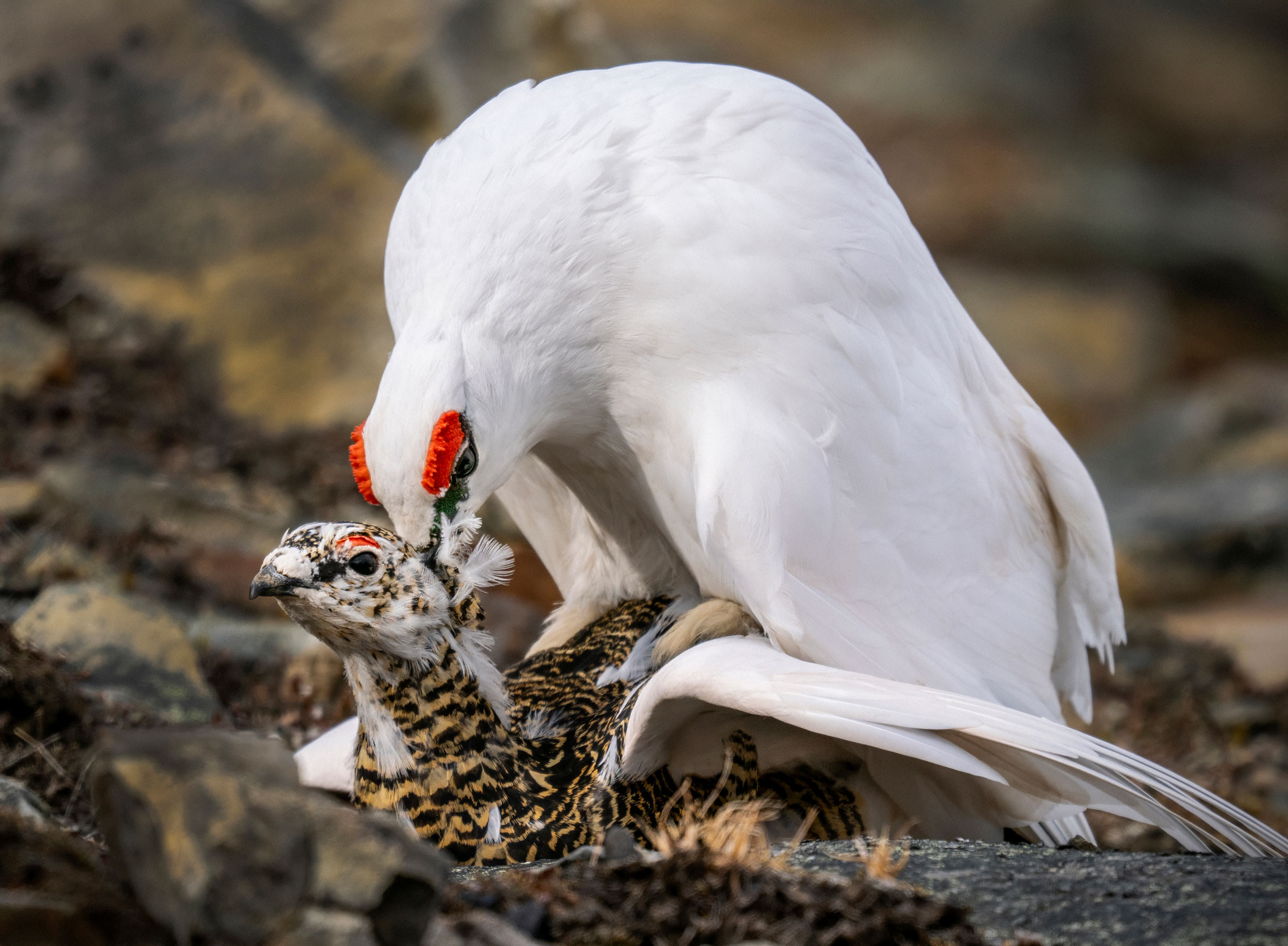
“Obviously the female was in charge,” Pål Hermansen told me. Hermansen, a Norway-based photographer, had been following a pair of courting Svalbard rock ptarmigan during the brief high-Arctic spring on the Svalbard archipelago. Now and then the male, about the size of a small chicken, with bright red combs frilling above his eyes for mating season, stopped eating, stretched his neck, and let out a burp-like call. When the bird heard another male, he would launch into the air and land with a more intense call—a territorial display. The female, meanwhile, remained unflapped, strolling and browsing on seeds and bits of vegetation. Finally, after days of Hermansen crouch-walking behind the male, who in turn waddled hopefully after the seemingly indifferent female, she abruptly laid flat and allowed the male to clamber aboard and grip the nape of her neck for stability. Hermansen managed to capture what he described as the “decisive moment.”
The season of mating and rearing young is a brief window of relative warmth in an otherwise frigid existence. Svalbard rock ptarmigan are the northernmost land-dwelling birds on the planet, never leaving their island haunts of Svalbard in Norway and Franz Josef Land in Russia, even during the four-month-long full darkness of the high-Arctic winter. Known in scientific parlance as Lagopus muta hyperborea, they are a subspecies of rock ptarmigan that is even more adapted to the cold and snow than their mainland cousins.
Like other ptarmigan, Svalbard rock ptarmigan feathers are mottled brown in the balmier months—starting in April for females and July for males—then transition to white for winter camouflage in September. But they can double their body mass and reduce their energetic demands by tamping down their immune systems during the colder months, when they are less likely to encounter germs so long as the Arctic stays frosty. And Lagopus—the genus for all ptarmigan—means “hare foot,” a reference to the birds’ richly feathered feet. It is here where Svalbard rock ptarmigan are perhaps most gifted.
Examining dozens of captive birds that had lived under simulated Svalbard conditions, scientists found that ptarmigan toe feathers were much more lush in winter than summer. This dropped the amount of foot skin in contact with the ground from 44 percent to zero.
While dense feathering likely provides cozy insulation, it may be even more important for ease of movement across winter snow. In the 1970s, University of Alberta researcher E. O. Höhn tested the load-bearing properties of the feet of three ptarmigan species in North America. He found that their winter plumage reduced sinking into the snow by half. Those benefits were even on full display when he tried to capture ptarmigan for his research: “The birds, walking quite leisurely and leaving tracks only about 15 millimeters deep, easily kept ahead of my companion and me,” he wrote in his paper. “Wearing only boots, I sank in the snow to midthigh, while he, wearing my snowshoes (small for his size), fared little better.”
Decades later, scientists conducted similar experiments on Svalbard ptarmigan feet in full winter for a yet-to-be-reviewed study. They found them to have significantly greater foot surface area than mainland rock and willow ptarmigan. This allowed the Svalbard subspecies to step lighter atop the snow.
If the tryst that Hermansen documented was successful, the female ptarmigan likely had several chicks toddling in her wake on their own feathered feet by late July. But research suggests that it will be more than a year before the chicks achieve winter plumage as hardy and helpful as their parents’, likely because growing to adult size requires so much of their energy.
Hi, I’m Dave, the executive director of bioGraphic. (And that’s my dog, Finn.) Thanks for taking the time to read this story.
Stories like this simply don’t get produced without financial support from readers like you. bioGraphic is not backed by a private company or owned by a billionaire. It’s an independent, nonprofit magazine. And one-quarter of our annual budget comes directly from reader donations.
We need your support more than ever, as governments slash funding for conservation and scientific research, placing even more ecosystems and wildlife at risk around the world. At bioGraphic, we’re steadfastly shining a light on the threats to our planet’s incredible biodiversity. And we’re showcasing the hard work of people bravely taking action to protect at-risk species.
bioGraphic publishes environmental reporting that you can’t find anywhere else: deeply researched, trustworthy stories that are also beautiful and captivating to read. We offer an antidote to reader apathy and doom-and-gloom news by revealing the wonders of the natural world and focusing on real solutions to big problems. When you finish a bioGraphic story, we want to leave you feeling informed, delighted, and inspired.
We don’t run ads or hide our stories behind a paywall. The readers who generously support bioGraphic allow our work to remain free for everyone.
Will you help us keep telling these crucial stories?

Authors


Related Articles
Milt Meal
Marine creatures will do almost anything for a meal—including feasting on the sperm and eggs of spawning invertebrates.
The Art of the Catch
To bulk up for winter hibernation, Alaska’s brown bears employ a range of techniques for snaring salmon.
The Wonder of a Pale Whale
A curious calf with an atypical birthday suit is a good sign for southern right whales.