
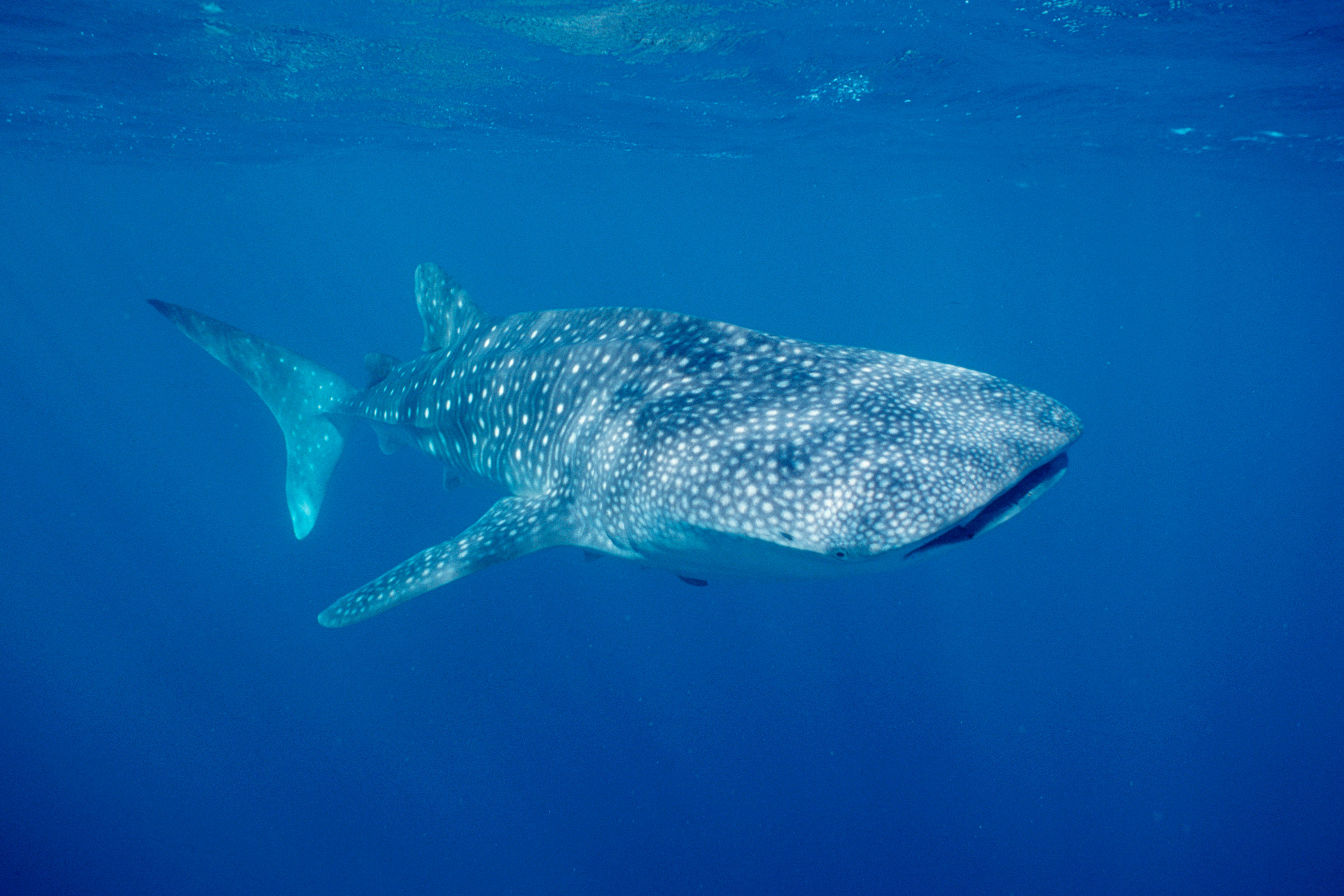
For a whale shark, giving birth in the wide-open ocean is a daunting task. Smells carry easily, predators abound, and despite the fact that adults can grow as long and heavy as a school bus, baby whale sharks are born about the size of a domestic cat. The ocean offers few suitable hidey-holes for depositing these vulnerable offspring.
But new research shows that by giving birth in places that leave other animals gasping for oxygen, whale sharks may be harnessing an invisible chemical feature of the ocean to give their young a boost.
Whale sharks, like most fish, largely take a fins-off approach to parenting. After birthing hundreds of live young, mom swims off, leaving her babies to fend for themselves. But when biologist Freya Womersley and her colleagues mapped global sightings of whale shark newborns from the past 50 years and compared them to four oceanographic parameters—sea surface temperature, water velocity, and the levels of chlorophyll and dissolved oxygen—they found that a majority of baby whale shark sightings have occurred near dangerous oceanographic features known as oxygen minimum zones (OMZs).
Often found along the eastern edges of the continents, sandwiched between land and productive upwelling currents offshore, OMZs are exactly what their name suggests: areas with very little oxygen. Oxygen levels inside these zones can be as much as 10 times lower than in the surrounding seawater, with the lowest oxygen levels usually found between 200 and 1,000 meters (660 to 3,280 feet) deep.
Womersley, a biologist with the United Kingdom’s Marine Biological Association, suggests that if tiny, speckled whale sharks can perform the fishy equivalent of holding their breath, they could be using these low-oxygen zones as a kind of shelter—ducking in and out of an OMZ to avoid ending up as someone else’s lunch. A previous study found that young sandbar sharks (Carcharhinus plumbeus) prefer to hunt and hide around low-oxygen areas, and other sharks have been observed closing their gills for up to 17 minutes while diving in deep, oxygen-poor water.
Womersley and her colleagues suggest that in addition to offering a place to hide, OMZs could make it easier for newborn whale sharks to find food. Baby whale sharks’ prey—microscopic zooplankton—also avoid low-oxygen zones. These tiny animals tend to concentrate on the OMZ’s edges, creating something akin to a buffet table for the growing filter feeders.
Baby whale sharks are not strong swimmers, Womersley says. It’s hard to imagine how they find enough food to grow into one of the biggest animals on Earth. “From a scientific standpoint, there has to be something to help them get as large as they do,” she says.
The realization that whale sharks may be harnessing OMZs for their own purposes is an exciting window into the lives of these otherwise elusive elasmobranchs.
Though their range spans most of the planet—occupying warm temperate and tropical waters throughout the Atlantic, Pacific, and Indian Oceans—whale sharks spend most of their lives in the deep. No one knows where whale sharks mate or how they spend most of their time. Much of what scientists have gleaned about these enormous creatures comes from studying teenage males which, for reasons unknown, tend to congregate near the coast. Spotting adult females is less common, and baby sightings are downright rare. Though Womersley’s study spanned 50 years of observations, her team could only find records of 33 newborn whale shark sightings. Only one pregnant female has ever been examined by scientists, and that was a corpse salvaged from Taiwanese fishers.
Though Womersley and her colleagues think the evidence for their OMZs-as-nurseries hypothesis is sound, they note that there could be other explanations for why most newborns have been seen near low-oxygen areas. For example, whale sharks could be giving birth throughout the oceans, with low-oxygen water driving the babies toward the ocean’s surface, making them easier for humans to see.
Simon Thorrold, an ecologist at the Massachusetts-based Woods Hole Oceanographic Institution who studies whale shark movement and was not involved in the recent research, agrees that the small number of observations makes it difficult to draw firm conclusions. “Any analysis based on such a small number of records is always going to be pretty speculative,” he says.
Firming up our understanding of whale sharks’ habits and habitats, then, requires more data—something both Womersley and Thorrold are working on. For his own research, Thorrold is analyzing the genomes of whale sharks from around the world. His study subjects carry tracking tags, and he hopes to learn if there are any links between the animals’ genetics and their migratory patterns.
Womersley, meanwhile, spent part of the winter tagging the juvenile male whale sharks that gather in Mexico’s sheltered Gulf of California. These satellite tags will track their movements and how deep they dive. Though she dreams of tagging and tracking newborn whale sharks, she hopes that by following the teenagers she can at least learn how older sharks react when they enter the persistent low-oxygen areas outside the gulf.
Each new bit of insight adds to scientists’ sparse understanding of whale sharks’ lives, which is coming together in ways Womersley hadn’t predicted. “As soon as you think you learn something, suddenly whale sharks come out and do something completely different or unexpected,” she says. “It’s a constantly evolving story about how they use the ocean.”
Hi, I’m Dave, the executive director of bioGraphic. (And that’s my dog, Finn.) Thanks for taking the time to read this story.
Stories like this simply don’t get produced without financial support from readers like you. bioGraphic is an independent non-profit—we’re not backed by a private company or owned by a billionaire. One-quarter of our budget comes directly from reader donations.
bioGraphic publishes environmental reporting that you can’t find anywhere else: deeply researched, trustworthy stories that are also beautiful and captivating to read. Right now, we need your help to raise $20,000 by October 2. Every dollar will go directly to more crucial reporting projects.
Around the world, governments are slashing funding for conservation and scientific research, placing even more ecosystems and wildlife at risk. At bioGraphic, we’re steadfastly shining a light on the threats to our planet’s incredible biodiversity. And we’re showcasing the hard work of people bravely taking action to protect at-risk species.
bioGraphic offers an antidote to apathy and doom-and-gloom news by revealing the wonders of the natural world and focusing on real solutions to big problems. When you finish a bioGraphic story, we want to leave you feeling informed, delighted, and inspired.
We don’t run ads or hide our stories behind a paywall. The readers who generously support bioGraphic allow our work to remain free for everyone.
Will you help us raise $20,000 by October 2?

Related Articles
When it Comes to Frog Sex, Teamwork Makes the Dream Work
New science on gray foam-nest tree frogs hints at the evolutionary benefits of multiple sexual partners.
How Much Plastic Does it Take to Kill a Seabird?
For the first time, researchers uncover how eating plastic trash may impact seabirds at the population level.
Shrimp Shell Slurry to the Rescue?
A new, multistep chemical process can turn bits of organic waste into “carbon-negative” fuel, food, and construction material.
