
Polyamory isn’t for everyone. Juggling multiple partners requires patience, communication, and above all else, cooperation.
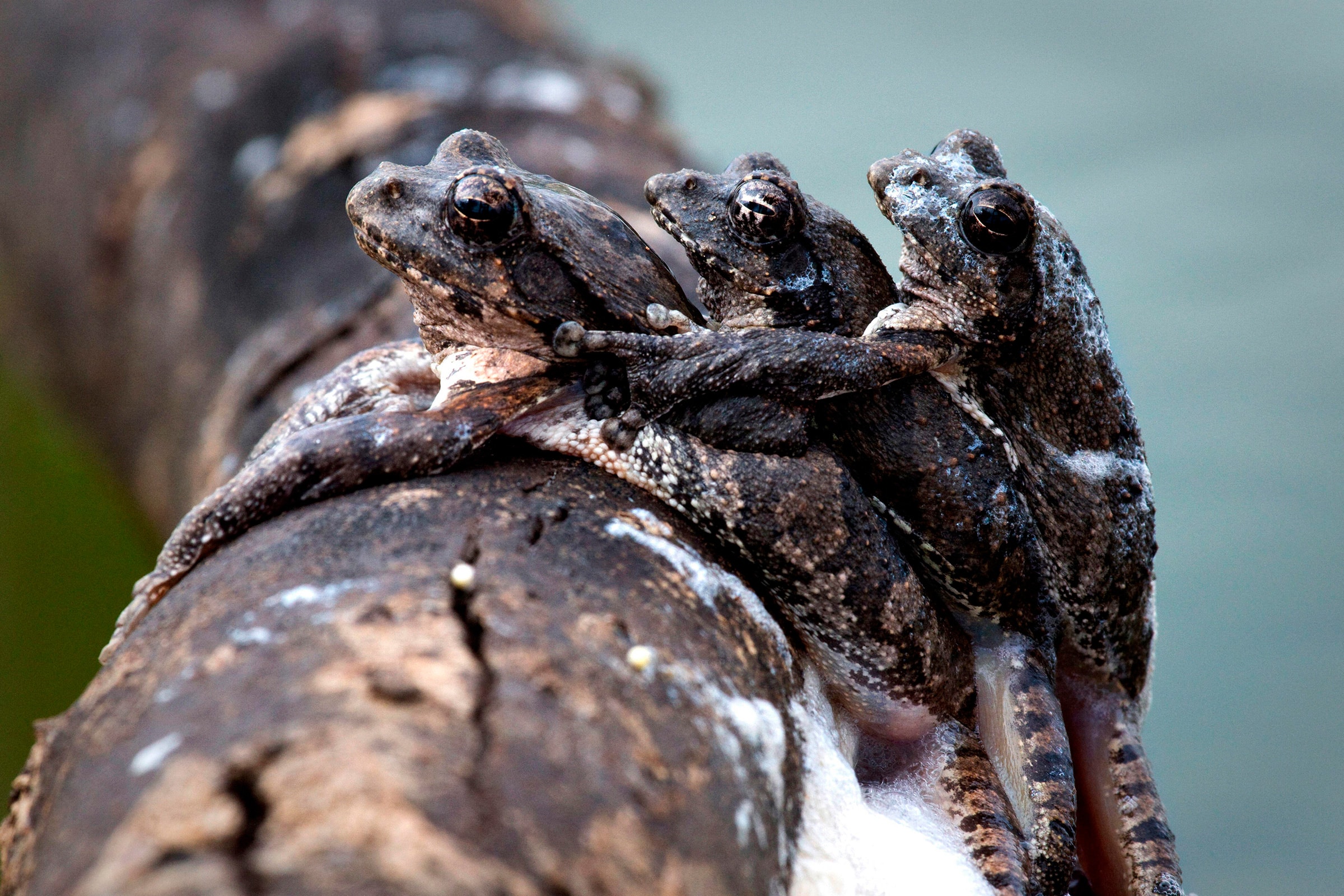
But while humans sometimes struggle to make it work, a lumpy green frog found in the savannas and dry forests of southeastern Africa seems to have polyamory figured out. Female gray foam-nest tree frogs (Chiromantis xerampelina) can breed with more than a dozen males at once without anyone fighting or getting squished. What’s more, females put males to work building the perfect foam nest for their eggs. Females who mate with more males are rewarded with bigger and better nests—and a greater chance that their offspring will survive.
This cooperative system works so well, say the authors of a new study, that it may explain why polyandry (the scientific term for a mating system in which females mate with multiple males) evolved in this and some other species.
For the majority of frog species, mating is a chaotic affair, with multiple males swarming a single female. During these breeding frenzies, females risk drowning or being crushed beneath the mass of males, while males risk injury as they fight with rivals.
“It’s a brutal and sometimes bloody competition to gain paternity,” says Phillip Byrne, an evolutionary biologist at the University of Wollongong in Australia and lead author of the study.
In comparison, Byrne says, the breeding habits of gray foam-nest tree frogs are positively peaceful. During the breeding season—which coincides with the rainy season—females climb into trees and secrete a soapy substance from their oviducts onto branches that overhang bodies of water. The female frogs then use their legs like whisks to beat their secretions into a foamy nest that will house their eggs and prevent them from drying up.
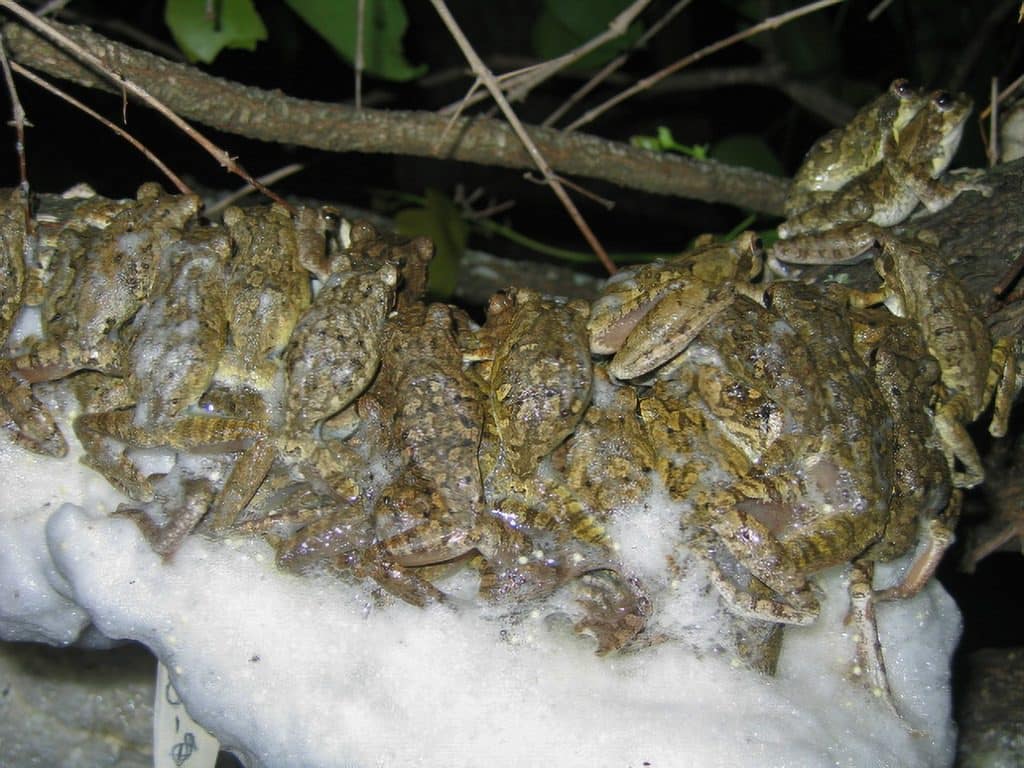
The entire process takes 4 to 6 hours. During this period, females mate with as many males as possible—sometimes just one, but sometimes up to 13 at once. And in the midst of all this egg laying and sperm spewing, males synchronize their hind-leg movements with their female partner, helping her whip up a bigger and more structurally sound nest.
When their delicate dance is done, the lovers go their separate ways. About a week later, their tadpoles hatch and drop from the nest into the water below—assuming the nest was well whipped. If not, the nest will dry out before the eggs hatch and the entire clutch will be lost.
Byrne has been studying this fascinating form of frog fornication for decades. For the most recent study, he and his colleagues spent hundreds of hours huddled beneath foam-covered trees in the Hans Merensky Nature Reserve in South Africa, observing 134 nests over the course of an entire breeding season. “I studied the frogs every night from sundown till sunup for a period of six months,” Byrne says. “It was surreal. I was dodging black mambas on the ground and boomslangs up in the trees.”
Of the 134 nests, nearly a third failed to produce tadpoles. While some collapsed or were blown away by the wind, 40 percent of the failed nests dried up before the eggs hatched. And in over 80 percent of such cases, the nests were small and constructed by only one male and one female.
The most successful nests were those whipped up by multiple mates. Those were nearly three times bigger than the largest nests built by just one pair; because larger foam structures have a lower surface-area-to-volume ratio, they lose water more slowly. Size, apparently, matters.
The researchers also found that males helped out more when they had other males around them—and that such coordinated construction didn’t get in the way of males’ ability to get the more important job done. Later genetic testing from six of the nests built by more than one male revealed that in each, multiple frogs fathered offspring. The team also noticed groups of females occasionally building communal nests that dozens of males helped construct simultaneously.
Over the past few decades, scientists have learned that mating with multiple partners can help females of many species ensure that their eggs are fertilized, and that their offspring are genetically diverse. But how and why this mating system evolved in many mammals, birds, fish, reptiles, and insects is not well understood.
Now, for gray foam-nest tree frogs, the reason is clear: More mates means more help around the house—or in this case, nest.
“You could easily imagine a situation where, with increasingly severe weather events and periods of drought, those frogs that are leaning towards polyandry might actually be favored genetically,” says Jonathan Kolby, an applied research ecologist with the Smithsonian Institution in Washington, D.C., who was not involved with the study.
The importance of what the researchers call “nesting assistance” could also explain why polyandry evolved in other species that enlist multiple mates to gather nesting materials or secure nesting sites. Some female carpenter bees, for example, mate with multiple males and put them all to work guarding the entrance to her nest. Female emus will mate with multiple males and lay eggs in multiple nests, each built by a male who will raise the chicks alone after they hatch.
The researchers hope future studies will test their theory that nesting assistance can drive polyandry—though scientists who wish to do so may have to spend days in the bush like Byrne did, surrounded by venomous snakes. In a time when conservation research increasingly unfolds in labs and behind computers, this study demonstrates “the importance of going back to the basics and doing real, observation‑based natural history research,” says Kolby.
“When scientists do this,” Byrne adds, “their observations generally yield super interesting and novel insights into animal behavior.”
One of those insights, at least when it comes to frogs, is that peaceful polyandry can be just as successful as cutthroat competition. “There’s definitely a lot of potential for species that are breeding communally to be cooperating with each other,” says Rayna Bell, the assistant curator of herpetology at the California Academy of Sciences, who was not involved with the study. “It doesn’t all have to be competition and arms races and adversaries. Maybe collaboration is also a viable solution for species survival.”
Hi, I’m Dave, the executive director of bioGraphic. (And that’s my dog, Finn.) Thanks for taking the time to read this story.
Stories like this simply don’t get produced without financial support from readers like you. bioGraphic is not backed by a private company or owned by a billionaire. It’s an independent, nonprofit magazine. And one-quarter of our annual budget comes directly from reader donations.
We need your support more than ever, as governments slash funding for conservation and scientific research, placing even more ecosystems and wildlife at risk around the world. At bioGraphic, we’re steadfastly shining a light on the threats to our planet’s incredible biodiversity. And we’re showcasing the hard work of people bravely taking action to protect at-risk species.
bioGraphic publishes environmental reporting that you can’t find anywhere else: deeply researched, trustworthy stories that are also beautiful and captivating to read. We offer an antidote to reader apathy and doom-and-gloom news by revealing the wonders of the natural world and focusing on real solutions to big problems. When you finish a bioGraphic story, we want to leave you feeling informed, delighted, and inspired.
We don’t run ads or hide our stories behind a paywall. The readers who generously support bioGraphic allow our work to remain free for everyone.
Will you help us keep telling these crucial stories?

Author

Related Articles

Trees as Public Health Infrastructure
New research shows that meeting tree canopy goals could prevent more than 67,000 premature deaths in the United States.
A Mite on a Bee on a Ship on the Sea Spells Trouble
Pollinator pathogens are spreading through international trade, threatening both agriculture and wild ecosystems.
How Much Plastic Does it Take to Kill a Seabird?
For the first time, researchers uncover how eating plastic trash may impact seabirds at the population level.