
In 1886, German scientists discovered that bacteria living on the roots of legumes fed the plants nitrogen from the air. Since then, scientists have found that nearly every terrestrial plant depends in some way on its microbiome: the collection of microbes entangled with its roots, shoots, and leaves.
Renske Jongen, a postdoctoral researcher at the University of Sydney, expected to find the same body of knowledge on microbes waiting for her when she moved from studying plant-soil interactions in the Netherlands to seagrass in Australia. But it didn’t exist. “I realized we know very little about how microbes affect marine plants such as seagrasses,” Jongen says, “which I thought was very strange, since they’re so important.”
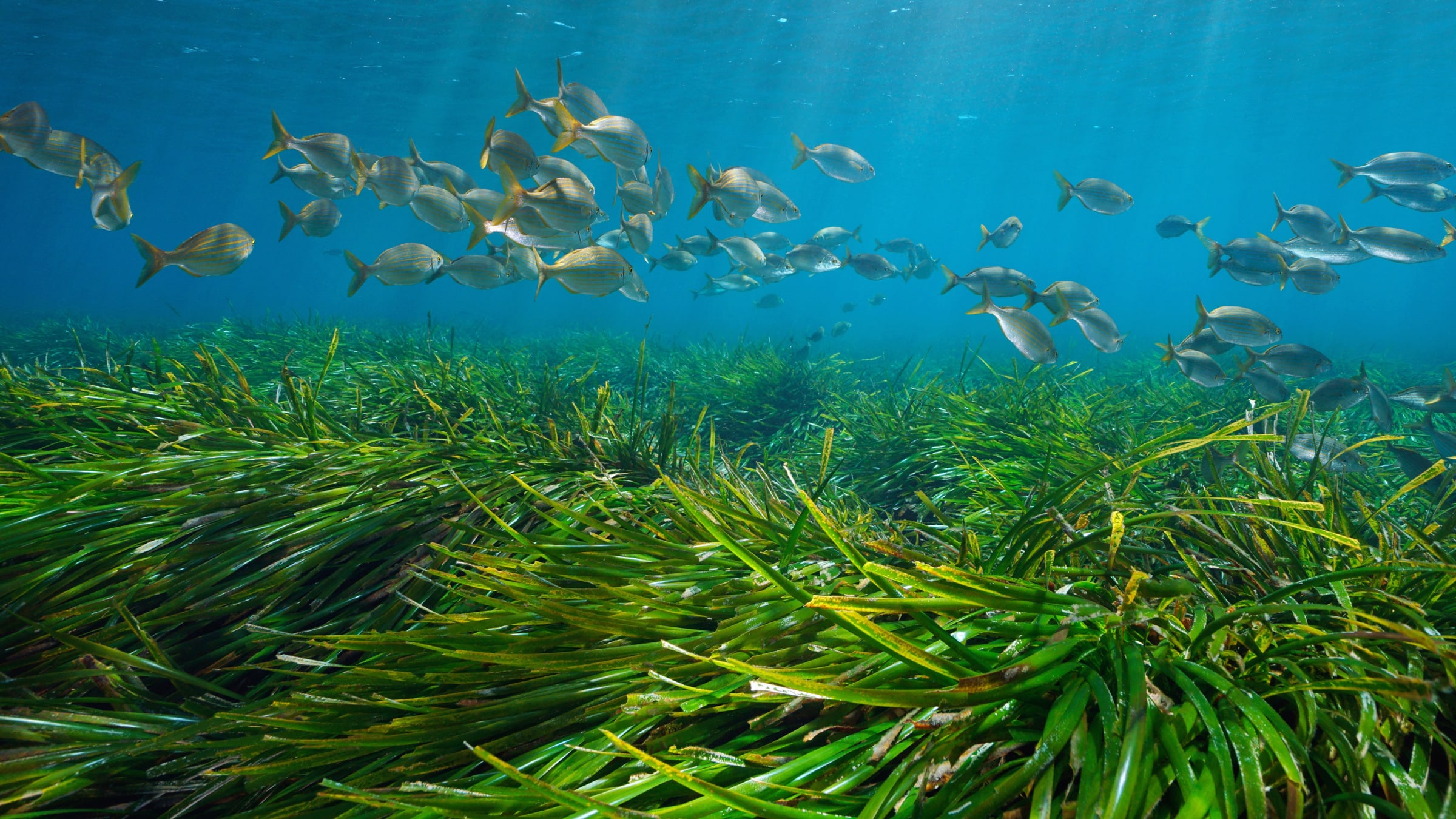
The planet’s 72 species of seagrasses are all descended from land plants that returned to the ocean around 100 million years ago. Even underwater, they retain their terrestrial habits: driving roots into the mud, trailing runners above it, and producing delicate flowers that release pollen, carried on the current instead of the wind. Turtles, manatees, and dugongs graze seagrass, and young fish, crabs, and shrimp shelter in it. Seagrass meadows also filter sediment and sequester carbon. Yet almost 30 percent have disappeared since the 19th century. Preserving those that remain—and restoring those killed by dredging, development, unregulated fishing, and pollution—is vital to our planet’s health.
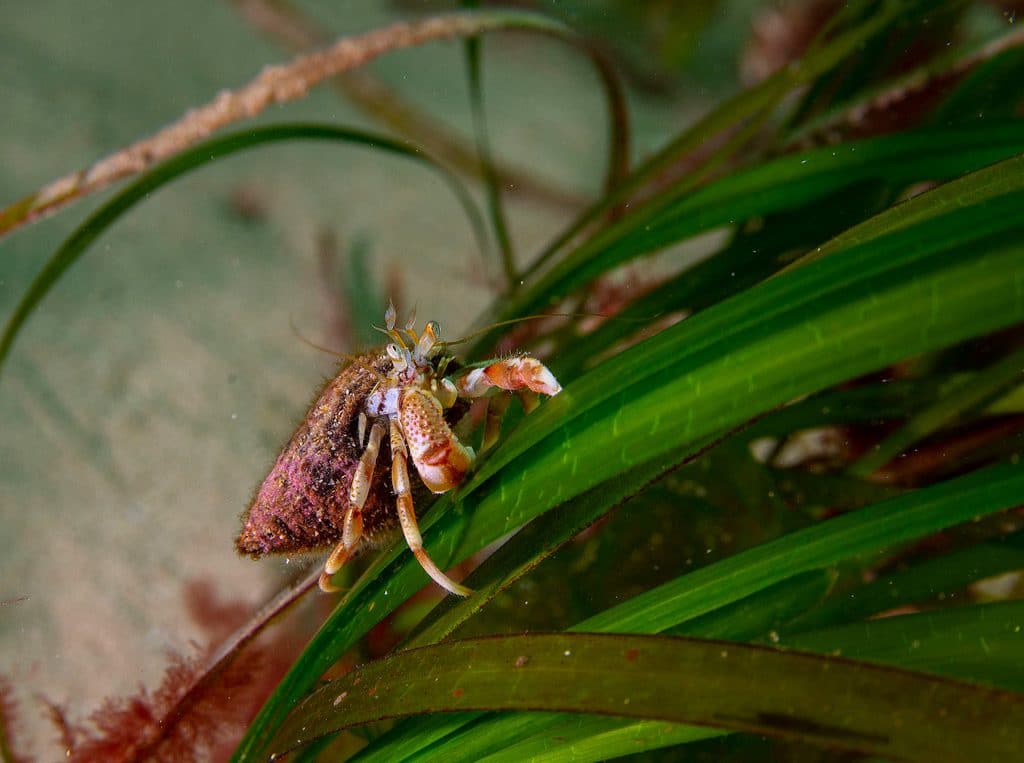
Now, Jongen and other scientists are unraveling the curious connections between seagrasses and their microbiomes, with the hope that better understanding this symbiotic relationship can help conservation efforts succeed.
Seagrass roots sit in sediment with almost no oxygen, where a toxic gas called sulfide builds up to levels that would poison most plants. Scientists surmised that seagrass survives because of the bacteria in the mud and on its roots, but no one knew quite how the organisms were linked. So Jongen and her team sank 90 pots of seagrass in a bay north of Sydney and, in some, stripped the bacteria from the roots and the surrounding mud. They also varied the quantity of nutrients the plants got, from none at all to the heavy doses found in estuaries fed by sewage and farm runoff.
The team found that, regardless of their nutrient load, plants with microbes grew sturdy roots, while those without microbes struggled. “Some of these bacteria can convert those toxic sulfides into something that is not harmful,” Jongen says. Other bacteria fix nitrogen, supplying an essential nutrient to the plant. Seagrass depends on these bacteria roughly the same way humans depend on the bacteria in our guts.
Yet as so often happens in science, answering one question raises another: If healthy seagrass needs bacteria, what happens when the ocean is polluted with chemicals designed to kill them?
Each year, around 9,500 metric tons of the most common antibiotics pass through human bodies and sewage treatment plants and into rivers. Even more enter from agriculture and fish farming. About 3,300 metric tons of these antibiotics reach the ocean, interfering with marine microbes and promoting antibiotic-resistant bacteria that can be transferred to humans via seafood.
Rocío Jiménez-Ramos and her colleague Luis Gonzalo Egea—both marine biologists at the University of Cádiz in Spain—also worried that antibiotics in the water could upend the delicate dance between seagrass and its microbiome.
To test whether such concerns are valid, the pair dug shoots of seagrass from a meadow in Cádiz Bay and replanted them in 18 glass chambers in a temperature-controlled room. Every evening for a week, they added a cocktail of three of the most common antibiotics found in coastal waters: ampicillin, streptomycin, and amoxicillin. Six chambers got a moderate dose; six a heavy dose; and the remaining six none at all. Then the biologists watched.
By day seven, the leaves in the heavy-dose chambers were growing a third slower than the untreated ones and had lost much of their green pigment. The bacteria had changed too: The helpful species had almost died off, while a bacteria linked to dying meadows had taken their place.
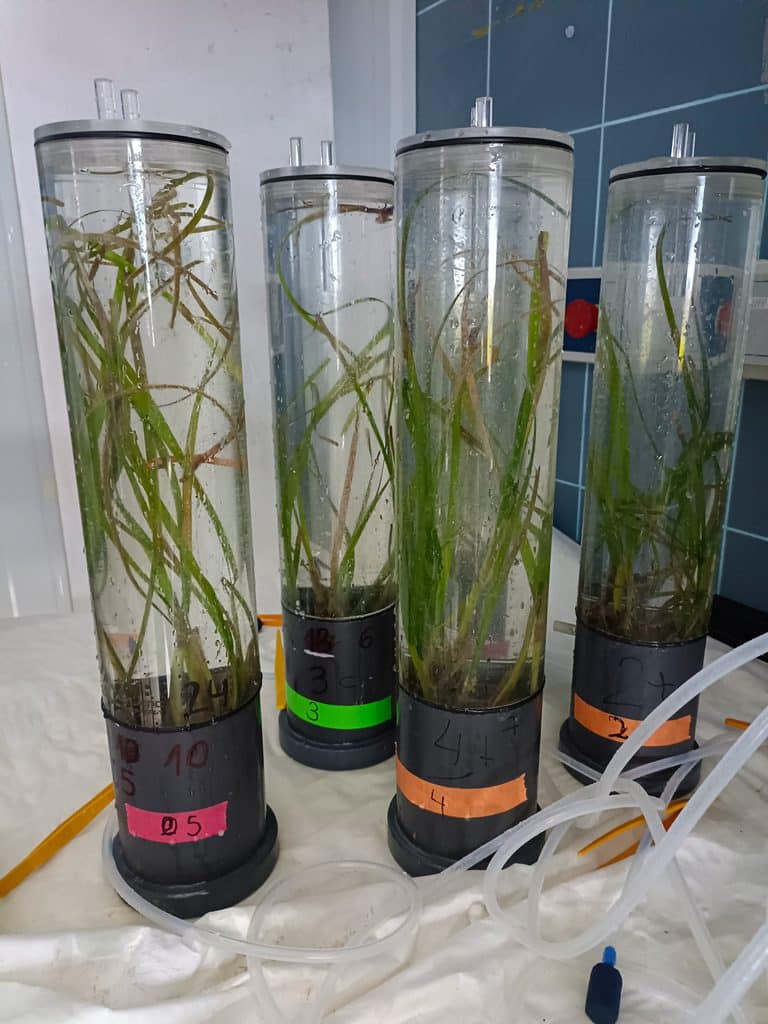
“It was striking how much the plants’ physiology had already changed after only one week,” Jiménez-Ramos says. Most surprisingly, though, the antibiotics had also attacked the plants’ own photosynthetic machinery: The researchers found that the dosed plants were no longer soaking up carbon. They were emitting it. “Photosynthesis decreased much more than respiration, so the community went from a net carbon sink to a net carbon source,” Jiménez-Ramos adds.
Could a real seagrass meadow flip the same way? Jiménez-Ramos admits that her experiment happened in glass chambers: The water was still, the test lasted only a week, and the doses were deliberately high, closer to what you might find below a sewage outfall or beside a fish farm than in open water. She hopes to conduct more research that could show whether antibiotic concentration affects the health of seagrass meadows in the real world, perhaps by sampling a variety of wild meadows and measuring the antibiotics in the water, the bacteria on the leaves and in the mud, and how much carbon the plants are taking in.
Still, the new research is illuminating. “Both these studies reinforce … some of our research surrounding understanding and harnessing microbials, and exploring how sewage outflows impact plants,” says Andy Cameron, conservation project manager at the United Kingdom’s Ocean Conservation Trust.
Cameron, who was not involved in either study, manages the U.K.’s largest seagrass restoration project, a 10-hectare (almost 25-acre) effort in Cornwall, England. Although he and his team can’t reduce the amount of antibiotics flowing out of sewage treatment plants and into the sea, Cameron believes that a better understanding of how bacteria and seagrass interact may nonetheless have practical applications.
“It’s the sort of science we need to inform our future restoration efforts,” he says. “In the short to medium term it might influence some decisions around site selection. In the longer term, I hope these sorts of studies can help us push for improvements or changes to the structures and systems that impact our coasts.” These might include retrofitting wastewater treatment plants with more advanced filters to remove pollutants, developing nature-based solutions, or implementing policies that curb antibiotic use in aquaculture.
In the meantime, planting seagrass is only half the job, because the plant is only half the partnership. “Restoring the plant may not be enough if the environmental conditions that disrupt its microbiome are still present,” Jiménez-Ramos says.
These are exactly the kinds of insights that Jongen hoped her research would inform. “Often we just look at a plant and assume it’s fine,” she says. But “there might be a bunch of things happening that we don’t see.” Understanding how those invisible interactions influence the health of marine ecosystems “can help us protect them better, or perhaps predict where we should protect them,” she adds.
Hi, I’m Dave, the executive director of bioGraphic. (And that’s my dog, Finn.) Thanks for taking the time to read this story.
Stories like this simply don’t get produced without financial support from readers like you. bioGraphic is not backed by a private company or owned by a billionaire. It’s an independent, nonprofit magazine. And one-quarter of our annual budget comes directly from reader donations.
We need your support more than ever, as governments slash funding for conservation and scientific research, placing even more ecosystems and wildlife at risk around the world. At bioGraphic, we’re steadfastly shining a light on the threats to our planet’s incredible biodiversity. And we’re showcasing the hard work of people bravely taking action to protect at-risk species.
bioGraphic publishes environmental reporting that you can’t find anywhere else: deeply researched, trustworthy stories that are also beautiful and captivating to read. We offer an antidote to reader apathy and doom-and-gloom news by revealing the wonders of the natural world and focusing on real solutions to big problems. When you finish a bioGraphic story, we want to leave you feeling informed, delighted, and inspired.
We don’t run ads or hide our stories behind a paywall. The readers who generously support bioGraphic allow our work to remain free for everyone.
Will you help us keep telling these crucial stories?

Author

Related Articles
Trees as Public Health Infrastructure
New research shows that meeting tree canopy goals could prevent more than 67,000 premature deaths in the United States.
A Mite on a Bee on a Ship on the Sea Spells Trouble
Pollinator pathogens are spreading through international trade, threatening both agriculture and wild ecosystems.
When it Comes to Frog Sex, Teamwork Makes the Dream Work
New science on gray foam-nest tree frogs hints at the evolutionary benefits of multiple sexual partners.