
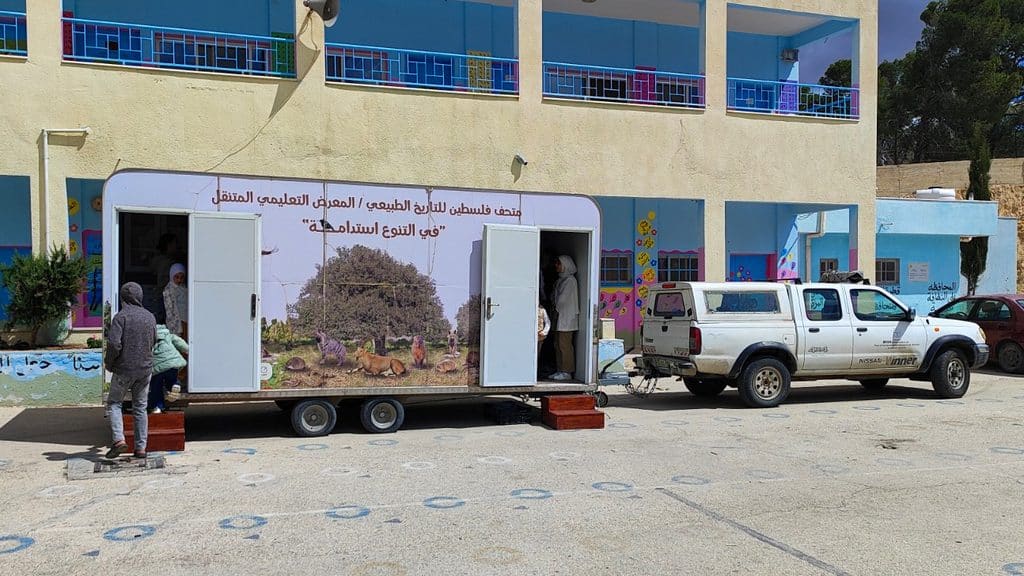
A white Nissan pickup truck winds through the desert of the West Bank, inching along the 40-kilometer (25-mile) route from Bethlehem City (or Bayt Laḩm) to the Jordan Valley. It’s a tense journey, slowed by Israeli military checkpoints and a travel trailer so laden with delicate, precious things that the truck can’t go faster than 50 kilometers (31 miles) per hour. The cabinets inside are packed with scientific specimens—glass jars filled with preserved reptiles, beetles and butterflies floating on pins, mollusk shells, dried flowers and leaves. The sides of the trailer are painted with pictures of the Palestinian natural world—an eagle-owl, a griffon vulture, a mountain gazelle, a Palestine viper. Some drivers honk and wave in support as they pass.
This is the mobile museum of the Palestine Museum of Natural History, based out of Bethlehem. Although the truck’s odometer is broken, museum staff estimate that it’s traveled tens of thousands of kilometers between 2023 and 2025, teaching children about plants and wildlife in the West Bank, one of the Palestinian territories currently under Israeli occupation. Prior to this trip to the Jordan Valley in November 2025, the mobile museum had visited 114 rural communities across the West Bank.
“I don’t expect people in remote areas, Bedouin communities, or villages that are endangered by the Israeli annexation and expansion to send their people to come visit us and see natural history and [learn about] environmental issues,” says Mazin Qumsiyeh, the museum’s director and founder of the Palestine Institute for Biodiversity and Sustainability. “We must go to them.”
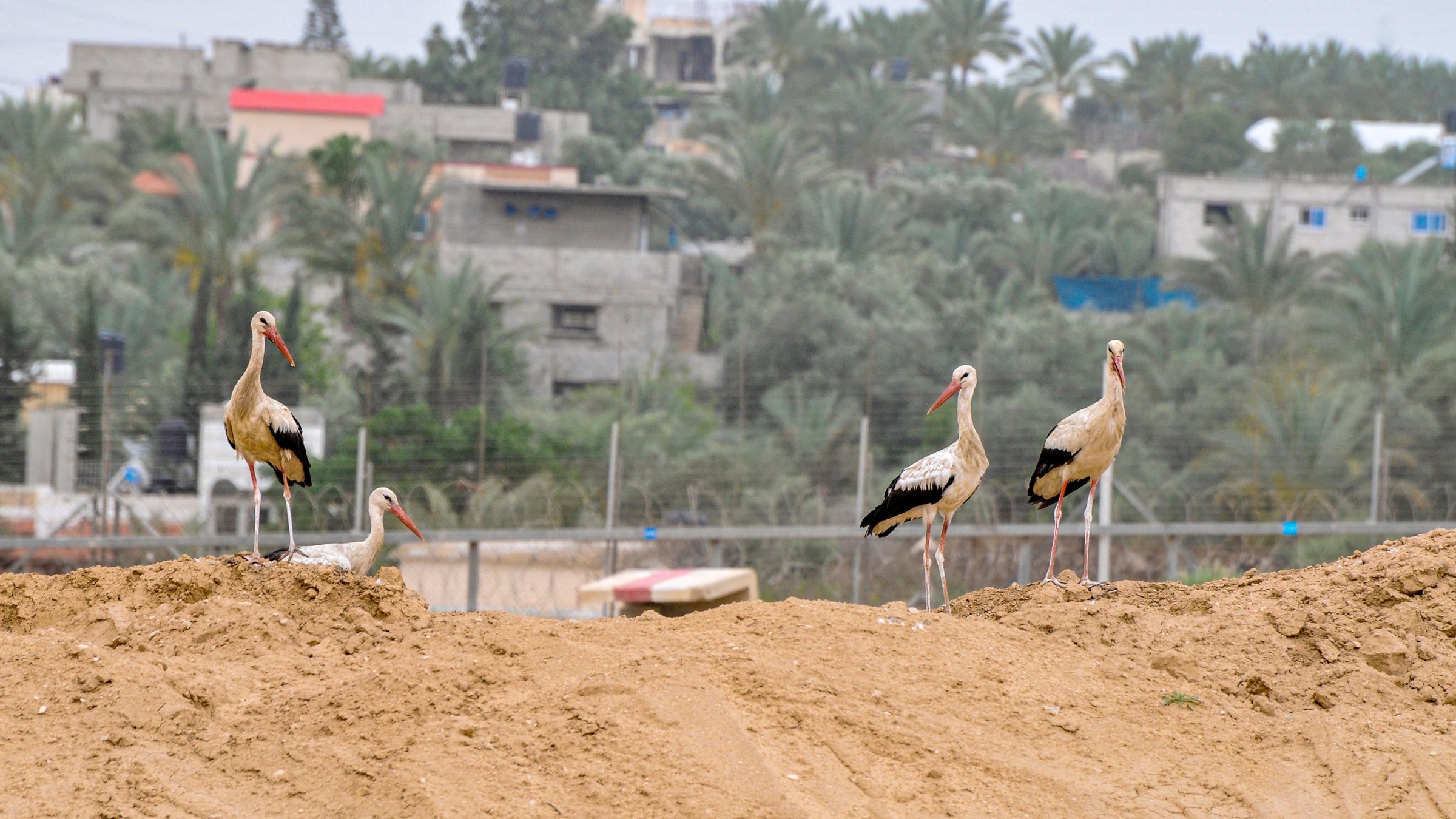
“We also tailor the exhibits relative to the area,” Qumsiyeh adds. In the Jordan Valley, for example, staff planned to teach visitors about the white storks flying over the valley on their migration to Africa.
In a faster car, without security checkpoints, the journey would take under an hour. But the biologists and museum staff members take several hours to make it to the valley: a narrow, crooked trough of sunken land running along the Jordan River to the Dead Sea. Although much of the region is hot and dry, the valley is several degrees warmer still, and significantly wetter. The river and its wetlands irrigate farmland in Syria, Israel, and Jordan—making it a strategic military buffer for Israel—and provide stopover sites for over 500 million migratory birds. The valley is also home to dozens of nomadic and permanent Palestinian communities. In one, the museum team plans to rest and have a cup of tea with the local organizers who are hosting them.
Before long, though, a crowd of schoolchildren and other villagers form around the caravan, buzzing with excitement. The staff obligingly emerge and unfold tables, bringing out boxes of scientific collections. A jar holding the coiled body of a snake yellowed by liquid preservatives gleams in the sun. The children file inside the travel trailer, and a staff member takes a taxidermied bat out of its glass enclosure and holds it up.
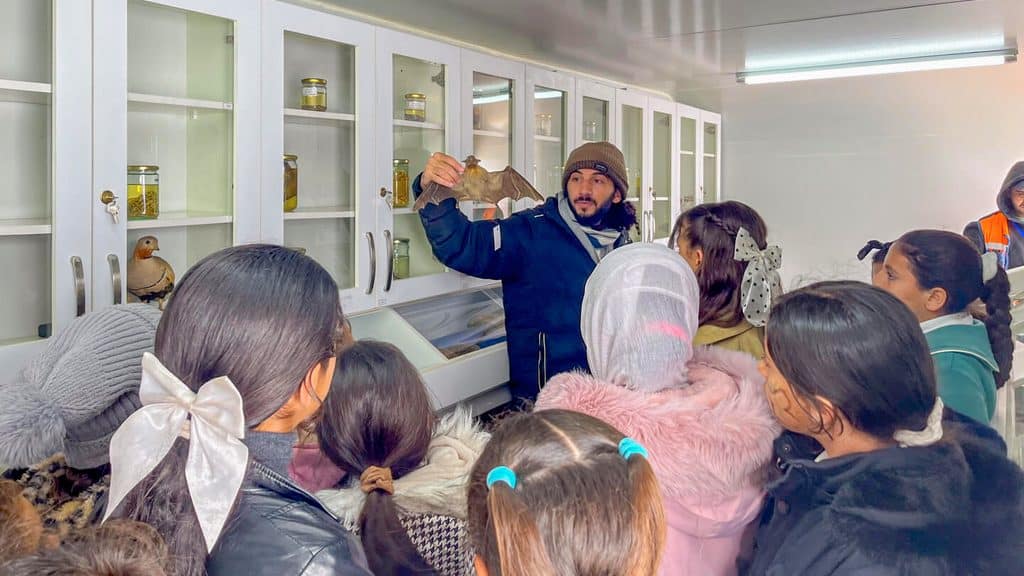
By bringing the museum to the most vulnerable communities, Qumsiyeh says the program challenges traditional, colonial museum models that take artifacts from oppressed places and peoples and display them for privileged patrons.
The mobile museum “then becomes an incubator for behavioral change and for revolutionary ideas: how we can stop using fossil fuels; how we can use renewable energy; how we can avoid destroying our environment with plastics, pollution, pesticides, insecticides, and things like that,” he says. Visitors to the museum have gone on to start environmental clubs at school, recycling programs, and native plant gardens.
This is the work Qumsiyeh has wanted to do all his life. His uncle, a biologist, brought a young Qumsiyeh on fieldwork trips amid the violence of his childhood: “That’s how I learned.”
In 1979, Qumsiyeh moved to the United States to study medical genetics, eventually holding teaching and research positions at Duke University in North Carolina and Yale University in Connecticut. But annual visits home in the early 2000s convinced him that conditions were only getting worse for people and the environment. In 2008, he and his wife, Jessie Qumsiyeh, left their jobs in the U.S. for the West Bank and poured their resources into the museum.
“From a six-figure income to a zero-figure income,” he says wryly.
Until Mazin Qumsiyeh founded the museum at Bethlehem University in 2013, Palestinians had few avenues for environmental research and education. And since the current war with Israel began on October 7, 2023, the museum’s mobile operation has only gotten harder. Palestinians were already restricted from driving on certain roads, and soldiers are now posted at entry and exit gates in every village and community in the West Bank.
“You will be questioned and harassed and sometimes attacked” passing through the gates, says Mohammed Abusarhan, a biologist and former museum staffer who is pursuing a PhD in bioinformatics at the University of Montreal in Quebec. When the mobile museum started its work in 2023, the United Nations recorded around 600 such gates. Today there are close to 900, adding more searches and potentially dangerous encounters to each trip the mobile museum makes.
While in Montreal studying and classifying aphid specimens he brought from the West Bank in the summer of 2025, Abusarhan worried for the safety of his colleagues back home. He knew they would travel north to villages in the West Bank, where reports of violence against Palestinians increasingly permeated the news. “I used to check on them constantly, constantly, constantly, and see what they are doing,” he says.
Fortunately, no one was hurt. But even routine fieldwork has been disrupted by violence.
Area C, a region to which Palestinians have limited access, holds some of the West Bank’s most intact and diverse natural environments. Between 2014 and 2025, places where the museum had previously collected specimens in Area C fell under Israeli military jurisdiction or were overtaken by Israeli settlements.
One such location is a pond in Jinşāfūţ, a tiny village in the northeastern West Bank. In 2016, while collecting tadpoles from the pond, Abusarhan and his colleagues found the Syrian spadefoot (Pelobates syriacus), a toad that had already gone extinct in Jordan and had likely been extirpated from other parts of its range in the West Bank. The Palestinian Authority gave the pond a protected designation, and Israel seemed to abandon plans to build a new highway through the area.
“That’s why I always say the work of the museum is very, very critical,” Abusarhan says. “I would like to believe that we were able to protect some lands.”
Now, the pond is no longer accessible, and the mobile museum’s truck and trailer sit unused in a lot back in Bethlehem. Land seizures, attacks on Palestinian vehicles, and violence at security checkpoints have intensified in the year since the mobile museum’s last visit to the Jordan Valley, museum staff say. Overall, the United Nations says that violence against Palestinians in the West Bank has hit a “new high” this year. As a result, the mobile museum has paused operations.
“I even get phone calls until today from people wanting us to come to their villages,” Qumsiyeh says. But the risks are too high and time constraints too great at the moment, he adds, though he is optimistic that the mobile museum will be back on the road soon, bringing the wonder he experienced as a boy over the Palestinian natural world to people whose lives have been upended by war. Meanwhile, the permanent natural history museum, with its gardens and research projects in Bethlehem, is still operating—Qumsiyeh looks forward to the addition of a new museum space on the Bethlehem University campus.
“The museum actually is an oasis of hope,” Qumsiyeh says. It’s “an oasis of peace, an oasis of tranquility in the midst of unbelievable horrors that [people] see around them.”
Hi, I’m Dave, the executive director of bioGraphic. (And that’s my dog, Finn.) Thanks for taking the time to read this story.
Stories like this simply don’t get produced without financial support from readers like you. bioGraphic is not backed by a private company or owned by a billionaire. It’s an independent, nonprofit magazine. And one-quarter of our annual budget comes directly from reader donations.
We need your support more than ever, as governments slash funding for conservation and scientific research, placing even more ecosystems and wildlife at risk around the world. At bioGraphic, we’re steadfastly shining a light on the threats to our planet’s incredible biodiversity. And we’re showcasing the hard work of people bravely taking action to protect at-risk species.
bioGraphic publishes environmental reporting that you can’t find anywhere else: deeply researched, trustworthy stories that are also beautiful and captivating to read. We offer an antidote to reader apathy and doom-and-gloom news by revealing the wonders of the natural world and focusing on real solutions to big problems. When you finish a bioGraphic story, we want to leave you feeling informed, delighted, and inspired.
We don’t run ads or hide our stories behind a paywall. The readers who generously support bioGraphic allow our work to remain free for everyone.
Will you help us keep telling these crucial stories?

Author

Related Articles
The Curious Connection Between Bacteria, Seagrass, and Carbon
New research shows that seagrass depends on the bacteria around it—and that the antibiotics entering our oceans could disrupt that relationship.
Trees as Public Health Infrastructure
New research shows that meeting tree canopy goals could prevent more than 67,000 premature deaths in the United States.
A Mite on a Bee on a Ship on the Sea Spells Trouble
Pollinator pathogens are spreading through international trade, threatening both agriculture and wild ecosystems.