
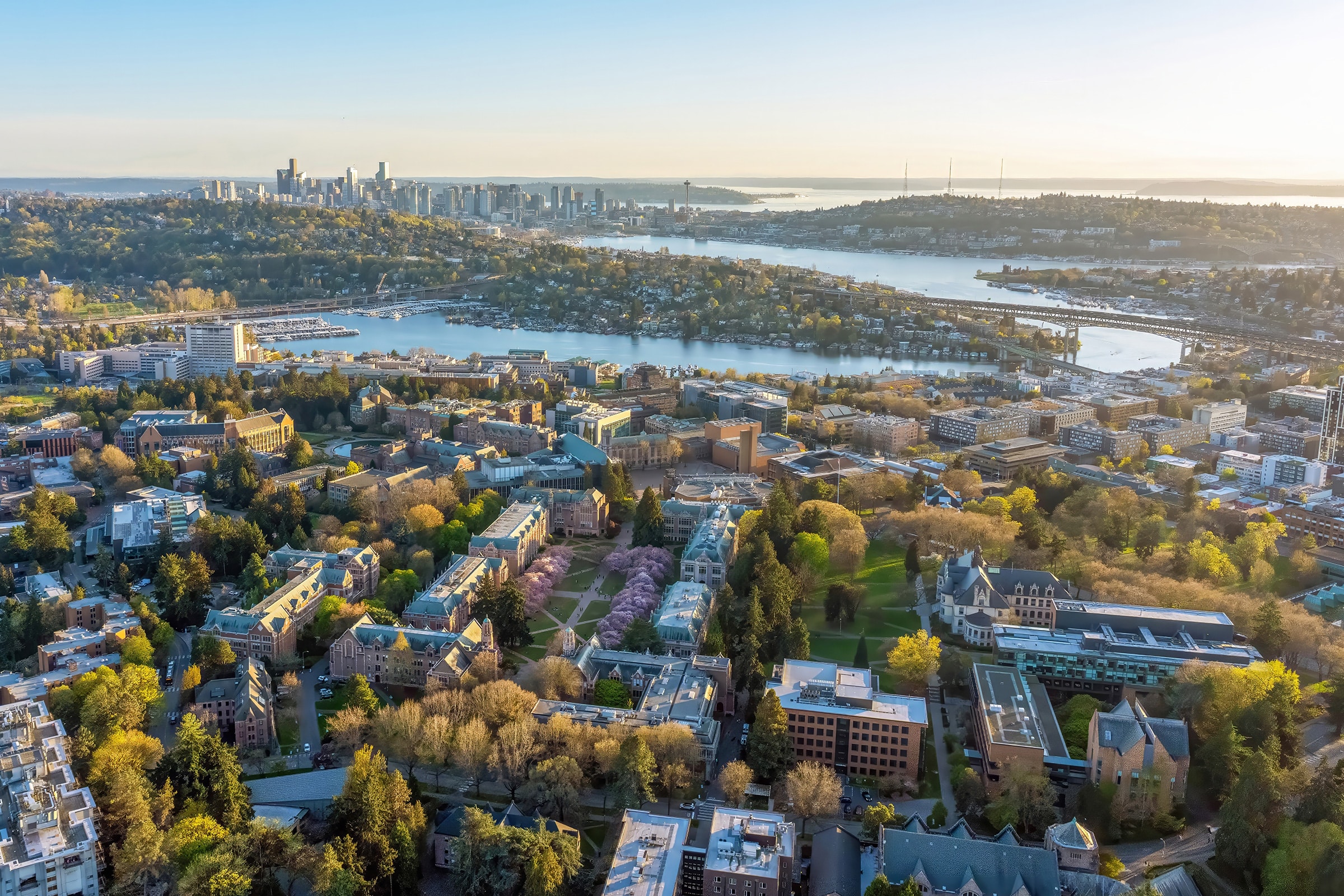
Although Seattle, Washington, landed its Emerald City nickname through a 1980s tourism campaign, it’s a fitting moniker: Seattle’s mild, rainy climate supports an abundance of trees in backyards, in city parks, and along streets. But as beloved trees are felled for development or die of old age or disease, the Emerald City is becoming less verdant: Its most recent tree canopy assessment found that tree cover dropped 1.7 percent from 2016 to 2021.
That small decrease may not seem like much, but new research suggests that it could have surprising implications for human health. For instance, city dwellers who live in neighborhoods with more trees (and often more resources) tend to have lower dementia risk and better heart and lung health, and are less likely to die prematurely as a result. Urban forests are also associated with cooler temperatures, cleaner air and water, and greater biodiversity. Yet until recently, few studies have measured the magnitude of these benefits in “health, deaths, or dollars,” says Colorado State University environmental epidemiologist David Rojas-Rueda.
Now, as Seattle and dozens of other cities across the United States work to expand their urban canopies, Rojas-Rueda and his collaborators have quantified the health and economic gains that cities could achieve if they actually meet their lofty goals. Seattle, for instance, is shooting to reach 30 percent tree cover (from its current 28 percent) by 2037. New York City aims to jump from 23 to 30 percent by 2040. Each city’s goal is unique, based on local ecology, climate, and other factors.
Hitting such targets, the researchers found, could collectively avoid more than 67,000 premature deaths across 144 cities, along with alleviating US $539 billion in economic burden from lives lost. (For cities lacking an official canopy goal, the team created a hypothetical figure based on average targets in the ecoregion.) Rojas-Rueda and his collaborators also modeled the effects of other policy scenarios for the 144 cities, such as increasing their 2019 tree cover by just 5 percent. That small boost cut the projected deaths and economic burden by a third. In the greater Seattle urban area, reaching 30 percent canopy cover could prevent around 450 adult deaths a year.
For urban forest managers like the City of Seattle’s Lauren Urgenson, this research helps communicate trees’ value and direct efforts for stewarding them. Trees are “more than a nice-to-have,” Urgenson says. They’re “essential public health infrastructure.” The challenge, she adds, is “planting and establishing trees where they’re most urgently needed.”
Rojas-Rueda’s study found that the most vulnerable communities—those with the highest rates of poverty and unemployment—disproportionately bear the health and economic costs of having fewer trees. It’s an inequity Urgenson has also noticed in Seattle. As in many cities, she acknowledges, Seattle’s most racially diverse, least wealthy neighborhoods are also the least green; some have less than half the average amount of tree cover found in the city. These neighborhoods have also experienced the highest arboreal losses in recent years.
Taken as a whole, this and related research shows that when scaled countrywide, the health benefits of urban nature—and the costs borne by communities that lack it—are “probably very large,” says Diane Pataki, an urban ecologist at Arizona State University who was not associated with the research. In fact, simply caring for existing urban trees and green space prevents more than 133,000 premature deaths annually, according to another recent study by Rojas-Rueda and colleagues. Pataki suggests that this evidence could bolster support for urban forests, especially in places where maintaining a city’s current canopy competes with other priorities, such as repairing roads and bridges. “People don’t have a lot of qualms about paying for their sewage treatment plants,” says Pataki. Likewise, green spaces should be a public health priority, she says: “We’ve got to shift our mindset.”
Despite this growing body of research, urban forests are being pummeled by forces such as disease and drought, and neglected due to lack of funding. Many cities are struggling to meet their tree cover goals. Denver, Colorado, for example, has one of the lowest tree canopies for a city of its size and climate, at 15 percent tree cover. (Some poorer neighborhoods reach only 4 percent, while the wealthiest top out at 35 percent.) Denver is planting saplings to try to reach 20 percent canopy cover, but at the same time, foresters are predicting the city will lose one-sixth of its trees to pests in coming years. Other urban trees, in Denver and beyond, are unlikely to survive the hotter temperatures wrought by climate change.
Since its last assessment, Seattle has been developing a “Tree Equity Plan” and is working with the most affected communities to reverse canopy loss. In one instance, community input helped guide city efforts to plant trees along a walking route into a historic park in the Chinatown-International District. The city also chose zelkova (Zelkova spp.), a type of deciduous tree valued in many East Asian cultures, for the park itself.
That’s an approach that Rojas-Rueda can get behind. Now that we know just how many lives can be saved by trees, he says, cities hoping to maximize their urban forestry investments should “start with those most vulnerable communities.”
Hi, I’m Dave, the executive director of bioGraphic. (And that’s my dog, Finn.) Thanks for taking the time to read this story.
Stories like this simply don’t get produced without financial support from readers like you. bioGraphic is not backed by a private company or owned by a billionaire. It’s an independent, nonprofit magazine. And one-quarter of our annual budget comes directly from reader donations.
We need your support more than ever, as governments slash funding for conservation and scientific research, placing even more ecosystems and wildlife at risk around the world. At bioGraphic, we’re steadfastly shining a light on the threats to our planet’s incredible biodiversity. And we’re showcasing the hard work of people bravely taking action to protect at-risk species.
bioGraphic publishes environmental reporting that you can’t find anywhere else: deeply researched, trustworthy stories that are also beautiful and captivating to read. We offer an antidote to reader apathy and doom-and-gloom news by revealing the wonders of the natural world and focusing on real solutions to big problems. When you finish a bioGraphic story, we want to leave you feeling informed, delighted, and inspired.
We don’t run ads or hide our stories behind a paywall. The readers who generously support bioGraphic allow our work to remain free for everyone.
Will you help us keep telling these crucial stories?

Related Articles
A Mite on a Bee on a Ship on the Sea Spells Trouble
Pollinator pathogens are spreading through international trade, threatening both agriculture and wild ecosystems.
When it Comes to Frog Sex, Teamwork Makes the Dream Work
New science on gray foam-nest tree frogs hints at the evolutionary benefits of multiple sexual partners.
How Much Plastic Does it Take to Kill a Seabird?
For the first time, researchers uncover how eating plastic trash may impact seabirds at the population level.