
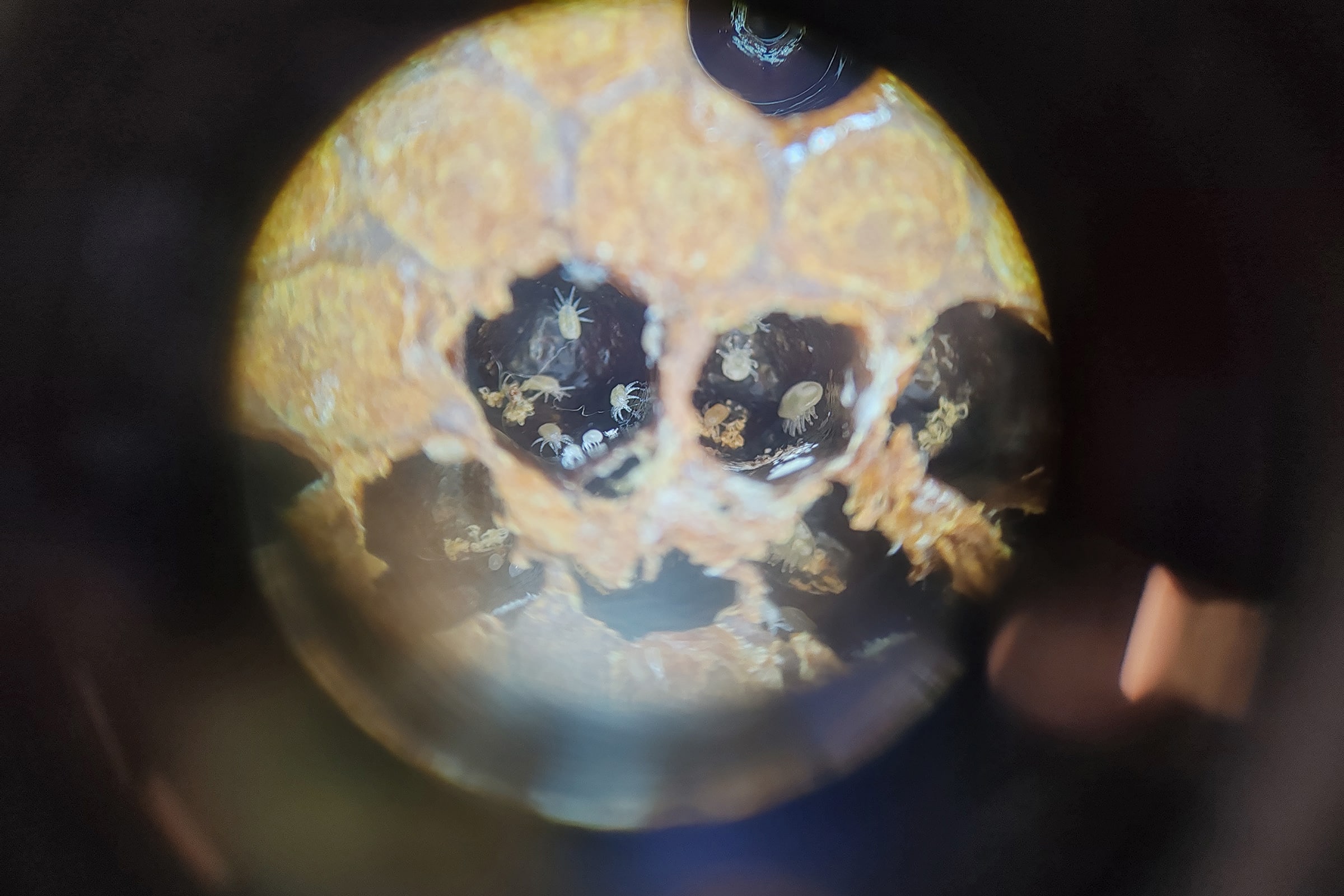
In July 2025, a crewmember on board a cargo ship heading from India to New Jersey noticed a swarm of bees. The ship’s master captain notified Customs and Border Protection in the United States, and federal apiarists guided the crewmembers—who were 6,667 kilometers (4,143 miles) from their final destination—on how to capture the hundreds of bees inside a plastic bag and store them in the ship’s freezers. The quick action prevented an exotic species and its pathogens from alighting on North American shores. But it was a warning bell for the continent.
The crew had intercepted giant honeybees (Apis dorsata). The wild bee species is native to Southeast Asia and has yet to reach North America alive. But when researchers at the U.S. Department of Agriculture (USDA) examined the carcasses of the ship’s bees under microscopes, they found something that heightened the prospect of a future bee-pocalypse: Tropilaelaps, a type of mite that lives on giant honeybees and has jumped to domesticated honeybee colonies in Asia and Eastern Europe. A Tropilaelaps infestation causes stunting and damages wings, legs, and abdomens, eventually leading to colony decline.
“It’s terrifying,” says Charles Linder, a beekeeper in Illinois and director of the BeeCAUSE Alliance, a collective of beekeepers in the U.S. and Canada. “It’s just a near miss.”
Keepers of domesticated bees in North America have already been grappling with a different type of mite, known as Varroa, which killed more than 60 percent of domesticated bees used for pollination and honey production between June 2024 and March 2025 in the U.S. alone. This and other mites are also dangerous for wild bee populations.
Mite-infected domesticated bees are more susceptible to other pathogens and tend to carry around more diseases in general. As those domesticated bees go about pollinating plants, they sprinkle their viruses, bacteria, and parasites in the environment, harming their wild cousins. For instance, a few viruses found in wild bee populations—including deformed wing virus and slow bee paralysis virus—are the result of them rubbing shoulders with domesticated honeybees while gathering pollen. One of the most egregious examples is the now-endangered rusty-patch bumblebee (Bombus affinis). Once common in midwestern and eastern North America, the wild bee’s populations plummeted in the 1990s due to pathogen spillover from domesticated bumblebees. Tropilaelaps adds yet another threat to the health of wild pollinators, which in turn threatens the health of ecosystems.
“There’s a strong conservation concern where the domestic bees act as a source of parasite and pathogen that can be damaging to their wild, native counterparts,” says Lewis Bartlett, an entomologist at the University of Georgia who also runs the university’s Bee Lab. There is cause for concern: The USDA researchers found that 42 bees from the ship had Tropilaelaps mites, and many of them bore other common honeybee diseases.
Compared with Varroa mites, Tropilaelaps are tinier, faster, and harder to spot. They also reproduce quicker than Varroa—every 24 hours, compared to every 30 hours—and feed on brood, the young, rather than on adult bees. Because of this, Tropiaelaps are trickier to control and can cause a domesticated honeybee colony to collapse in a matter of months. (Varroa infestations, in comparison, typically take a year and a half to decimate a hive.) This makes it nearly impossible for beekeepers to treat their colonies for mites, says honeybee researcher Maggie Gill, a scientist with the United Kingdom’s Department for the Environment, Food, and Rural Affairs.
Gill has studied Tropilaelaps in Thailand, where she witnessed the astonishing destructive abilities of the mites on honeybee hives. “If this spreads, then we’re in serious trouble,” she thought in 2023 when she first encountered Tropilaelaps.
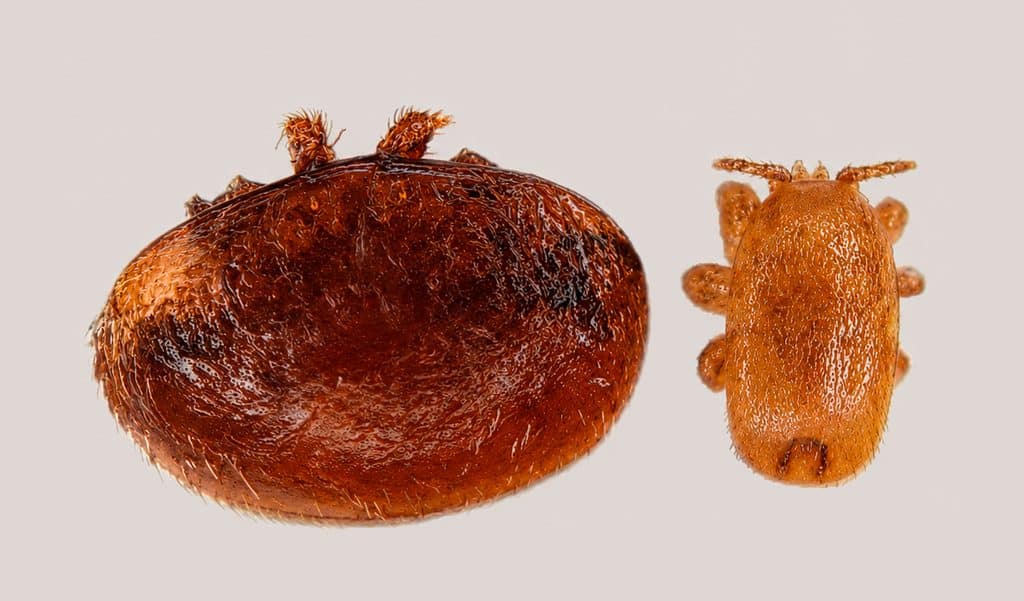
Tropilaelaps mites (right) are tinier, faster, and harder to spot when they infect bee colonies than Varroa mites (left). Both pose a threat to wild bee populations. Photograph by Maggie Gill
The swarm on board the cargo ship revealed a worrisome development: The mite-infected giant honeybees were all adults without a brood. Previously researchers believed the mites needed a brood to survive longer than six days. But on the ship, the Tropilaelaps mites endured for up to 99 days on the adults alone. Researchers don’t entirely understand why, but there are theories.
“That suggests that Tropilaelaps has adaptations tied to its natural host, the giant honeybee,” explains Jose Luis Ramirez, a research entomologist with the USDA and coauthor of a study documenting the near miss. This makes the mites—and the bees that carry them—even more troubling from a biosecurity perspective. It also suggests that global trade is already carrying the mites across oceans and into countries where domesticated and wild bees alike have limited natural defenses, if any.
In 2024, the mites were detected in Georgia and Western Russia. Since then, they’ve wiped out 60 to 80 percent of domesticated colonies in those locales. Then, in July 2026, a Turkish beekeeper posted on Facebook that she’d found the mites in a hive. Commenters responded: “It will shake the mountain,” and “What is the medicine for this?”
There is no proven treatment for Tropilaelaps mites, though Gill is currently in Asia trying to develop one. Formic acid works for Varroa and seems to slow down Tropilaelaps, depending on the season, but only temporarily, with the possibility of reinfestation because of their fast reproductive rate. It’s also disruptive for bees, and sometimes even kills them.
In Asia, though Tropilaelaps is trouble, most honeybee operations are small scale, with keepers tending between 10 and 50 hives. In North America and Europe, beekeepers often oversee thousands of hives. Like in a crowded tenement stuffed with humans, diseases proliferate more easily in these crowded conditions. “That is why it’ll be so devastating for us,” Linder says.
The ecological makeup of North America and Europe may also factor into the possibility for devastation. “If we transport novel parasites or diseases into those populations via our domestic and commercial beekeeping, we can really damage what remnants of native ecosystems exist, especially in the limited regions of old-growth forest in places like Europe,” Bartlett says. Old-growth forests cover 1.4 million hectares (3.4 million acres) across 32 countries in Europe. Wild bees in these areas can be particularly vulnerable to new pathogens.
Because Tropilaelaps is native to Southeast Asia, it may also carry other pathogens that European honeybees are not used to, according to Bartlett. He worries that the slow movement of Tropilaelaps through Europe could lead to the Americas. “That’s where I’m keeping my eye on,” he says.
Hi, I’m Dave, the executive director of bioGraphic. (And that’s my dog, Finn.) Thanks for taking the time to read this story.
Stories like this simply don’t get produced without financial support from readers like you. bioGraphic is not backed by a private company or owned by a billionaire. It’s an independent, nonprofit magazine. And one-quarter of our annual budget comes directly from reader donations.
We need your support more than ever, as governments slash funding for conservation and scientific research, placing even more ecosystems and wildlife at risk around the world. At bioGraphic, we’re steadfastly shining a light on the threats to our planet’s incredible biodiversity. And we’re showcasing the hard work of people bravely taking action to protect at-risk species.
bioGraphic publishes environmental reporting that you can’t find anywhere else: deeply researched, trustworthy stories that are also beautiful and captivating to read. We offer an antidote to reader apathy and doom-and-gloom news by revealing the wonders of the natural world and focusing on real solutions to big problems. When you finish a bioGraphic story, we want to leave you feeling informed, delighted, and inspired.
We don’t run ads or hide our stories behind a paywall. The readers who generously support bioGraphic allow our work to remain free for everyone.
Will you help us keep telling these crucial stories?

Author

Related Articles
The Curious Connection Between Bacteria, Seagrass, and Carbon
New research shows that seagrass depends on the bacteria around it—and that the antibiotics entering our oceans could disrupt that relationship.

Trees as Public Health Infrastructure
New research shows that meeting tree canopy goals could prevent more than 67,000 premature deaths in the United States.
When it Comes to Frog Sex, Teamwork Makes the Dream Work
New science on gray foam-nest tree frogs hints at the evolutionary benefits of multiple sexual partners.