
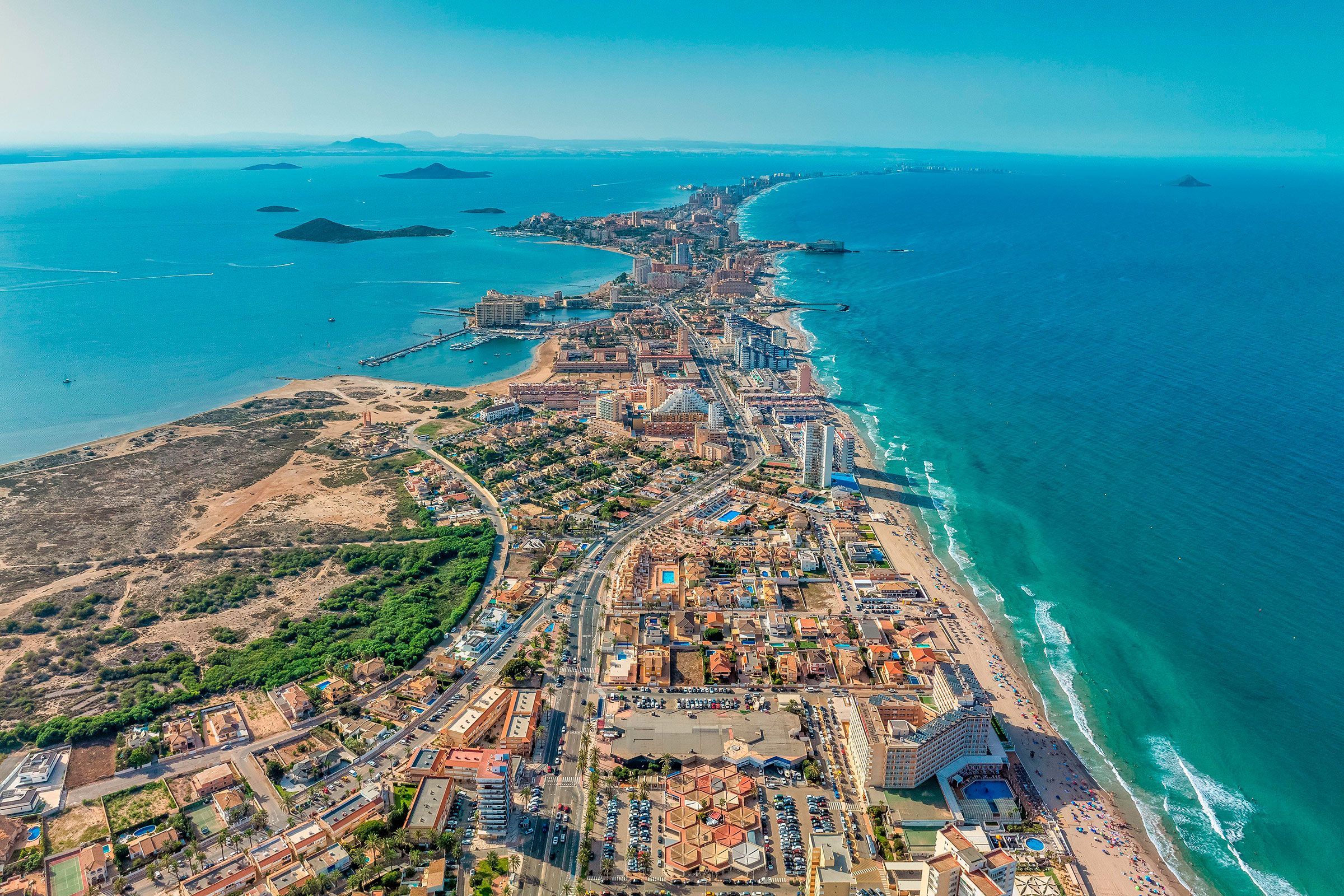
Mar Menor, a 135-square-kilometer (52-square-mile) lagoon in southern Spain, is the only ecosystem in Europe that can be named a victim in a legal case. In September 2022, the Spanish Senate granted the largest saltwater lagoon in the Mediterranean legal personhood. From then on, any human who wanted to help Mar Menor could represent it in court.
For those in the budding Rights of Nature movement, who recognize the planet and all its ecosystems as living beings with inalienable rights, the Mar Menor victory was a breakthrough. The first body of water in Europe granted legal personhood, the move caught the region up to similar legal successes elsewhere, such as with Colombia’s Atrato River in 2016 and New Zealand’s Whanganui River in 2017.
Protection for Mar Menor came after a series of mass die-offs ravaged the ecosystem. In 2016, excessive nutrient runoff triggered a massive algal bloom that turned parts of the lagoon a misty green and killed 85 percent of its marine vegetation. Then in 2019, and again in 2021, nutrient runoff stripped the lagoon of oxygen, suffocating thousands of fish and crustaceans, and littering its shores with creatures gasping for air.
Spurred by the crises, environmental activists, lawmakers, and local residents banded together. They collected around 640,000 signatures and, in 2022, successfully pushed a citizen initiative through the Spanish parliament’s upper chamber. Their efforts resulted in a new law granting Mar Menor and its surrounding basin rights in every sense of the word: the right to live and flourish; the right to be protected; and the right to recover. The law’s Article 6 was particularly groundbreaking. It stated that any person or relevant legal entity “is entitled to defend the ecosystem of the Mar Menor.”
“The right to recovery is no longer something that depends on a ministry wanting to do it, but it is a right of the Mar Menor,” says Teresa Vicente. A law professor at the nearby University of Murcia, Vicente earned the Goldman Environmental Award, often called the Green Nobel, for the key role she played in driving the initiative and writing the law that gives personhood to Mar Menor.
But three years on, Mar Menor is still waiting for humans to act on their promises. So I visited this famous coastal lagoon—the name of which translates to Minor Sea—and chatted with some of its protectors to find out what was happening on the ground.
• • •
Mar Menor is about 451 kilometers (280 miles) southeast of Madrid. On the four-hour drive there, I expected the farm fields that lined the highway to give way to largely untouched protected areas. Instead, they expanded into plains populated with lime trees and lettuce, greenhouses bearing tomatoes, and an urbanized landscape of vacation apartments and hotels.
I arrived at Mar Menor, on the shores of Los Alcázares, on a Sunday afternoon. Walking the constructed beach and looking out over the clear water, I relished the sunset and the familiar feeling of salt water on my feet. As I surveyed the scene, I noticed a napkin floating by, a dead jellyfish that looked like a fried egg, and in the distance an expansive stretch of concrete buildings crowding the thin strip of land that separates Mar Menor from the Mediterranean Sea.
The next morning, I met with Pedro Luengo, a spokesperson for the environmental group Ecologistas en Acción. Luengo grew up in nearby Murcia in the 1980s and spent hours in Mar Menor as a child, swimming and observing seahorses, fish, and small crustaceans.
“People thought it was going to be a panacea—that as soon as the law was passed everything would be solved,” Luengo says. But upstream from Mar Menor, the endless fields of intensive agriculture—the source of the nutrient runoff that plagues the lagoon’s wildlife—remain active.
Scientists have been warning since the 1980s that agricultural and livestock production and rampant construction would degrade the lagoon ecosystem. But “the companies in the agricultural and livestock sectors are highly organized to pressure the administration, and they also wield significant economic power,” Luengo says.
The Rambla del Albujón, a 40-kilometer (roughly 25 mile-mile) watercourse that runs through the farming country, discharges 5 to 10 billion liters (1.3 to 2.6 billion gallons) of pesticides, hydrocarbons, nutrients, and water polluted with urban waste into Mar Menor each year. Although measures such as water filtration and monitoring have been implemented, nothing has fully prevented contaminants from discharging into the lagoon.
Meanwhile, the council that is supposed to be in charge of representing Mar Menor was only established in May 2025, two and a half years after the lagoon was first granted rights.
Faced with such delays, Pablo Rodríguez Ros, an oceanographer and the author of the 2023 book El mar que muere (The Dying Sea), about the diverse assaults on Mar Menor, believes the protected area risks becoming a paper park. “The problem here is not that there are no laws; the problem is that the laws are not enforced,” he says.
Case in point, even before Mar Menor was granted legal personhood, the lagoon was already protected by a raft of regional and international designations. For example, Mar Menor is on the Ramsar List of Wetlands of International Importance, an international designation recognized by 172 nations. It is also a Specially Protected Area of Mediterranean Importance, a European Union initiative that, since 2001, has recognized the lagoon as a key ecological site that is owed protection by the 21 countries bordering the Mediterranean Sea.
Against this backdrop, says Luengo, the most positive outcome from Mar Menor receiving personhood is that it could “make it easier to prosecute environmental crimes. And I say this because in the Spanish legislation it is very, very, very difficult to prosecute an environmental crime.”
• • •
The vision advocates thought they had secured for Mar Menor in 2022 will take more time and more court cases.
The most significant legal challenge on the docket is scheduled for May 2026, when Mar Menor will appear for the first time as a plaintiff against an agricultural company accused of illegally discharging more than 162,000 cubic meters (43,000,000 gallons) of polluting desalination wastewater upstream of the lagoon. This trial is part of a broader case, known as Topillo, which was launched by Greenpeace and other organizations in 2017 against more than 30 companies accused of illegal agricultural practices in the Mar Menor watershed.
And though Article 6 of Mar Menor’s personhood designation gives people the ability to defend the lagoon in court, Murcia’s local court recently rejected the idea that civil organizations can legally represent the lagoon. In response, the Topillo case lawyers are also headed to the European Court of Human Rights to argue that the Spanish judiciary is failing to uphold the law and consequently Mar Menor’s rights. That May 2026 challenge will be another test of Spain’s recognition of nature as a legal entity, and of putting this new legal framework into practice.
Susana Borràs-Pentinat, an international public law expert at Spain’s Rovira i Virgili University, says the situation currently playing out around Mar Menor could set the tone for the Rights of Nature movement across Europe. “It is a very interesting moment to see how the legal and judicial framework is being stretched,” she says. For the Rights of Nature concept to mesh with modern society, she says, “we need better preparation—not only for our judges but also for our institutions.”
Granting legal personhood to Mar Menor poses a profound challenge to judges, as well as to politicians and others tasked with balancing the region’s agricultural production with the health of the lagoon. At the same time, the designation is a call to arms for those who live around the lagoon, says Borràs-Pentinat. “If we want these laws to be effective,” she says, people need “to understand our link with nature—and that defending nature is also defending ourselves.”
Hi, I’m Dave, the executive director of bioGraphic. (And that’s my dog, Finn.) Thanks for taking the time to read this story.
Stories like this simply don’t get produced without financial support from readers like you. bioGraphic is not backed by a private company or owned by a billionaire. It’s an independent, nonprofit magazine. And one-quarter of our annual budget comes directly from reader donations.
We need your support more than ever, as governments slash funding for conservation and scientific research, placing even more ecosystems and wildlife at risk around the world. At bioGraphic, we’re steadfastly shining a light on the threats to our planet’s incredible biodiversity. And we’re showcasing the hard work of people bravely taking action to protect at-risk species.
bioGraphic publishes environmental reporting that you can’t find anywhere else: deeply researched, trustworthy stories that are also beautiful and captivating to read. We offer an antidote to reader apathy and doom-and-gloom news by revealing the wonders of the natural world and focusing on real solutions to big problems. When you finish a bioGraphic story, we want to leave you feeling informed, delighted, and inspired.
We don’t run ads or hide our stories behind a paywall. The readers who generously support bioGraphic allow our work to remain free for everyone.
Will you help us keep telling these crucial stories?

Author

Related Articles
The Curious Connection Between Bacteria, Seagrass, and Carbon
New research shows that seagrass depends on the bacteria around it—and that the antibiotics entering our oceans could disrupt that relationship.
Trees as Public Health Infrastructure
New research shows that meeting tree canopy goals could prevent more than 67,000 premature deaths in the United States.
A Mite on a Bee on a Ship on the Sea Spells Trouble
Pollinator pathogens are spreading through international trade, threatening both agriculture and wild ecosystems.