
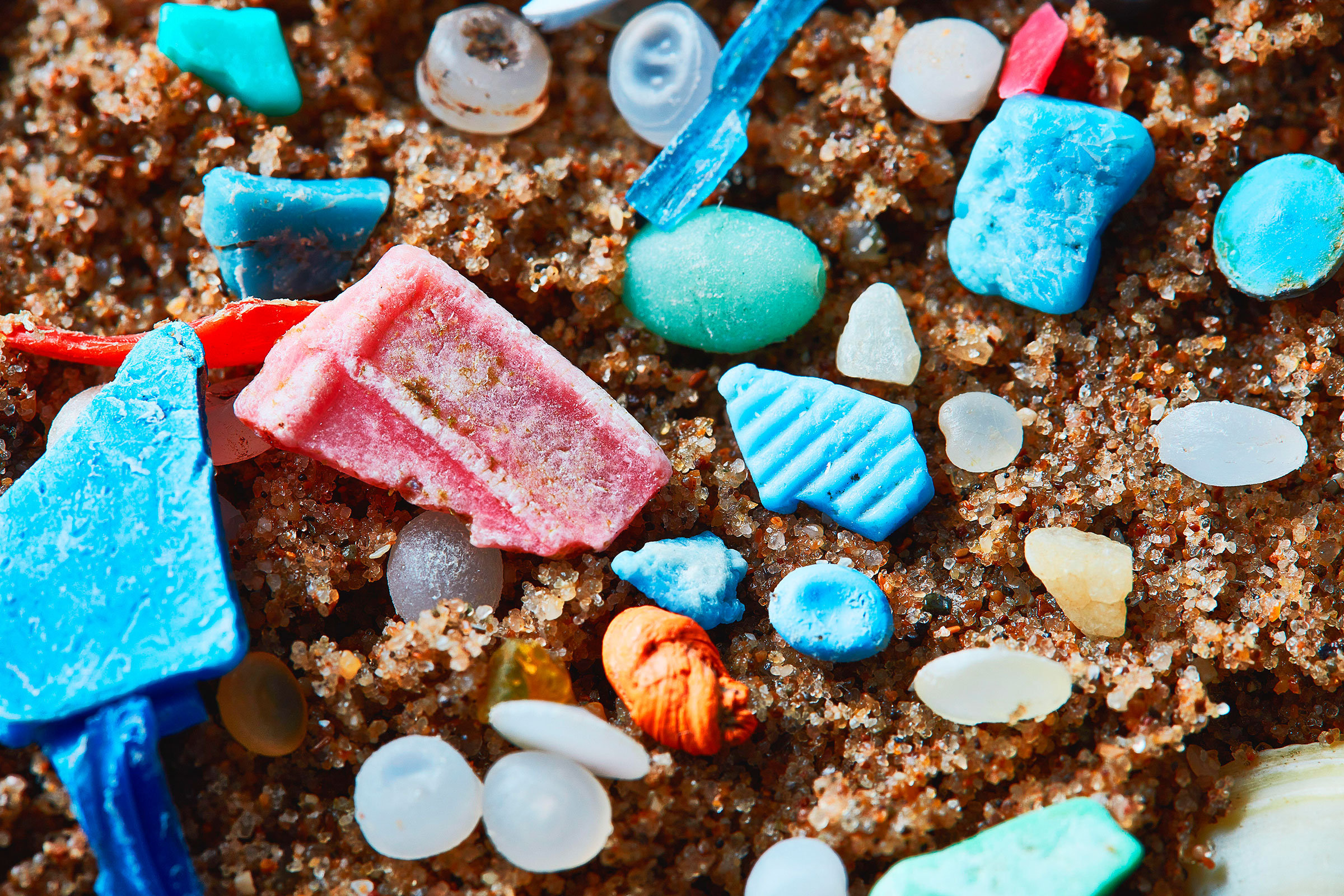
Humans are experts at rearranging matter. Advances in chemistry have given us lifesaving drugs, massive agricultural yields, and … uh … Crocs. But many of our chemical creations, like plastics and so-called forever chemicals, have an unpleasant tendency to hang around, showing up in our water, food, and even our bodies. It can feel claustrophobic: With the products of our technology now woven into remote ecosystems and our own flesh, there’s no escape from ourselves.
But humans aren’t the only chemical engineers in town. Simply by metabolizing, plants turn air into wood and sunlight into sugar. And microbes—including archaea, bacteria, fungi, and protists—are capable of amazing feats of metabolic chemistry. They can digest diesel and polyester, break down pesticides and fabric dyes, and store heavy metals in their bodies like chipmunks hoarding nuts in their cheeks. Microbes break down plastics and other compounds by harvesting the energy from the chemical bonds that hold them together. This results in a bunch of loose carbon, hydrogen, and other elements being cut loose to the environment, which tend to go on to bond with oxygen to form water, carbon dioxide, and other gases.
Using microbes to clean up waste is a well-established technology. In many towns, wastewater treatment plants rely on a mix of microbes to break down sewage into carbon dioxide, methane, and water, though some more complex compounds persist and can wind up back in the wild. Often the helpful microorganisms are already present in wastewater, but treatment plant managers can also buy blends of microbes to give the process a kick. Other commercial microbial blends eat through the waste from paper and textile mills and farms, or clean up oil and gas in contained spaces.
These microbial mixes are powerful, but they have big limitations. Jiandong Jiang, a microbiologist at China’s Nanjing Agricultural University, says that when they are spread in the wild these beneficial microbes are quickly outcompeted by local species. And even in an enclosed tank, the microbes eventually die off and have to be replaced.
Scientists have long dreamed of using microbes to break down unwanted contaminants in open environments. And the key to that, says Jiang, is that rather than spreading motley mixes of microbes, scientists should instead be crafting and dispersing deliberately designed microbial communities—microbiomes purpose-built for a specific goal.
Microbiomes are microscopic ecosystems, and you can find them everywhere. They’re hidden in the soil, in the sea, and in animals’ guts, and found clinging to plastic trash. Over the past few decades, scientists have been diving deep into how these complex assemblages of microbes affect the world around them. And some, like Jiang, are already experimenting with creating entirely new microbial communities to solve environmental problems, like cleaning up microplastics and restoring trashed agricultural soil.
The microbes that are already being used for remediation in closed systems, like wastewater treatment plants, were largely discovered by isolating them from sites where spills have occurred or places like lagoons or landfills where the compounds they consume are common. Microbiologists call this the top-down approach to finding hard-working microbial cleaners. But designing a microbiome from scratch requires a whole lot more microbial knowledge.
To create custom microbiomes to remediate farm soil, free-flowing rivers, and other open systems, Jiang and others are using a bottom-up approach. They make a list of all the tasks they want their microbe army to accomplish and then, using new tools like genome-scale metabolic modeling—which gives a clue to what chemicals a microbe can consume—they pinpoint species that can accomplish those tasks.
The trick is to design a team that works together. In traditional microbial mixes, each species is a superhero that seeks out and spars with its respective supervillain. In a custom microbiome, in comparison, teams of microbes work together to fell a more formidable foe. One species in the microbiome, for instance, might break a persistent pollutant into more manageable chunks that are then the perfect food for other species. Other microbes might be included to play supporting roles, producing compounds the others need, the same way field medics and cooks keep frontline fighters in top shape. It is those internal interactions that make functional microbiomes more stable in competitive environments than traditional microbial mixes.
In the future, Jiang says, advances in synthetic biology and genetic engineering—the practices of creating artificial microbes and giving existing ones new abilities by changing their DNA—will likely enable scientists to develop custom microbiomes capable of breaking down even more recalcitrant targets, such as plastics. This work is already well underway in labs around the world, though the significant ecological, ethical, and legal concerns involved mean the use of genetically engineered or fully synthetic microbial cleanup crews in the wild is a longer-term vision, Jiang says.
Lucas Ruberto, a microbiologist at the Argentine Antarctic Institute in Buenos Aires, thinks that future will arrive sooner rather than later. Ruberto spent the past decade working to remediate diesel pollution in Antarctica with bacteria he identified through the classic top-down method. He expects custom microbiomes designed with the bottom-up approach to see widespread use in as little as 10 years, and he expects engineered cells will be used in some of those efforts.
“The advantages are really important,” he says. “If we can manipulate this tiny world, we can do almost anything.”
Emily Aurand, who promotes biotechnology research on behalf of the California-based nonprofit Engineering Biology Research Consortium, says custom microbiomes are already proving their potential. She points to a team at the University of Delaware that has successfully tweaked the microbes inside the guts of mealworms to enhance their ability to digest plastic into carbon dioxide and other waste products. “We can get a lot of worms to do it in a box in a lab,” Aurand explains, adding that it will take money and community support to dump that box of manipulated mealworms into the local landfill.
The researchers Aurand works with are very aware that part of the challenge of creating custom microbiomes is coming up with ways to control them and limit their spread. No one wants plastic-eating worms invading a hospital and eating all the IV lines and latex gloves, after all. Taking the technology to the next level—of actually spreading these novel microbial communities in the field—will obviously require earning people’s trust. Yet as Aurand says, it’s hard for scientists to demonstrate that a custom microbiome is safe without actually doing the experiments. The path to gaining public acceptance, Aurand suggests, is to build in technological fail-safes—like microbes that die after a certain number of generations—and to scale field trials very, very gradually.
Social acceptance for microbiomes designed from existing species will likely be higher than for those that include genetically engineered or synthetic microbes. But genetic manipulation may not be necessary to achieve the benefits custom microbiomes promise. In his lab at India’s Banaras Hindu University, Pratyoosh Shukla and his colleagues are developing custom communities of algae and cyanobacteria that can break down microplastics and heavy metals without DNA-level modification. “Since the microbe itself is doing a very good job, I don’t think that there is much need of genetically modifying it,” he says.
As long as they avoid any potentially pathogenic strains, Shukla says deploying communities of naturally occurring microbes into the wild is low risk. He sees microplastics beginning to fall to cleverly designed microbiomes within a decade or two.
If the field of ecology has taught us anything, it’s that all organisms are affected by all of the other species with which they regularly interact. Through our actions, we are already having a profound influence on the wider microbial world—the spread of antibiotic resistance in wild bacteria is evidence enough of that. What those creating custom microbiomes propose is that we begin manipulating these microscopic ecosystems with intention.
Hi, I’m Dave, the executive director of bioGraphic. (And that’s my dog, Finn.) Thanks for taking the time to read this story.
Stories like this simply don’t get produced without financial support from readers like you. bioGraphic is not backed by a private company or owned by a billionaire. It’s an independent, nonprofit magazine. And one-quarter of our annual budget comes directly from reader donations.
We need your support more than ever, as governments slash funding for conservation and scientific research, placing even more ecosystems and wildlife at risk around the world. At bioGraphic, we’re steadfastly shining a light on the threats to our planet’s incredible biodiversity. And we’re showcasing the hard work of people bravely taking action to protect at-risk species.
bioGraphic publishes environmental reporting that you can’t find anywhere else: deeply researched, trustworthy stories that are also beautiful and captivating to read. We offer an antidote to reader apathy and doom-and-gloom news by revealing the wonders of the natural world and focusing on real solutions to big problems. When you finish a bioGraphic story, we want to leave you feeling informed, delighted, and inspired.
We don’t run ads or hide our stories behind a paywall. The readers who generously support bioGraphic allow our work to remain free for everyone.
Will you help us keep telling these crucial stories?

Author

Related Articles
The Curious Connection Between Bacteria, Seagrass, and Carbon
New research shows that seagrass depends on the bacteria around it—and that the antibiotics entering our oceans could disrupt that relationship.
Trees as Public Health Infrastructure
New research shows that meeting tree canopy goals could prevent more than 67,000 premature deaths in the United States.
A Mite on a Bee on a Ship on the Sea Spells Trouble
Pollinator pathogens are spreading through international trade, threatening both agriculture and wild ecosystems.