
Photograph by Lucas Bustamante
Story by Steven Bedard
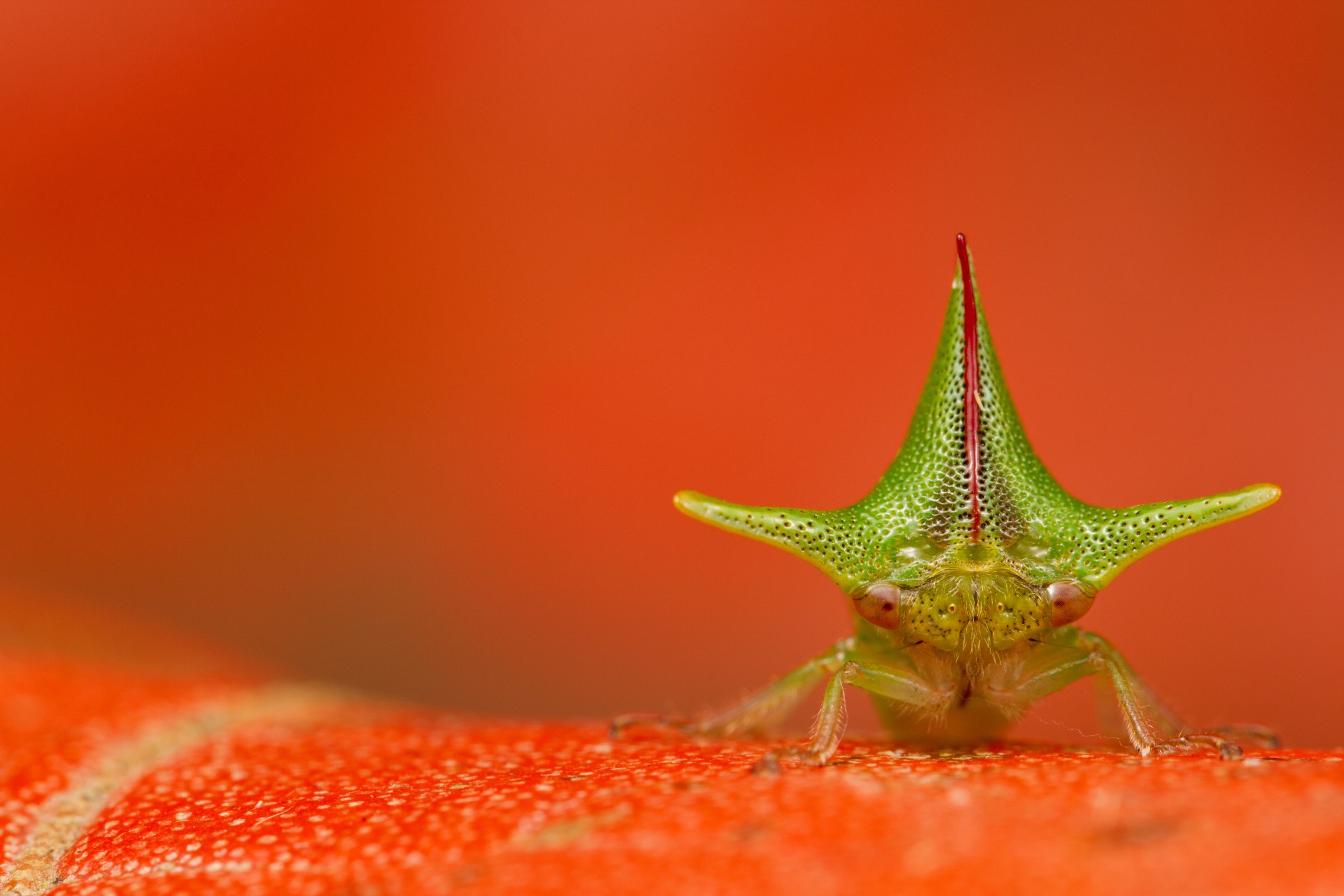
When we think of impressive headgear in the animal kingdom, horned and antlered mammals and heavily armored dinosaurs probably come most readily to mind. But on a relative basis, tiny treehoppers have nothing to be ashamed of, and little to fear.
Of all the traits that treehoppers are known for—if they’re known at all, if they’re seen at all—the most spectacular is their helmet, or, in scientific parlance, their pronotum. This often-outlandish structure, which many researchers think is a highly modified set of wings, has, in a sense, been given evolutionary free rein—because, really, who needs another functional set of flight appendages when you already have two?
Given such latitude and guided by natural selection’s keen sense of style, the world’s 3,000-plus treehopper species have evolved an astoundingly diverse assortment of outsized headgear. These helmets sometimes resemble inanimate objects such as plant seeds or bird poop, or completely different creatures such as ants. One of the most common forms of headgear, as worn by this Alchisme grossa treehopper photographed in the Ecuadorian highlands, mimics a thorn. It’s not hard to imagine how a group of these gregarious insects lined up along the stem of their host plant might appear to a hungry bird or lizard. Edible? Not if you value the ability to swallow.
Whether camouflage or defense, or both, has been the primary driving force of treehopper pronotum evolution will likely be an open question for some time. But scientists studying treehoppers in Bolivia think they may have identified a critical factor driving pronotum size and shape, at least in A. grossa: maternal care.
In a surprising show of parental investment, female A. grossa treehoppers stand watch over each clutch of eggs they produce until their babies have hatched and developed into adulthood. When a predator or parasite approaches, females shield their offspring from view or twist and vibrate their bodies aggressively to ward off the intruder.
Bulky and intimidating head ornaments are understandably helpful to these efforts. Indeed, the scientists found that larger headgear was correlated with both bigger clutches of eggs and higher offspring survival rates. Looking like a large thorn, even while perched on a host plant that has no thorns of its own, apparently presents no significant disadvantage to a mother treehopper, and it enables her to protect large broods—offspring that will pass their own outlandish headgear on to the next generation.

Mindo, Ecuador
Hi, I’m Dave, the executive director of bioGraphic. (And that’s my dog, Finn.) Thanks for taking the time to read this story.
Stories like this simply don’t get produced without financial support from readers like you. bioGraphic is not backed by a private company or owned by a billionaire. It’s an independent, nonprofit magazine. And one-quarter of our annual budget comes directly from reader donations.
We need your support more than ever, as governments slash funding for conservation and scientific research, placing even more ecosystems and wildlife at risk around the world. At bioGraphic, we’re steadfastly shining a light on the threats to our planet’s incredible biodiversity. And we’re showcasing the hard work of people bravely taking action to protect at-risk species.
bioGraphic publishes environmental reporting that you can’t find anywhere else: deeply researched, trustworthy stories that are also beautiful and captivating to read. We offer an antidote to reader apathy and doom-and-gloom news by revealing the wonders of the natural world and focusing on real solutions to big problems. When you finish a bioGraphic story, we want to leave you feeling informed, delighted, and inspired.
We don’t run ads or hide our stories behind a paywall. The readers who generously support bioGraphic allow our work to remain free for everyone.
Will you help us keep telling these crucial stories?

Authors


Related Articles
Milt Meal
Marine creatures will do almost anything for a meal—including feasting on the sperm and eggs of spawning invertebrates.

The Art of the Catch
To bulk up for winter hibernation, Alaska’s brown bears employ a range of techniques for snaring salmon.
The Wonder of a Pale Whale
A curious calf with an atypical birthday suit is a good sign for southern right whales.