
The Bird Who Needs Less
Little bustards thrive when farmers scale back.
Photograph by Òscar Domínguez
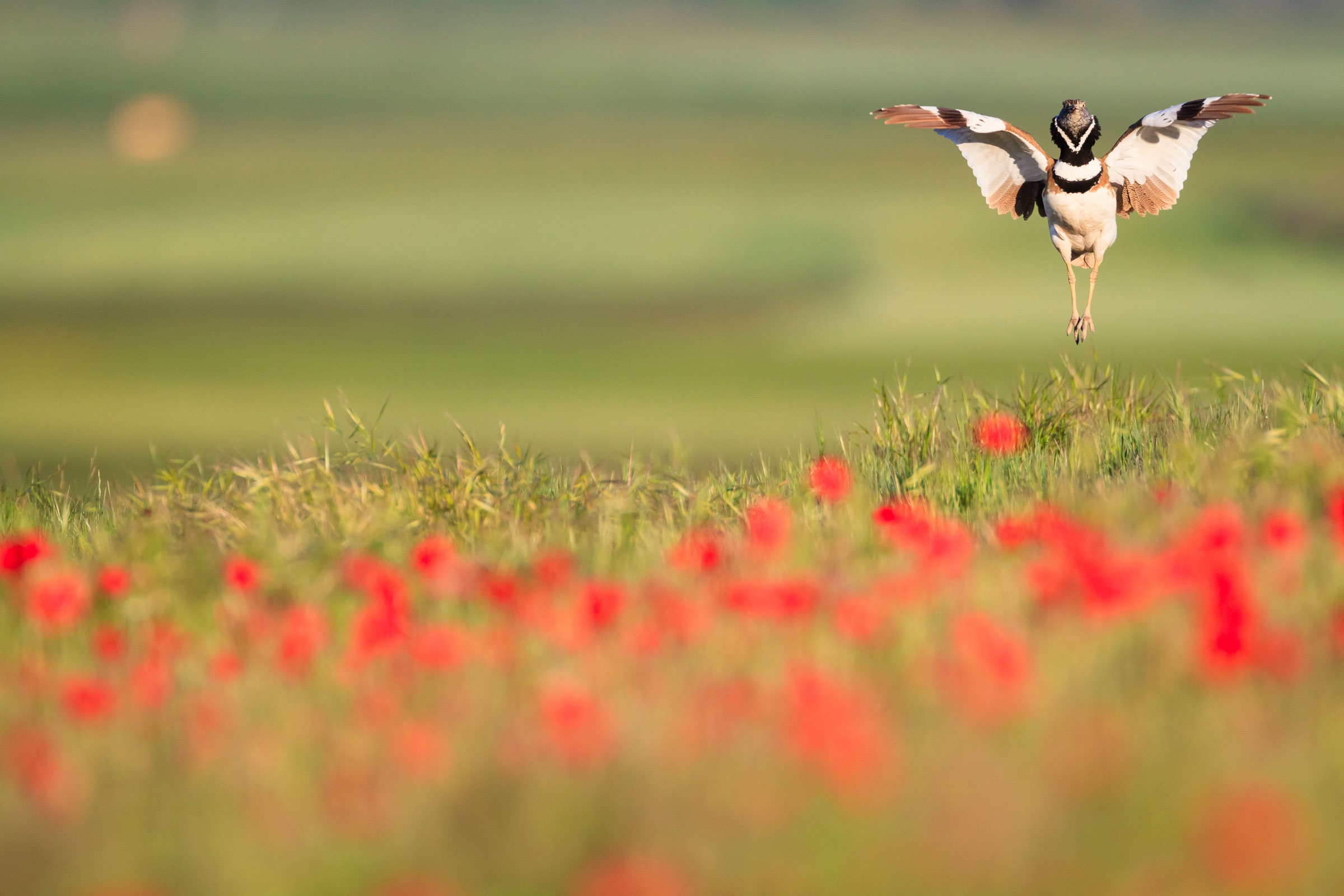
Sometimes less is more. Especially for the ground-dwelling bird known as the little bustard (Tetrax tetrax).
In the dry steppes of Europe’s Iberian Peninsula, the little bustard relies on low-intensity agriculture for habitat. Unlike modern farmers who irrigate heavily, traditional agriculturalists in Spain and Portugal rely on water that falls from the sky and practice crop rotation, alternating fields of dryland crops—wheat and barley, sunflowers and garbanzo beans—in a pattern that leaves some fields fallow. The unplanted fields offer a cornucopia of seeds, shoots, grasshoppers, beetles, and weevils for little bustards to eat. The high-protein arthropods are particularly necessary during breeding season.
Photographer Òscar Domínguez spotted this male in a fallow field dotted with poppies in Catalonia, Spain. This little bustard was part of a lek, where males courting females gather with a magnificent display of acrobatics. Unlike the males in other bird species, little bustards engage in “exploding leks”—that is, instead of competing in close quarters, they spread out and claim a roomy patch of land as their personal stage. To attract a female, males sing, beat their wings—which whistle, thanks to a uniquely shaped primary feather—stamp their feet, and make a series of rapid jumps. If a female is sufficiently wooed, she will mate and then lay two to six eggs in a depression she scrapes in the ground.
To snap this showboat, Domínguez positioned himself east of the lek before dawn, as he’s noticed that the males typically leap during the first hour after sunrise. If it’s raining, they often don’t jump at all.
Outside breeding season, males and females have similar plumage: brownish with fine black lines, white bellies, light-brown legs, and white wings with black tips. But when it’s time to mate, males sport a distinctive pattern of black and white on their necks and heads. Both sexes reach to around the height of a bowling pin and weigh about as much as two soccer balls. Although the little bustard is heavy for its size, it’s the smallest of the three bustard species found within its range.
Little bustards range from China and Russia to Spain, Portugal, and Morocco. Globally, the bird is listed as near threatened on the International Union for Conservation of Nature’s Red List of Threatened Species. In Europe, though, the little bustard is considered vulnerable. While the Iberian Peninsula had long been a stronghold, over the past 30 years, mounting market pressure has pushed farmers to invest in irrigation to produce more food, including higher value crops like olives. Aside from increasing harvests and fundamentally transforming farm fields into crop conveyor belts that never rest, irrigation kills little bustards indirectly. To pull water from an aquifer, pumps require electricity. So as irrigation arrives on a landscape, so do power lines. Flying over fields, little bustards collide with the lines so forcefully that they die. Water shot from sprinklers can intrude on the birds, flooding their ground nests. Intensifying food production also leads to more mechanization and pesticides—both of which harm eggs and rob bustards of their own food supply.
The good news is if you leave it, they will come. In protected areas in Spain—mostly nature reserves with strong regulations around agriculture—little bustards thrive compared with their compatriots in areas with little or no regulation. To bolster little bustard populations, and those of other steppe birds, traditional farming with its lesser impacts offers the most protection.
Hi, I’m Dave, the executive director of bioGraphic. (And that’s my dog, Finn.) Thanks for taking the time to read this story.
Stories like this simply don’t get produced without financial support from readers like you. bioGraphic is an independent non-profit—we’re not backed by a private company or owned by a billionaire. One-quarter of our budget comes directly from reader donations.
bioGraphic publishes environmental reporting that you can’t find anywhere else: deeply researched, trustworthy stories that are also beautiful and captivating to read. Right now, we need your help to raise $30,000 by October 2. Every dollar will go directly to more crucial reporting projects.
Around the world, governments are slashing funding for conservation and scientific research, placing even more ecosystems and wildlife at risk. At bioGraphic, we’re steadfastly shining a light on the threats to our planet’s incredible biodiversity. And we’re showcasing the hard work of people bravely taking action to protect at-risk species.
bioGraphic offers an antidote to apathy and doom-and-gloom news by revealing the wonders of the natural world and focusing on real solutions to big problems. When you finish a bioGraphic story, we want to leave you feeling informed, delighted, and inspired.
We don’t run ads or hide our stories behind a paywall. The readers who generously support bioGraphic allow our work to remain free for everyone.
We reached our goal, but there’s time left. Will you help us smash our original goal and reach a new goal of $30,000 by October 2?

Related Articles
The Art of the Catch
To bulk up for winter hibernation, Alaska’s brown bears employ a range of techniques for snaring salmon.
The Wonder of a Pale Whale
A curious calf with an atypical birthday suit is a good sign for southern right whales.
Saying “Ah!” at the Shrimp Spa
On coral reefs, an army of tiny cleaners eat their clients’ parasites, food particles, and dead skin, boosting biodiversity in the process.
