
The Heaven and Earth Bird
The green-crowned brilliant is one of over 360 species of hummingbirds, feathered flying jewels that have fascinated people the world over.
Photograph by Guy Edwardes
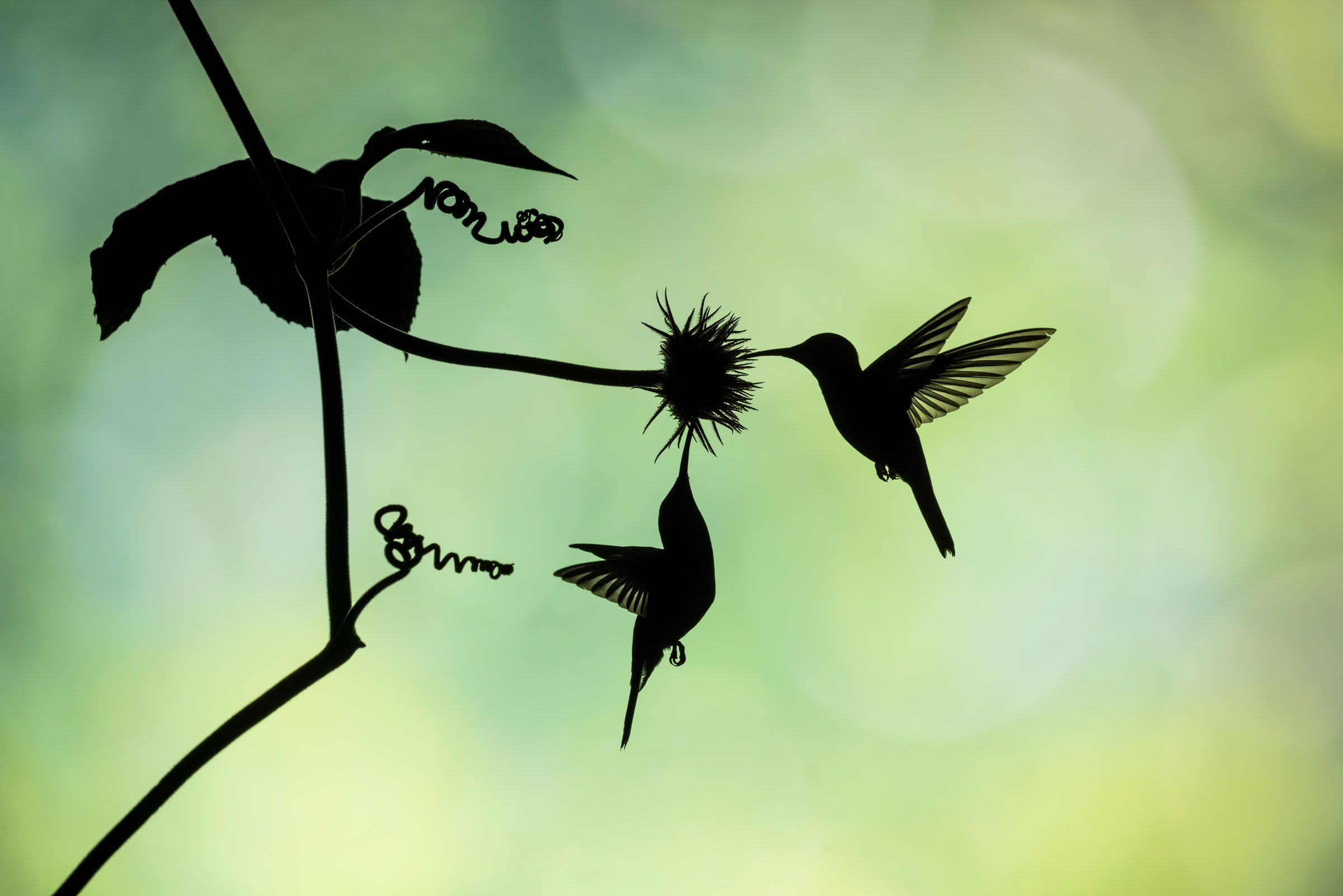
In 1851, during the Great Exhibition in London, England, a collection of stuffed hummingbirds attracted over 75,000 people, including Queen Victoria, Charles Dickens, and Charles Darwin. The collector, John Gould, had prepared 1,500 birds for display in glass cases. Likely among them was the green-crowned brilliant (Heliodoxa jacula) from his vast collection, pictured here in silhouette in its native habitat, which extends through Costa Rica, Panama, Colombia, and Ecuador.
Hummingbirds are endemic only to the Americas, hence the interest from British audience members who likely had never seen such iridescent avian gemstones. Darwin first encountered hummingbirds during his voyage on the HMS Beagle 19 years before the exhibition and was struck then by their eye-catching plumage. The birds’ jewel-toned feathers inspired him to consider the role sexual selection plays in evolution.
Green-crowned brilliant males have luminescent green-tourmaline crowns, emerald breast feathers, and a spot of cobalt at their throat; in the sun’s rays, flying males could be mistaken for flickering green and blue lights. The female green-crowned brilliant is decidedly less brilliant. Her plumage is somewhat less shimmery, and she has no vibrant patch of blue: Her elegance comes from a lovely white stripe below her eye and green-spotted white underparts. Both sexes have long forked tails. Standing at around 12 centimeters (4.7 inches)—imagine the height of a beer can—Heliodoxa jacula is relatively large for a hummingbird.
All hummingbirds are part of the Trochilidae family, numbering some 360 species, with most identified for Western science by Gould. In Victorian fashion, Gould often relied on others to bring him specimens from the field.
Collectors would have tromped along the forested edges of glades and across lightly forested highlands up to 2,000 meters (6,562 feet) in altitude to capture Heliodoxa jacula. That hummingbirds move so adeptly between mountains and lowlands, and between heaven and earth, is a source of inspiration for several Indigenous cultures. In Peru, hummingbirds are sometimes considered the souls of visiting dead relatives. In parts of Mexico, a hummingbird is called the resurrection bird. In Costa Rica, a hummingbird—bu.tzún in the Bribri language—inside a house relays the news that visitors will arrive that day or the next.
Wild hummingbirds eat small insects and nectar. But in many parts of the Americas, it’s not unusual to see red-colored feeders filled with a mix of refined sugar and water—mimicking the sugar concentration of nectar—hanging off porches or near windows. People are so enamored by these feathered flying jewels that we crave a closer communion.
Feeders have enabled all manner of photographers, from amateurs to professionals, to document the beauty of hummingbirds, much like what Gould did with his taxidermic display. But photographer Guy Edwardes sought a more natural scene when he visited the cloud forest in Costa Rica. To see the birds in the wild, he had to look up. There they were, sipping nectar, silhouetted against the backlit tree canopy, looking incorporeal, as if at any moment they would trade earth for heaven.

Related Articles
The Wonder of a Pale Whale
A curious calf with an atypical birthday suit is a good sign for southern right whales.
Saying “Ah!” at the Shrimp Spa
On coral reefs, an army of tiny cleaners eat their clients’ parasites, food particles, and dead skin, boosting biodiversity in the process.
Friends or Foes?
A flatworm and a sea squirt mingle in the tropical waters of West Papua, offering a glimpse into the complexity of interspecies relationships.
