
Story by Shi En Kim
Utrecht is one of the greenest cities in the Netherlands, if not all of Europe. On any given day, the city’s 345,000 residents can encounter bursts of cultivated vegetation in its many parks, planted between buildings, and lining its ancient canals. The verdant display even extends overhead. While many municipalities are adopting green roofs—for aesthetic and functional reasons—Utrecht has scaled the approach to one of the city’s most mundane types of infrastructure: bus stops.
In 2019, Utrecht crowned 316 bus stops with sedum, a sun-loving succulent with colorful, pollinator-attracting blooms. With each bus stop having a roof about the size of a pool table, these commuter hubs collectively created a green space the size of a small neighborhood park.
Wherever they’re installed, green roofs benefit the environment and local wildlife. Rooftop greenery can reduce stormwater runoff, counter urban heat, and offer habitat for myriad creatures, from birds to insects. But as researchers studying Utrecht’s living bus stops have recently found, these elevated islands are also benefiting an often overlooked—yet incredibly important—player in ecosystem health: mycorrhizal fungi.
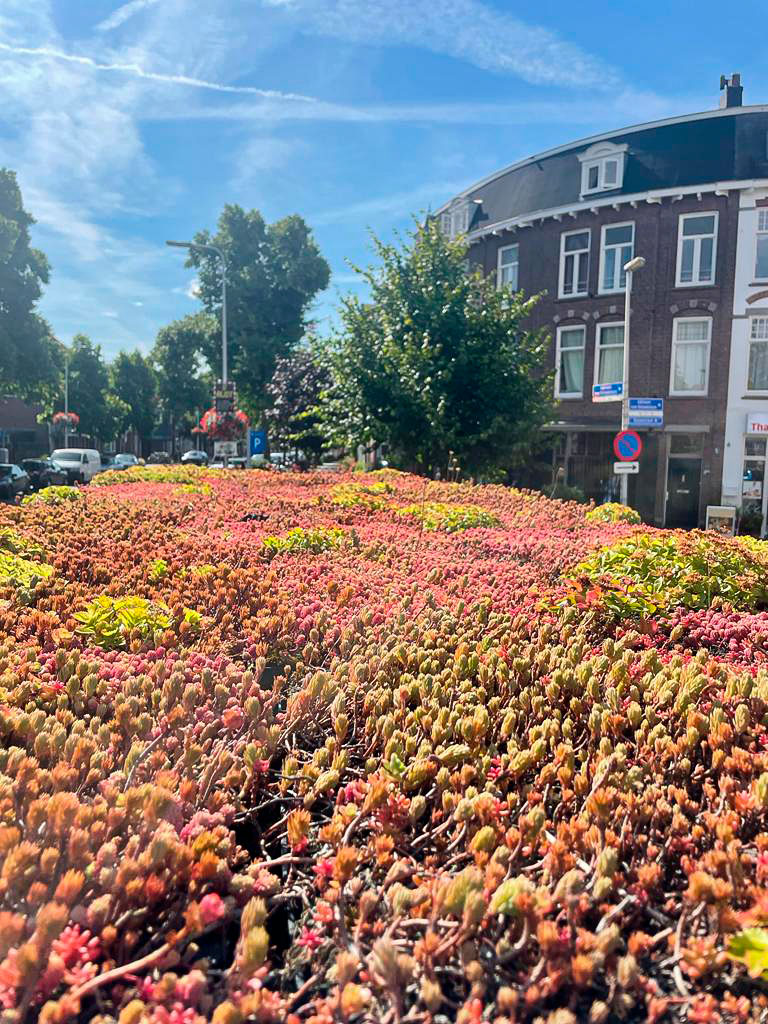
In Utrecht, Netherlands, flower-adorned green roofs top 316 of the city’s bus stops. These tiny gardens, it turns out, are home to a huge diversity of beneficial mycorrhizal fungi. Photo courtesy of the Society for the Protection of Underground Networks
Over the past several hundred million years, mycorrhizal fungi have evolved beneficial partnerships with plants of all kinds. In exchange for sustenance—the sugars produced by the host plants’ photosynthesis—the fungi create a complex subterranean web that helps gather key nutrients from the soil for their plant partners. Mycorrhizal fungi can be found growing inside and around the roots of 90 percent of all terrestrial plants, entangled in a symbiotic dance that’s persisted since plants first colonized land.
In 2022, researchers from the Society for the Protection of Underground Networks (SPUN), an organization devoted to studying the world’s mycorrhizae, climbed onto Utrecht’s bus stops to study its high-flying fungi. Justin Stewart, a data scientist with SPUN, says that because Utrecht’s green bus stop roofs were all installed in the same year and with the same setup, they’re a useful test bed for studying how mycorrhizal fungi make their way in urban landscapes. Ultimately, his team found that the bus stop gardens are flourishing with fungal biodiversity, surpassing even what you’d find “in a park that was built by the city 200 years ago,” Stewart says.
“There’s something just so intimate about sitting underneath a biodiversity hot spot [while] waiting to go to work,” he adds.
Mycorrhizal fungi serve the environment in countless ways, including by sequestering carbon from the atmosphere, boosting nutrient cycling, and improving soil structure. Their presence benefits people, too. Exposure to nature’s motley microbes can strengthen our immune systems, and even tamp the incidence of asthma or flare-ups of chronic inflammatory diseases.
For the green roofs’ plants, mycorrhizal fungi are likely playing an important role in helping them thrive, says Anna Droz, an accredited green roof professional and a microbial ecologist in Grand Valley, Michigan, who wasn’t involved in SPUN’s research. And wildlife in cities, let alone on green roofs, needs all the help it can get, she says.
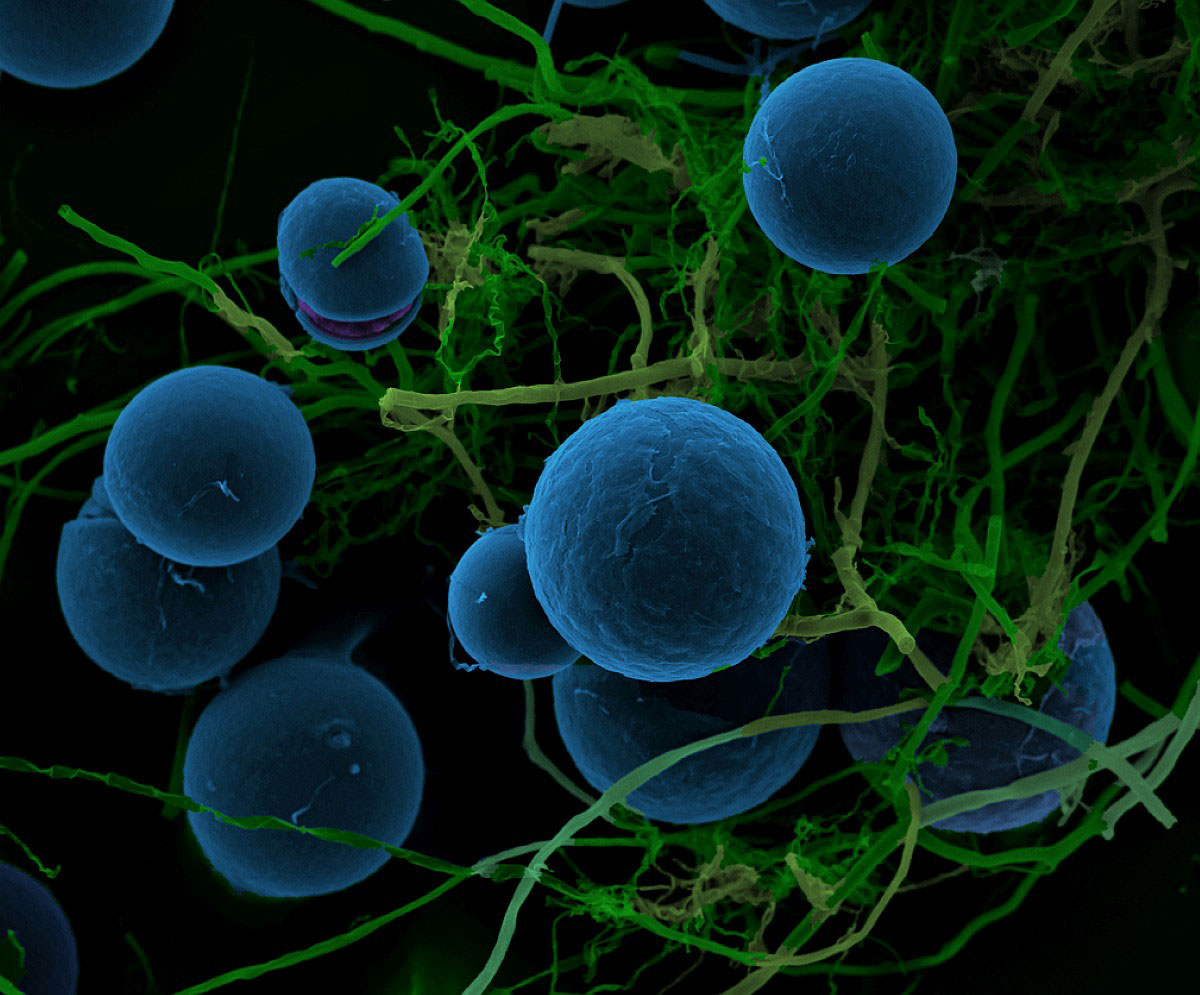
An artificially-colored microscope image shows the spores (blue) and connective tissues (green) of one particular fungus, Rhizophagus irregularis. Photo courtesy of Vasilis Kokkoris / VU Amsterdam/AMOLF/SPUN
Cities are often highly polluted. In these landscapes built of concrete and steel, Droz says, wildlife struggles to find purchase. And green roofs are particularly rough places to eke out an existence. The shallow soil beds are prone to drying out, and the elevated inhabitants see no mercy from the sun’s unrelenting glare. But the mutually advantageous relationship between plant and mycorrhizal fungi can make it easier for both to survive.
Given all the benefits of microorganisms, scientists are starting to ponder ways to make cities friendlier for fungi and other helpful microbes. And, given Stewart’s observations in Utrecht, establishing green roofs seems like a good way to give mycorrhizal fungi in particular a helping hand.
Beyond discovering how much fungal biodiversity Utrecht’s bus stops support, the SPUN mapping project revealed that green roofs play a key role in helping mycorrhizal fungi spread. The rooftop gardens, says Stewart, serve as both landing sites for untethered fungal spores and launchpads for subsequent generations of them. While each roof is small, Stewart says the hundreds of green spaces scattered around Utrecht may be more supportive of fungal dispersal than larger, farther flung parks. By more carefully considering where green bus stops are built, scientists may even be able to improve this connectivity and further boost fungal dispersal.
Kelly Ksiazek-Mikenas, a plant ecologist at Elmhurst University in Illinois who wasn’t involved in the research, warns there is some nuance to fashioning green roofs into hotbeds of mycorrhizal diversity. These days, commercial mixes of mycorrhizal fungi are available for people to add to their gardens or potted plants, and although one may expect that they should do the trick on green roofs, in Ksiazek-Mikenas’s own experiments, store-bought mycorrhizal additives don’t usually take. She suspects it’s because the products only contain a few generic fungal strains that aren’t tailored to a particular plant or environment. For a better chance of success, she recommends transferring healthy soil from a natural habitat, bringing the native fungal assortment with it. And unlike Utretch, which planted mostly sedum, she suggests growing a diversity of plants rather than a single species. The goal, she says, would be to more closely replicate natural ecosystems. “Nature knows how to do stuff better than we do.”
Utrecht’s green roofs were not built with mycorrhizal fungi in mind, yet they became fungal hotspots all the same—a reminder of, and testament to, life’s capacity to flourish amid the human throng.
Author

Related Articles
Shrimp Shell Slurry to the Rescue?
A new, multistep chemical process can turn bits of organic waste into “carbon-negative” fuel, food, and construction material.
The Lonely Race to Save Ukraine’s Past
In a country ravaged by war, Ukraine’s conservators are torn between protecting the country’s past and fighting for its future.
No One Knows How to Handle Nurdle Spills
A year after a shipwreck flooded India’s beaches with tiny plastic pieces, scientists fear the environmental damage has just begun.