
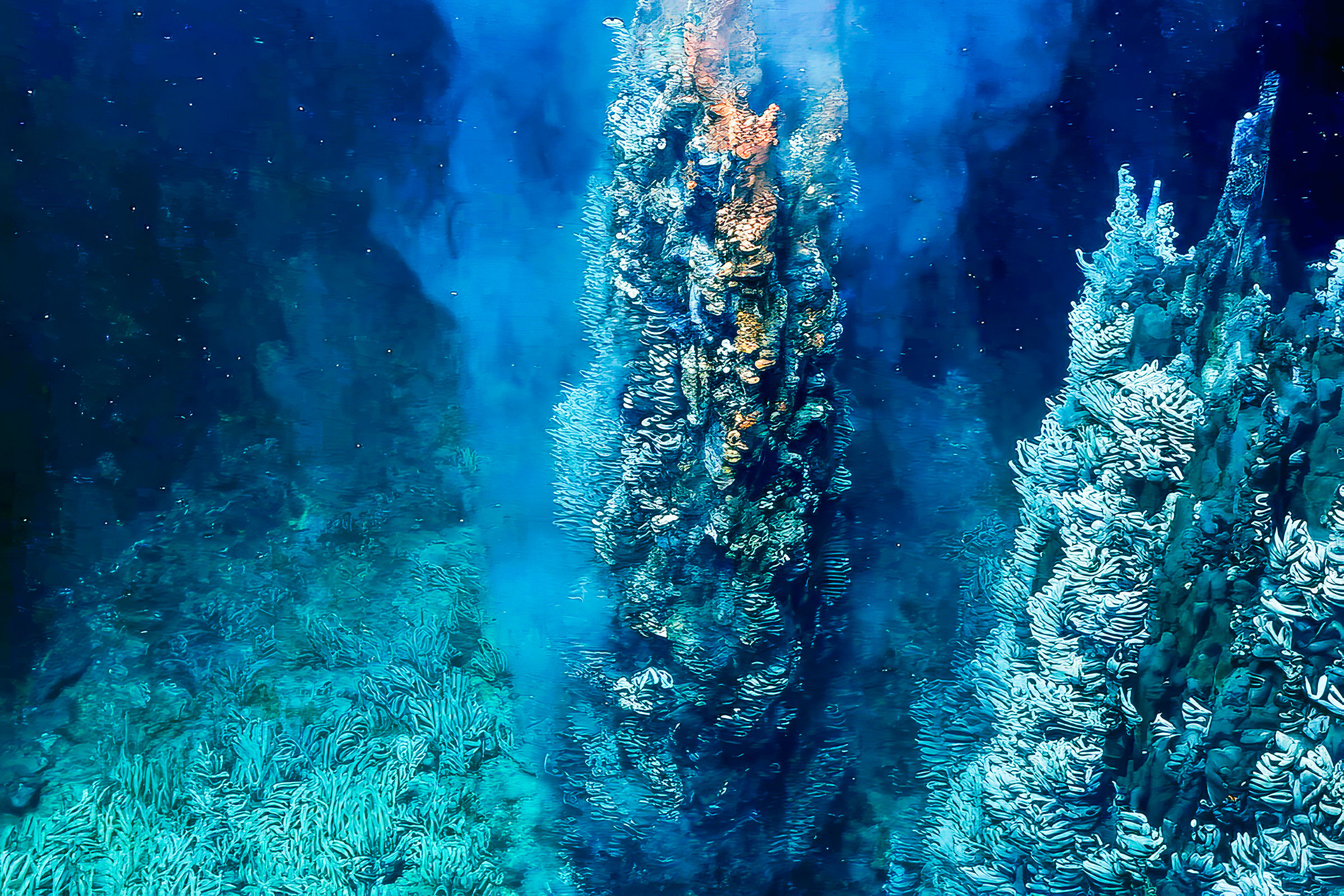
When it’s not at home, the Pompeii worm looks like a hairy question mark. But when it is home—burrowed into the side of a hydrothermal vent some 2,600 meters (8,530 feet) beneath the ocean’s surface—only the worm’s head is visible. Like a bouquet of red fronds peeking out from beneath a spray of superheated fluid, as though a houseplant has perched on the side of a chimney, the Pompeii worm (Alvinella pompejana) is one of the few creatures on Earth whose head is routinely hundreds of degrees cooler than its butt.
In 1987, scientists on a two-month expedition aboard the French research vessel Nadir discovered something striking about these denizens of the deep. What they originally thought was the Pompeii worms’ fleecy skin was, in fact, an insulating layer of bacteria. Further investigation revealed that one of the microbes, in particular, produces a heat-resistant compound that helps the worms withstand the extreme conditions.
Within a decade, French scientists patented a method for making the compound in the lab. Years later, a biotechnology company developed it into a cosmetic ingredient. Marketed as Abyssine, the chemical acts as a shield for the skin, protecting and helping it recover from abrasions and sun damage. In 2003, American cosmetics company Kiehl’s debuted a line of face and eye creams with this deep-sea compound as its star ingredient; Abyssine can now be found in cosmetic products around the world.
Abyssine’s transformation from protector of deep-sea worm butts to UV-blocking cosmetic ingredient is the most commercially successful example to date of deep-sea bioprospecting, which is the process of studying marine organisms in the search for new medicines, materials, and other useful chemicals. Other discoveries from the deep have already found their way into everything from nutritional supplements to biofuels, biodegradable materials, and gene-editing systems. Recently, the Pompeii worm even inspired a potential solution to overheating satellites.
But as remotely operated underwater vehicles and improved sampling techniques grant people ever more access to the deep, and the pace of bioprospecting flourishes, researchers led by Erik Zhivkoplias, a doctoral candidate studying marine governance at Stockholm University in Sweden, are warning of a potentially troubling trend.
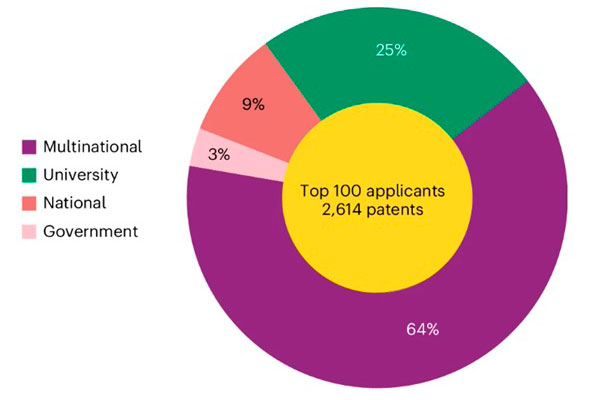
In a recent paper exploring the burgeoning deep-sea bioprospecting industry, Zhivkoplias and his colleagues note that of the thousands of existing patents referencing deep-sea gene sequences, the vast majority come from just three countries: the United States, Germany, and Japan. Drilling deeper, they found that just three multinational companies—Germany’s BASF and the American companies DuPont and International Flavors & Fragrances—have claimed genes from half of the identified species. (While you cannot patent an organism’s genes directly, you can slightly modify a natural genetic sequence and patent that.)
Most of these genetic discoveries, says Zhivkoplias, came from publicly funded research expeditions. And given that most of the deep sea falls outside of any country’s territorial boundary, the discoveries also originate from a legal no-man’s-land.
Deep-sea exploration is extraordinarily expensive and time-consuming. But Marcel Jaspars, an organic chemist at the University of Aberdeen in Scotland who founded the university’s Marine Biodiscovery Centre, says that looking for useful gene sequences is easier than ever. Today, when a new species is found during a research cruise, scientists routinely upload the organism’s genetic information to a series of online databases for other researchers to use.
“At the moment, it’s all publicly available, so there is no restriction as to who uses it and how it’s used,” says Jaspars. “I could literally go in there and search sequences and find something that’s really cool and then exploit it and make money. That’s what’s happening right now.”
Jaspars, who holds nine patents on marine DNA sequences, says companies like BASF and DuPont aren’t searching through these databases for one fantastic DNA sequence, like panning for gold. Instead, they’re browsing for promising possibilities. If a gene sequence doesn’t do exactly what the researchers want, says Jaspars, it’s possible to find similar sequences with more appealing attributes and modify the original to include them.
Zhivkoplias notes that while the initial discovery of DNA sequences may have been taxpayer funded, companies argue that it takes a lot of investment and work to develop those sequences into viable products.
So what happens if a compound from the deep sea blows up to become the next Ozempic? After all, the much-vaunted weight-loss drug is itself the product of bioprospecting. Ozempic’s active ingredient, semaglutide, was inspired by a hormone found in the venom of the Gila monster.
In November 2024, a United Nations body agreed that one percent of profits from all products derived from a natural origin should be devoted to a global fund dedicated to preserving biodiversity. The deal is neither legally binding nor enforceable. It also doesn’t apply to companies in the United States, the only United Nations member that hasn’t signed on to the United Nations’ Convention on Biological Diversity.
Zhivkoplias is skeptical that the biotech sector will voluntarily contribute to the fund, but he says the deal links commercial products with the wild organisms that make them possible. “I think establishing this connection was very important,” he says.
A much stronger position on bioprospecting can be found in the United Nations’ high seas treaty. Developed over decades of discussion, the treaty declares that when a genetic discovery is made in the deep sea outside of any nation’s jurisdiction, profits must be shared such that some money flows back to help conserve these areas.
Uncertainty about how such a profit-sharing system would work has been a source of hesitation for countries considering joining the high seas treaty, Zhivkoplias says. As a result, only 16 countries have ratified the treaty, which won’t come into force until 60 countries sign on.
Jaspars wishes world leaders would go even further. He’d like to see nations devise a more universal profit-sharing system, one designed to apply to all types of bioprospecting across all locations and organisms.
Either way, Zhivkoplias says, international agreements are only the first steps in ensuring that groups beyond multinational companies prosper from exploiting wild places—and that life in those places continues to flourish.
Hi, I’m Dave, the executive director of bioGraphic. (And that’s my dog, Finn.) Thanks for taking the time to read this story.
Stories like this simply don’t get produced without financial support from readers like you. bioGraphic is an independent non-profit—we’re not backed by a private company or owned by a billionaire. One-quarter of our budget comes directly from reader donations.
bioGraphic publishes environmental reporting that you can’t find anywhere else: deeply researched, trustworthy stories that are also beautiful and captivating to read. Right now, we need your help to raise $30,000 by October 2. Every dollar will go directly to more crucial reporting projects.
Around the world, governments are slashing funding for conservation and scientific research, placing even more ecosystems and wildlife at risk. At bioGraphic, we’re steadfastly shining a light on the threats to our planet’s incredible biodiversity. And we’re showcasing the hard work of people bravely taking action to protect at-risk species.
bioGraphic offers an antidote to apathy and doom-and-gloom news by revealing the wonders of the natural world and focusing on real solutions to big problems. When you finish a bioGraphic story, we want to leave you feeling informed, delighted, and inspired.
We don’t run ads or hide our stories behind a paywall. The readers who generously support bioGraphic allow our work to remain free for everyone.
We reached our goal, but there’s time left. Will you help us smash our original goal and reach a new goal of $30,000 by October 2?

Related Articles
When it Comes to Frog Sex, Teamwork Makes the Dream Work
New science on gray foam-nest tree frogs hints at the evolutionary benefits of multiple sexual partners.
How Much Plastic Does it Take to Kill a Seabird?
For the first time, researchers uncover how eating plastic trash may impact seabirds at the population level.
Shrimp Shell Slurry to the Rescue?
A new, multistep chemical process can turn bits of organic waste into “carbon-negative” fuel, food, and construction material.
