
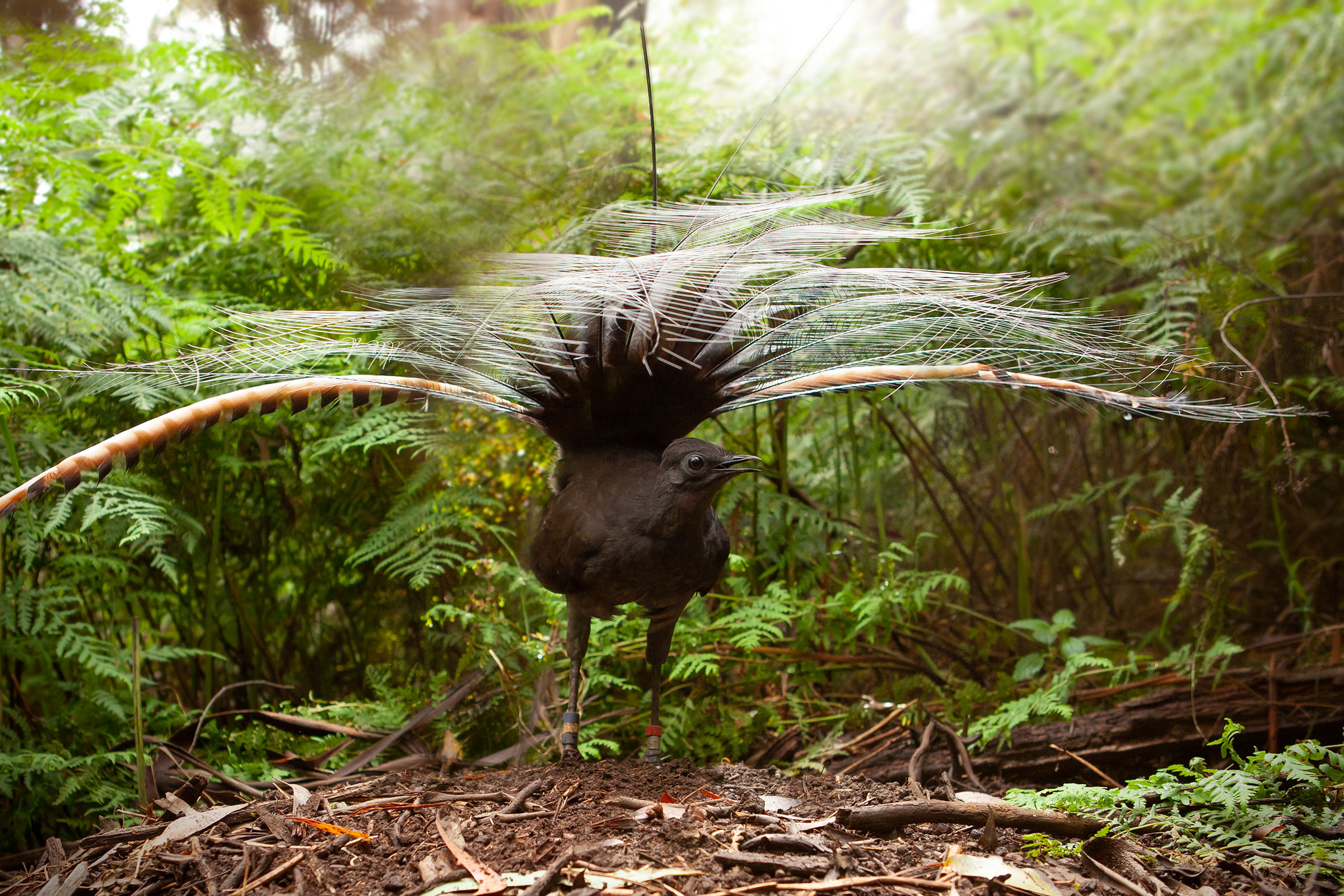
The superb lyrebird (Menura novaehollandiae) is as transcendently impressive as its name suggests. The male sings and dances and is runway-gorgeous with an ornate tail that resembles a gown’s lacy train. While these physical attributes have long captivated observers, lyrebirds also happen to be superb ecosystem engineers—and, new research reveals, skilled farmers.
As engineers, superb lyrebirds depend on their formidable claws. Throughout the rainforests of southeastern Australia where they live, the birds dig and rake for worms, centipedes, spiders, and other invertebrates to eat, annually displacing enough dirt per hectare to fill five medium-sized dump trucks. That’s roughly 14 truckloads per bird—an amount that Guinness World Records acknowledged in 2020 as the “most surface material displaced by a land animal.” More importantly, as they stir the soil, the birds stop dead leaves from accumulating, so the forest floor is less likely to burn in a wildfire.
The researchers who carried out the 2020 study that led to the world record followed up on that work with more questions: How does displacing so much leaf litter and surface soil affect habitat? And does that displacement benefit the superb lyrebird itself? Lead author Alex Maisey invested in a hand rake, mesh, and fencing to find out. After two years of research, he found that these pheasant-sized ground dwellers aren’t just digging for their dinner—they’re creating better conditions for their invertebrate prey to thrive. They are, in a sense, tilling the soil to grow their own food.
“It’s like they create little compost heaps everywhere,” says Maisey, an ecologist at La Trobe University in Australia who studies how animals impact physical environments. “If you think of how productive compost would be, it allows [prey] to grow larger quicker.”
So superb lyrebirds may be even more groundbreaking than expected: they are the original composters.
For his recent study, Maisey set up a total of 54 survey plots in three different forested locations in national parks within 100 kilometers (161 miles) of Melbourne. Superb lyrebirds—a species of least concern, according to the International Union for Conservation of Nature—are plentiful in each of the locales, which ranged from damp to wet to cool temperate rainforest dominated by various species of eucalyptus trees, along with southern sassafras and myrtle beech.
Each site featured three treatments: a fenced-off control plot inaccessible to lyrebirds; a plot open to wild lyrebirds; and a plot Maisey raked by hand monthly to simulate a lyrebird digging 5 to 10 centimeters (2 to 4 inches) into the soil. This part of the research was fun. Maisey spotted copperhead and tiger snakes, heard a koala with an odd growl, and once ran into what looked like a dog—not allowed in Australian national parks—but turned out to be a pet goat on a leash. Then came the hours of monotonous math.
Each October during the study period, Maisey gathered invertebrates from the plots. Altogether, he collected 197,880, many no bigger than a grain of rice. That included worms, centipedes, millipedes, wood lice, amphipods, mites, and springtails, along with larvae and pupae. Many computer calculations later, the results were in. The control sites had either the same amount of biomass at the end of the study or less than they started with. In the sites that had been raked—by Maisey or lyrebirds—biomass increased.
Although he didn’t specifically test this, Maisey thinks that when a layer of leaf litter lies undisturbed, it quickly becomes hard-packed dirt that is inhospitable to macroinvertebrates. By raking, “you’re increasing the amount of habitat vertically, and that’s effectively increasing habitat quality and the amount of habitat for those invertebrates.”
Clive G. Jones, an ecologist at the Cary Institute of Ecosystem Studies in New York, who with his colleagues introduced and developed the concept of ecosystem engineering in 1994 and is not associated with the current study, says the research illustrates a key point that’s often overlooked. “Everyone thinks of engineering as building stuff, but it can be tearing down stuff, the decay process,” he says. Animal engineers also maintain the structure of an ecosystem. Foraging lyrebirds do all three.
Maisey’s study, Jones says, also provides valuable information about what an ecosystem engineer gets out of its engineering. While the answer is obvious for some species, like beavers building wetlands, it’s less apparent for others. “It’s much easier to go out and say, ‘Hey, this organism digs a hole,’ but we don’t have a comprehensive set of data on all the hole-digging organisms and the contributions they make,” Jones says.
While beyond the scope of the study, Maisey noticed that yellow robins, white-browed scrubwren, and pilot birds—all closely associated with superb lyrebird habitat—follow lyrebirds around, as if fans of farm-to-table dining. He also observed that lyrebirds, like all sustainable agronomists, leave a foraging pit for 20 months before returning to till the leaf litter and soil again.
The more philosophical takeaway is that lyrebirds’ celebrated beauty and pizzazz may be a distraction from their more practical contributions. “The species is very charismatic,” Maisey says. “So this gives us a chance to try and illustrate the important role it plays beyond just being a nice bird to look at or listen to—they have this really important functional role in the ecosystem.”
Hi, I’m Dave, the executive director of bioGraphic. (And that’s my dog, Finn.) Thanks for taking the time to read this story.
Stories like this simply don’t get produced without financial support from readers like you. bioGraphic is not backed by a private company or owned by a billionaire. It’s an independent, nonprofit magazine. And one-quarter of our annual budget comes directly from reader donations.
We need your support more than ever, as governments slash funding for conservation and scientific research, placing even more ecosystems and wildlife at risk around the world. At bioGraphic, we’re steadfastly shining a light on the threats to our planet’s incredible biodiversity. And we’re showcasing the hard work of people bravely taking action to protect at-risk species.
bioGraphic publishes environmental reporting that you can’t find anywhere else: deeply researched, trustworthy stories that are also beautiful and captivating to read. We offer an antidote to reader apathy and doom-and-gloom news by revealing the wonders of the natural world and focusing on real solutions to big problems. When you finish a bioGraphic story, we want to leave you feeling informed, delighted, and inspired.
We don’t run ads or hide our stories behind a paywall. The readers who generously support bioGraphic allow our work to remain free for everyone.
Will you help us keep telling these crucial stories?

Author

Related Articles
The Curious Connection Between Bacteria, Seagrass, and Carbon
New research shows that seagrass depends on the bacteria around it—and that the antibiotics entering our oceans could disrupt that relationship.

Trees as Public Health Infrastructure
New research shows that meeting tree canopy goals could prevent more than 67,000 premature deaths in the United States.
A Mite on a Bee on a Ship on the Sea Spells Trouble
Pollinator pathogens are spreading through international trade, threatening both agriculture and wild ecosystems.